

Due to the complexity of information flows — from pulling reports to generating insights — many teams (including CRM, Product, and Revenue) feel discouraged. As a result, they ask fewer questions moving forward. While many firms rely on a central analytics team to manage requests across departments, handling everything through one function often creates bottlenecks. This leads to delays and frustration across the business, pushing teams to act on stale insights or abandon evidence-based decision-making entirely. This phenomenon is often referred to as data fatigue in FMCG, a challenge that builds when reporting is fragmented and insights arrive too late to act on. Put simply, this is a guide on how FMCG teams in the GCC can reduce data fatigue and make faster decisions using decision-ready insights.
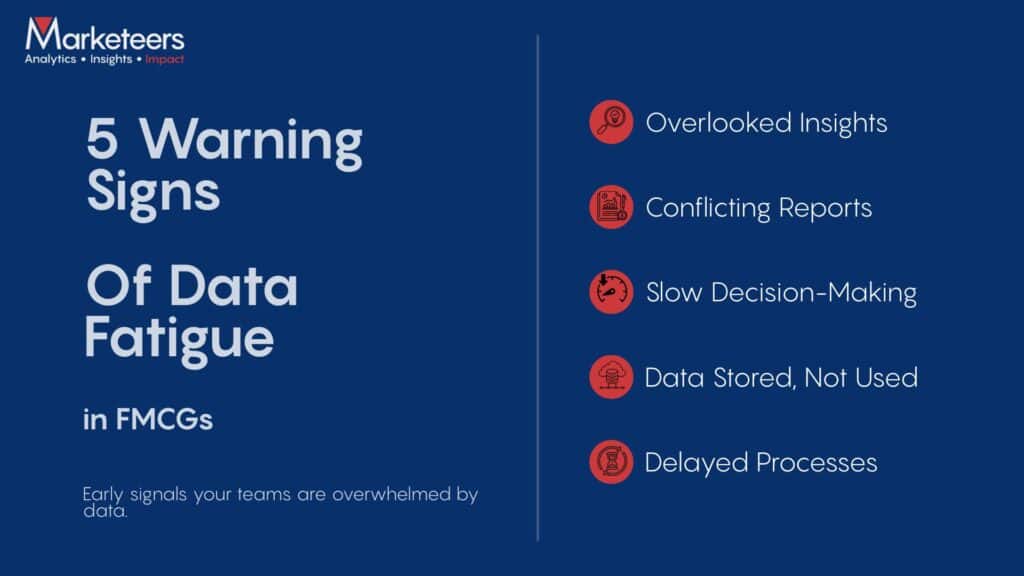
Additionally, we’ll go through common data challenges FMCG firms face, ways to efficiently handle dashboard overload within the GCC, and ways for organizing data in the Saudi Arabia and UAE consumer goods industry. We’ll also discuss decision-ready data and how it’s key in reducing data fatigue in FMCG, especially when consumer goods teams are overloaded with reporting and need quick, trusted insights. In practice, this often shows up as reporting overload, dashboard fatigue, and slow turnaround times that make insights harder to act on.
Common Data Challenges for FMCG Companies

Data plays a critical role in driving measurable growth in FMCG. Yet data fatigue in FMCG has become increasingly common, especially when teams are flooded with dashboards and metrics but lack decision-ready insights. This is due to the sheer volume of inputs and the difficulty of turning them into action. To dive deeper into what causes information overload in FMCG, here are some common challenges for FMCG firms:
Fragmented Data
One of the key challenges within the FMCG industry is the large chunks of data generated across several departments like Marketing, Finance, & Sales. This often leads to fragmentation across tools and teams. Due to the lack of synchronization, businesses find it hard to take evidence-based decisions. Data fragmentation have various drawbacks that hinder business processes such as, slower overall performance, complexity and increased overall cost.
Outdated Data
Data is rapidly evolving, and insights need to be in real time to reap their benefits. Old ways of managing data, like manual reporting, often result in delays, making business decisions slow and causing businesses to miss out on opportunities—and even, at times, lose customers due to lower customer satisfaction.
Inaccurate & Incomplete Data
Due to less accurate or incomplete data, businesses might make flawed business decisions. In particular, within FMCG, firms struggle with quality issues such as duplicates, outdated, and inconsistent information, which makes inaccurate data one of the key signs of insight fatigue in FMCG.
Poor Segmentation
Segmenting customers based on their behaviors and preferences is key for FMCG firms in order to create personalized and targeted experiences, which result in customer retention and loyalty. However, without efficient analysis, this segmentation is hard to conduct efficiently.
How to Handle Data Overwhelm in the FMCG GCC Market
To handle insight fatigue in FMCG, businesses need to consider a few key points in mind in order to effectively compete within the market.
Forging a Unified Data Management System
By forging a unified data management system, consumer goods firms within the GCC can integrate and manage information from frequent sources. By unifying it under one umbrella, businesses can gain real-time insights that are based on reliable inputs, which can drive efficiency and enhance overall performance.
AI/Machine Learning Integration
With the rapid evolution of AI and machine learning, businesses that are not integrating advanced analytics tools are missing out. What makes these tools critical is their ability to assist businesses in spotting overlooked trends, opportunities, and predicting consumer behaviors in certain scenarios, which often empowers them to conduct insight-led decisions.
Data Governance & Protection Policies
Businesses within the FMCG industry in the GCC need strict data governance policies, as this could dramatically enhance quality and reliability. Through regular filtration and consistent monitoring, businesses could ensure that they’re making decisions based on trusted information.
Utilizing Tools for Distinct Purposes
Businesses within the GCC need to leverage distinct tools for different purposes to help them navigate information overload and challenges within the market. For instance, businesses that want to dive deeper into customer behavior are recommended to acquire a CRM system to segment their target efficiently. As a result, they can create targeted marketing campaigns and be more personalized with their audience, resulting in loyalty in the short term and creating brand pioneers in the long one.
Methods for Organizing Data in the GCC
The primary methods of organizing data within Saudi Arabia are governed by a national framework created by the National Data Management Office (NDMO). This framework sets mandatory standards for public entities and private firms, focusing on governance, security, and protection.
If you’re a firm operating within the Saudi Arabian or GCC consumer goods market and looking for ways to manage data, here are some methods of organization to consider:
1. Data Governance
Creating clear guidelines on the uses of data with clear authority of best management practices to make and consider, and tying them directly to the business strategy. Also, using data within an ethical framework and being accountable for any breach or misinterpretation. In addition, adhering to national policies and regulations. Data governance helps keep firms’ and their audiences’ sensitive information from any attempt to breach. This results in protection and also trust of the audience in the firm.
2. Improving Data Quality
Improving data accuracy and quality through making sure of its sources, consistently monitoring it in real time, and investing in high-quality tools to process it. Also, protecting it from breaches and unauthorized management. Enhancing its quality reduces time and makes decision-making easier.
3. Utilizing Advanced Analytics Tools
Using advanced analytics tools to navigate through complex data aids significantly within business decision-making and helps businesses in conducting insight-led decisions. Using tools such as data cataloging is supported and backed for efficient management and often results in economic growth. Leveraging advanced analytics tools is a key competitive advantage for those who use it efficiently.
Strategies for Managing Data Overload in the GCC Consumer Goods Industry
Businesses operating within the consumer goods industry in the UAE should stick with the strategies mentioned for managing overload, such as centralizing data and creating a single source of truth instead of fragmentation, efficiently leveraging artificial intelligence and automation processes, and making sure that the data is accurate, up to date, and relevant.
If you’re a business within the UAE and trying to find solutions that move the needle, our Data & Analytics solutions are your best bet—and here’s why:
One Single Source of Truth
You don’t need scattered spreadsheets taking over your day. Use our solutions to integrate your existing systems flawlessly with our platform. No training required, no hours wasted—connect your data sources in a blink.
Interact With Your Data
Data doesn’t need to be complicated, and you don’t need to drown in a sea of spreadsheets trying to analyze vast amounts of information. With our pilot dashboard, get data you can talk to and monitor it in real time in a visually compelling way.
Insights for Action
What is the use of data if it’s not actionable? Get actionable insights in real time and tailor-made to your exact scenario. Get actionable insights from your existing data to keep up with the trends within the market without having to worry about decisions to make.
For UAE Consumer Goods Businesses: Manage data overload effectively by centralizing information, leveraging AI and automation, and ensuring data accuracy. Our Data & Analytics solutions provide the complete toolkit you need to transform fragmented data into actionable business intelligence.
| Challenge | Our Solution | Key Benefits |
|---|---|---|
| Data Fragmentation & Scattered Systems |
One Single Source of Truth Integrate your existing systems flawlessly with our platform. Connect your data sources instantly—no training required, no hours wasted. |
|
| Complex Data Analysis & Information Overload |
Interact With Your Data Our pilot dashboard lets you talk to your data and monitor it in real time through visually compelling interfaces. No drowning in spreadsheets. |
|
| Lack of Actionable Intelligence |
Insights for Action Get real-time, actionable insights tailored to your exact scenario. Keep up with market trends and make confident decisions backed by your existing data. |
|
Decision-Ready Data: The Fastest Way to Reduce Data Fatigue In FMCG
Decision-ready data, or DRD, is used to refer to knowledge that has been entirely processed, validated, and managed, and can be used instantly to aid in decision-making without the need for businesses to clean the data or analyze it thoroughly.
What makes decision-ready data different is its ability to bridge the wide gap between data in its raw form and actually acting upon it—without over-reporting and looking at disconnected dashboards all day. This process makes information available to key decision-makers who are not essentially experts.
This is often the best way to reduce data fatigue in FMCG, especially when teams need trusted insights they can act on immediately, because this information is already:
- High-quality & consistent
- Easily discoverable & comprehensible
- Accessible to key decision-makers, avoiding delays
- Tailor-made for the exact purpose, without assumptions and guesswork
“Decision-ready data is the fastest way to reduce dashboard overload.”
Conclusion
All in all, data fatigue in FMCG isn’t caused by a single factor — it is a result of several practices that lead to reporting overload and complexity, including fragmented data, disconnected dashboards, and over-reporting instead of conducting efficient and reliable methods such as enforcing strict data governance rules, integrating advanced analytics tools, and managing siloed information under one umbrella. In short, reducing decision paralysis caused by reporting overload comes down to unified reporting, stronger governance, and decision-ready insights that teams can act on immediately. Thus, businesses across the GCC, especially within KSA & UAE, should effectively use these methodologies in order to efficiently use data to make accurate and real-time decisions that result in growth across various factors. Looking for ways to manage your analytics and reporting in the GCC?