

What is a Market Assessment for Saudi Arabia Market Entry?
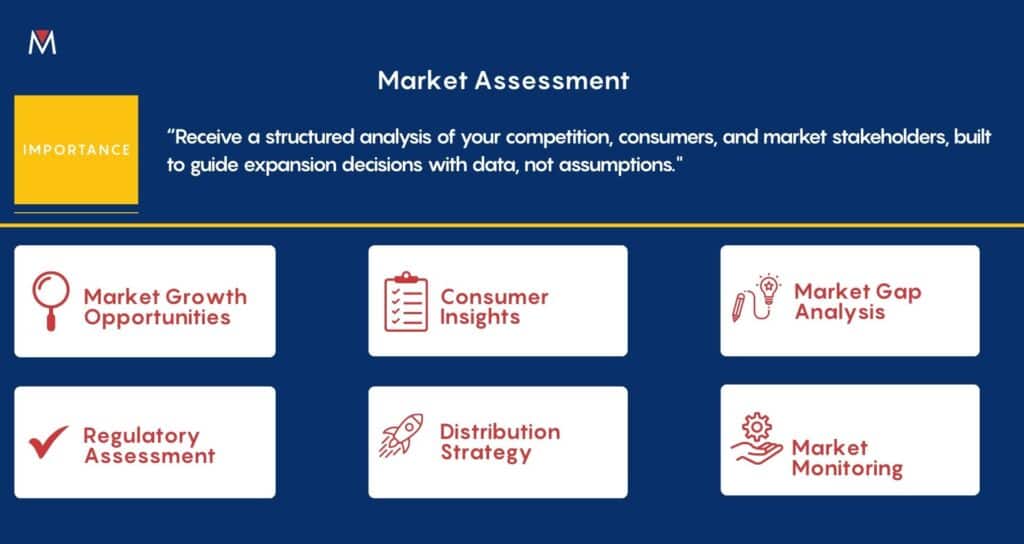
A Market assessment for Saudi Arabia market entry is a thorough analysis of your firm’s competition, consumers, and industry stakeholders, structured to guide expansion decisions with data rather than assumptions.
It is crucial because it gives you a full picture of whether your product is needed or demanded in the market.
It also provides detailed insight into:
- Market and growth opportunities
- Hidden gaps
- Channels to distribute your product
- Market trends
- Factors that would make your product succeed
- Whether your product meets consumer preferences
Market assessment is essential whether you want to enter a new market, expand your business, or grow your consumer base.
According to CBInsights, 42% of startups fail due to misreading market demand, making assessment critical before any market entry commitment.
Market assessment covers:
- Competitor mapping
- Consumer preference analysis
- Gap identification
- Regulatory factors
- Distribution landscape
Unlike generic market size reports, a proper assessment is customized to your product and category giving you a clear answer to one question: Is this market worth entering, and if so, how?
Saudi Arabia’s GDP has reached $1.32 trillion, making it the largest economy in the Arab world. According to industry projections, GDP growth is expected to accelerate to 4.5% by 2027.
This is not a market that is slowing down. It is a market that is opening up.
However, if the Saudi Arabian market looks ambiguous to you, what you need is a clear strategy for actually entering it. The market has a distinct structure, distinct competitors, and distinct consumer behavior, which means your existing strategies may not transfer directly.
The key to Saudi Arabia market entry is market assessment.
General reports on market size and growth exist, but they are generic. What you actually need is specific knowledge of the nature of Saudi Arabia, governmental rules and how your product is perceived relative to your competition in this market. That is the role of market assessment.
If you’re looking to enter the Saudi Arabian market, this guide is for you.
In this guide, we’ll cover:
- How market assessment aids Saudi Arabia market entry
- What a proper assessment actually involves
- Tips for success
Why Market Assessment Matters for Saudi Arabia Market Entry
Mitigate Risks and Seize Opportunities
Market assessment allows you to mitigate risks associated with entering new markets while identifying hidden opportunities that might not be immediately visible.
Toyota demonstrated the power of proactive risk mitigation when the 2011 earthquake in Japan caused a 78% YoY production drop. By moving quickly and strategically, the brand recovered its production capacity rapidly.
Lidl demonstrated the opportunity side. By weighing its options and assessing which markets would deliver the desired outcome, Lidl grew international operations to over half of total revenue, with sales reaching €46 billion and 11% annual growth.
The Gulf specifically rewards businesses that do this homework. A PwC report found that 78% of successful international expansions in the Gulf were secured through strategic government or private-sector partnerships, and you cannot identify those partnerships without first understanding the market you are entering.
Tailor Your Operations to Market Demands
What works in the Egyptian market may not work in the Saudi Arabian market. Many companies underestimate how important localization is when entering an unfamiliar market, and the cost of that mistake is well documented.
Walmart pulled out of Germany in 2006 after losing $1 billion, largely due to failing to account for cultural nuances. German customers felt uncomfortable with behaviors that were standard in American stores.
Starbucks assumed Australians would behave similarly to Americans. They didn’t. Customers considered the prices too expensive and the brand lacked sufficient local market understanding. The result: 61 store closures and $143 million in losses.
Market assessment shows you how to shape your operations and customize your strategy before you commit, not after.
Analyze Your Competitors’ Strengths and Weaknesses
Understanding your competition fully allows you to create superior positioning, overcome market resistance, and identify strategic advantages.
Netflix identified the potential of streaming while Blockbuster relied on an outdated model, and dominated as a result.
Amazon maintains its competitive edge through efficient supply chain management, faster delivery, and superior customer experience. These are not accidents, they are the result of understanding where competitors fall short.
In Saudi Arabia, local players with strong distributor relationships and cultural trust can often be harder to displace than multinational brands. Knowing this before you enter is the advantage.
When Do You Need a Saudi Arabia Market Assessment?
You’re Relying on Experience Alone
Experience is valuable. But experience in one market does not equal readiness in another. In Saudi Arabia specifically, market dynamics shift quickly and new regional and international players enter regularly. Data specific to your product, your category, and your competitive position is not optional, it is the foundation of a credible entry strategy.
You’ve Tried to Do It Internally
A proper assessment requires primary research, secondary data analysis, competitor interviews, consumer studies, and country-level analysis, all synthesized into actionable insights. What initially looks like a two-week project often becomes a three-month distraction that still fails to provide the full picture.
What a Proper Market Assessment for Saudi Arabia Market Entry Actually Involves
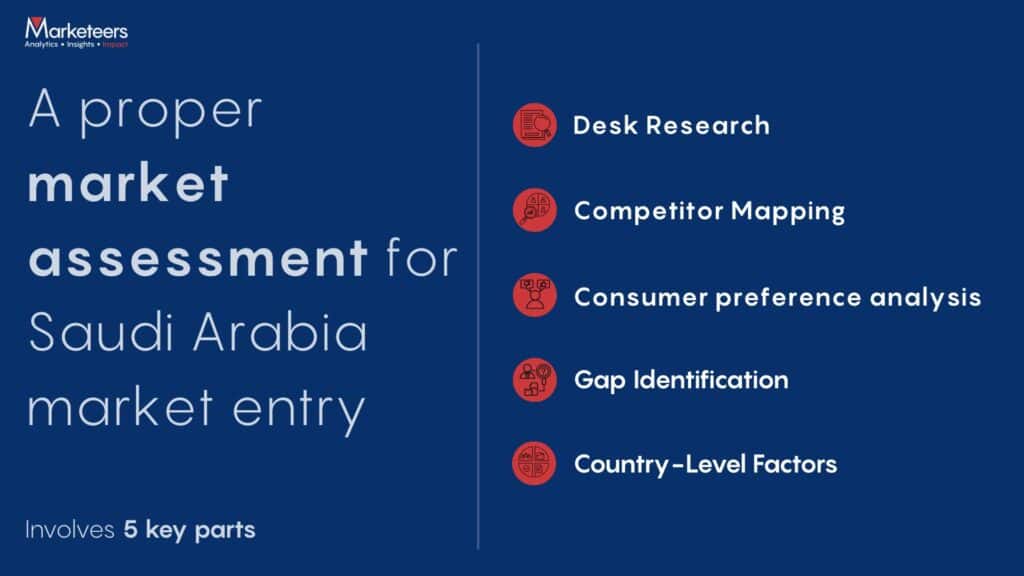
A proper market assessment covers five interconnected layers.
To put it simply: A market size report tells you the pond is big. A market assessment tells you whether there are fish in your corner of the pond, who else is fishing there, what bait works, and whether you have the right equipment to compete.
Desk Research
Desk research forms the foundation of the entire assessment. It goes beyond surface-level data, covering the growth rate of your specific category, the overall market size, the estimated market share of key players, and structured interviews with industry experts.
This phase answers the first critical question: Is this market expanding, and is it worth entering for your specific product or service?
It draws from industry reports, regulatory databases, trade data, and government publications, synthesized to give you a grounded view of the opportunity before deeper research begins.
Competitor Mapping
Competitor mapping goes beyond listing who is in the market. It analyzes positioning, pricing, distribution channels, weaknesses, and areas where competitors are not competing.
In Saudi Arabia, local players with strong distributor relationships and cultural trust can often be harder to displace than multinational brands, which makes this layer especially important.
Consumer Preference Analysis
Consumer behavior in Saudi Arabia varies by region, age group, cultural factors, and Vision 2030’s influence on purchasing behavior. What works in Riyadh may not work in Jeddah or the Eastern Province.
This is where qualitative research becomes critical, one-to-one interviews and consumer cluster sessions. Numbers tell you what is happening. Conversations tell you why.
Gap Identification
Once you understand your competitors and your consumers, patterns emerge: underserved segments, unmet needs, unclaimed price points, and open distribution channels.
These gaps form the foundation of a viable Saudi Arabia market entry strategy.
Country-Level Factors
Country-level considerations include regulatory requirements, import duties, Saudization implications, regional distribution infrastructure, and Vision 2030 reforms.
Ignoring these factors is not only a strategic mistake, it can become a legal and operational problem.
When You Don’t Know What You Don’t Know: A Real Client Story
A gelatin manufacturer approached us looking to expand into the pharmaceutical sector.
What initially appeared straightforward turned out to be far more complex. Pharmaceutical-grade gelatin differs from food-grade gelatin across every dimension: different decision-makers, different procurement processes, different compliance requirements, and a completely different competitive landscape.
We conducted a full market assessment, comprehensive desk research on the pharmaceutical sector, competitor mapping across regional and international suppliers, and primary research with pharmaceutical purchasing departments.
When we presented the findings, the client was not surprised that an opportunity existed. They were surprised by how much they hadn’t quantified: by how much, for which applications, and which competitors were vulnerable to displacement.
That is the purpose of a market assessment. Even experienced businesses with strong products can operate blindly in new markets, not because of a lack of capability, but simply because they are not yet inside that market.
How Marketeers Research Runs a Saudi Arabia Market Assessment
Our Market Entry Research Process
A structured, five-step approach to determine whether your product can compete in a new market—and if yes, how, where, and against whom.
| Step | What We Do |
|---|---|
| Step 1: Detailed Briefing | We begin by understanding your product, your current market position, your entry objectives, and what success looks like for your business. |
| Step 2: Comprehensive Desk Research | We gather secondary data from credible regional and international sources, covering regulatory mapping, industry analysis, category growth rate, market size, estimated market share of key players, and interviews with industry experts. This phase establishes whether the market is expanding and whether the opportunity is real for your specific product. |
| Step 3: Primary Research (Consumer Scope) | We run qualitative research sessions and quantitative surveys to understand preference, perception, and purchase intent. |
| Step 4: Competitor and Gap Analysis | We conduct one-to-one interviews with decision-makers and industry stakeholders, and analyze competitors based on positioning, pricing, distribution, and unoccupied segments. |
| Step 5: Customized Findings and Recommendations | The final output answers one question: can your product compete in this specific market? And if yes, how, where, and against whom. |
Step 1: Detailed Briefing
We begin by understanding your product, your current market position, your entry objectives, and what success looks like for your business.
Step 2: Comprehensive Desk Research
We gather secondary data from credible regional and international sources, covering regulatory mapping, industry analysis, category growth rate, market size, estimated market share of key players, and interviews with industry experts. This phase establishes whether the market is expanding and whether the opportunity is real for your specific product.
Step 3: Primary Research ( Consumer Scope )
We run qualitative research sessions and quantitative surveys to understand preference, perception, and purchase intent.
Step 4: Competitor and Gap Analysis
We conduct one-to-one interviews with decision-makers and industry stakeholders, and analyze competitors based on positioning, pricing, distribution, and unoccupied segments.
Step 5: Customized Findings and Recommendations
The final output answers one question: can your product compete in this specific market? And if yes, how, where, and against whom.
Frequently Asked Questions: Saudi Arabia Market Entry and Market Assessment
How do I know if Saudi Arabia is worth entering before committing to a full assessment?
This is exactly what a market assessment is designed to determine.
The first phase, comprehensive desk research, answers the go/no-go question before deeper research begins. Many clients approach us with strong hypotheses about the Saudi market. Some are validated. Some are not. Both outcomes are valuable, because discovering that a market is not right for your product saves significant resources.
What is the difference between a market assessment and a market research report for Saudi Arabia?
A market research report provides general information, market size, growth rate, key players. A market assessment focuses on your specific product and entry strategy. It determines whether your product can compete, who your direct competitors are, where market gaps exist, and what your entry strategy should consider.
Do Egyptian businesses need a separate market assessment for Saudi Arabia?
Yes. Existing MENA research is only a starting point. Saudi Arabia has distinct consumer preferences, regulatory requirements, distribution infrastructure, and competitive dynamics. Assuming regional familiarity equals market readiness often leads to costly mistakes. A Saudi-specific market assessment is essential for a serious entry strategy.
Ready to Find Out If Saudi Arabia Is the Right Move for Your Business?
If you’ve read this far, you’re past the “should we consider Saudi Arabia?” stage. The real question is whether the opportunity is real for your product, your category, and your competitive position. That is exactly what a market assessment answers. Visit marketeersresearch.com/market-assessment to learn more, or reach out directly and we’ll help you determine whether Saudi Arabia deserves your next move, and what that move should look like.