

To understand what is RGM at its core. The RGM Revolution is not a software upgrade. It is not a new dashboard or a smarter spreadsheet. It is the wholesale transformation of how commercial organizations sense, decide, and act on revenue opportunities in real time, at scale, with AI embedded in the core of every pricing, promotion, and portfolio decision.
Between 2025 and 2026, a make or break moment have been reached, and three big changes occurred simultaneously:
Businesses stopped testing generative AI and began using it in their operations
Retailers are sharing more information freely due to the pressure to sell in real-time
Profit margins in the consumer goods industry (FMCG) have become so tight that companies can no longer afford to make slow, old-school decisions
Revenue managers who once had weeks to run a scenario now have hours. The organizations that thrive will be those that have rebuilt revenue growth management not as a function, but as a commercial operating system. One where a coherent RGM strategy, promotion optimization, and trade investment decisions are continuously optimized, not periodically reviewed. In fact, there are plenty, one notable example is Nestle, who used agentic AI to automate 40% of their sales teams routine tasks resulting in 20-35% time savings for the sales team to focus on what matters most. However, this does not mean that teams should integrate AI and wish for the best. In fact a report from MIT unveiled that nearly 95% of AI pilot programs fail to generate any financial benefits or profit gains. Though, this was not because generative ai models lacked capability, it was in fact due to firms and people not actually properly using these tools capturing their power with minimal risk. Hence, in this article we will discuss:
 Marketeers Research
REVOLUTION
What Is the RGM Evolution and Why Does It Matter Now?
The RGM evolution refers to the structural shift from periodic, analyst-dependent revenue management to continuous, AI-orchestrated commercial decision-making. It matters now because the speed of market change has permanently outpaced the cadence of traditional RGM cycles.
For most of the past two decades, revenue growth management operated on a quarterly rhythm. Category teams would run elasticity models, finance would sign off on price pack architecture scenarios, and commercial directors would approve trade investment allocations based on historical data that was already 60 to 90 days old by the time it reached the decision table. That model worked when markets moved slowly and when retailers negotiated on similar timescales.
Neither of those conditions applies in the modern day world.
Between rising store brands, too many places to shop, and wildly changing costs, companies have almost no time left to make decisions. In today’s VUCA world, the average employee still spends 13 hours a week manually digging through data. The problem? Markets are moving so fast that by the time they find an answer, the information is already out of date. The RGM (Revenue Growth Management) Revolution fixes this by replacing slow, manual work with instant, automated decisions.
Key insight: The RGM evolution is not about having more data. It is about compressing the distance between insight and commercial action to near zero.
The Key Stages in the Evolution of RGM Technology
RGM technology has progressed through four distinct stages. So what are the 4 stages of data-driven RGM ?
Descriptive (The “What”): Tracking basic stats. Like a rearview mirror, it only shows where you’ve been.
Diagnostic (The “Why”): Analyzing past promos to see why they succeeded or failed. It’s detective work using old data.
Predictive (The “If”): Using AI to forecast what might happen next. It’s a weather report for your sales.
Prescriptive (The “How”): The AI tells you exactly what to do and can even auto-pilot the changes. It’s your GPS providing the fastest route.
Past (Stages 1 & 2): We spent all our time explaining failures after they happened. These two stages are often referred to as foundational RGM analytics
Recent (Stage 3): We got better at guessing the future using complex algorithms.
Now (Stage 4): We use simulations (like a flight simulator) to test price changes safely before they go live. This isn’t just a small upgrade; it’s a total shift in how business works.
Key insight: Each stage of RGM evolution has not replaced human judgment — it has raised the quality of judgment the commercial team is asked to make.
How RGM Has Evolved in Terms of Efficiency
The efficiency gain from modern RGM is best understood not in percentage terms but in the nature of the work itself. Manual RGM demanded that skilled analysts spend the majority of their time assembling data; intelligent RGM demands they spend that time on decisions.
A traditional commercial team building a promotion optimization model would spend three to five days gathering sell-out data, normalizing it across retailers, and building scenario models in Excel. A prescriptive RGM platform performs that same assembly in minutes, presenting scenarios ranked by projected revenue and margin impact. The The evolution of RGM in CPG has shifted the analyst’s role analyst’s role from data preparation to commercial judgment: which scenario fits the retailer relationship, the brand strategy, and the broader category context.
This shift has a human dimension that often goes underappreciated. Revenue managers in FMCG are under sustained pressure to deliver more with reduced headcount, faster timelines, and greater accountability to commercial outcomes. The efficiency gains from intelligent RGM are not primarily about cost reduction — they are about restoring decision quality by freeing expert capacity for genuinely expert work. Automation frameworks have documented similar patterns in commercial workflow transformation, where removing low-value repetitive tasks produces disproportionate gains in decision output quality.
Key insight: Intelligent RGM does not reduce the need for commercial expertise — it concentrates that expertise where it creates the most value.
Major Breakthroughs in RGM Research Over the Past Decade
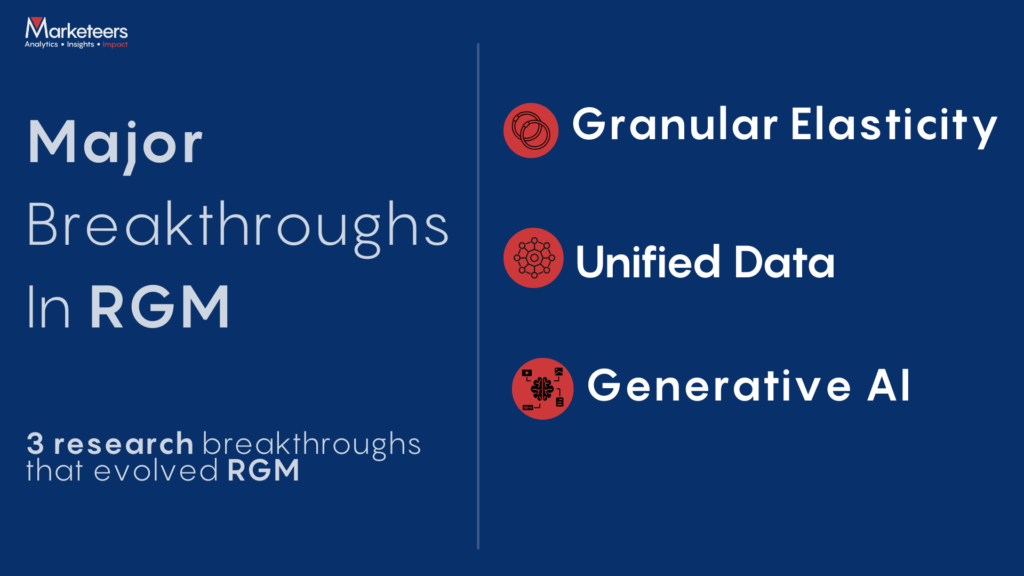
The past decade produced three research breakthroughs that together make the RGM Revolution structurally possible. Before businesses were mostly guessing, now they have a high-tech toolkit!
Granular Elasticity
Before, businesses looked at the broader picture, will people buy less soda if we raise prices ?
Now, it is knowing exactly how a certain SKU ( a 12oz can for instance ) sells at a certain location ( supermarket ) during a specific time ( Christmas period )
Unified Data
Before, the sales team didn’t talk to the advertising team, and the people stocking shelves were in the dark. This led to “siloed” decisions that generated revenue losses.
Now, the data is in one place and all the team could actually make a decision, looking into a unified dashboard.
Generative AI
Before, if sales increases, firms would jump to conclusions that this jump in sales was due to promotion, though the reality was it was just the weather was good that day!
Now, AI exactly identifies what caused this sales increase separating assumptions from facts, identifying the real cause of sale gain or loss
Key insight: Granular elasticity, unified data, and AI are not independent tools — they function as an integrated research stack that the RGM Revolution is built on.
How Recent Developments in RGM Affect Cost-Effectiveness
Recent RGM developments have significantly improved cost-effectiveness by reducing both the human capital required to run analysis cycles and the cost of wrong decisions made under analytical uncertainty. CPG businesses adopting data-driven approaches to revenue growth management are now projected to achieve sales growth of 3% to 5% . Additionally, they are achieving returns ranging from 2% to 5% on their yearly trade spending, which accounts for a substantial 24% increase. Real-time RGM platforms has leveled the playing field, making it easier and cheaper for companies to avoid expensive mistakes.
Data-as-a-Service models made it accessible to every businesses, meaning you don’t need to be a billion-dollar company to have the best tools. Smaller brands can now “rent” the same smart technology that the giants use.This is shifting competitive dynamics across the industry, compressing the capability gap that once separated large multinationals from challenger brands.
Key insight: The most significant cost-effectiveness gain in modern RGM is not in analysis efficiency — it is in the reduction of high-cost promotional and pricing mistakes before they reach the market.
The Role of AI in RGM
AI has fundamentally changed what RGM systems can do by enabling continuous optimization rather than periodic review, a distinction that defines the core of the RGM Revolution.
It is good to think of AI as your brand’s nervous system, where you are not meeting quarterly to see where things went wrong, but rather moving into a world of continuous optimization.
What AI shifted in revenue growth management is that it made it easier to realize that a campaign is not working instantly, why people are buying or not buying which actually provides an early warning or opportunity to either dedicate the budget efficiently or actually ditch dedicating it.
AI tools now actually act as a smart thermostat for your brand’s value, where the system constantly monitors competitor moves, how much stock is on the shelves and how shoppers are behaving to suggest the sweet spot at the exact time.
AI tools are not something yet to be tested, in fact 66% of CPG brands have implemented or adopted AI in their processes.
What is actually a game changer is that teams no longer have to be tech oriented and data scientists to understand their data anymore, they can now simply talk to their data!
Key insight: AI has not automated RGM decision-making — it has scaled the quality and speed of the inputs that inform those decisions across the entire commercial organization.
Future Trends Predicted in RGM Technology ( What Comes Next? )
Revenue growth management is moving in one clear direction: deeper knowledge, applied faster, across more of the business. Companies are beginning to draw on click-stream data, mobile location data, and long-term purchase histories, feeding these into machine learning tools to spot consumer microsegments and store-level profit pools that traditional analysis simply cannot see. Promotion measurement is leaving behind the old practice of looking at aggregate gross-margin totals, and moving toward understanding exactly which type of shopper responded, why they responded, and whether their behaviour changed over time. Think of it as shifting from reading a weather report for the whole country to having a personalised forecast for your street. McKinsey’s RGM analysis notes that a single hypothetical brand with 30 SKUs could face hundreds, if not thousands, of pricing scenarios — a volume impossible to solve without predictive, automated technology. At the same time, RGM is growing beyond specialist teams sitting in one corner of the business. Through centres of excellence, structured training programs, and standardised tools shared across markets, it is becoming a skill that lives throughout the entire organisation, the way customer service does rather than the way legal counsel does. Online channels are also identified as a frontier that companies must adapt to, though the document signals this as a question companies need to answer rather than a solved problem. Across all of these directions, the common thread is the same: the companies that build these capabilities now, and build them broadly, are the ones positioned to lead. At Marketeers Research, we believe the future of RGM belongs to companies that operationalize it, not just study it. Smart Value RGM is built for that shift, helping commercial teams convert fragmented data into actionable decisions across pricing, promotions, assortment, and trade. In a market where speed and clarity shape growth, the winning organizations will be those that embed RGM into the way revenue decisions are made every day