
According to multiple reports, nearly 90% of new products struggle to compete effectively against similar offerings—a sobering reality for any brand leader. Even notorious titans aren’t immune to the risks of a flawed process: Kodak and Nokia famously faced bankruptcy after failing to pivot, and Ford’s “Edsel” remains a cautionary tale after suffering a gargantuan loss of $350 million. These figures underscore the absolute necessity of a phased development approach to secure success and mitigate risk. In this guide, we’re going to dive deep into why New Product Development (NPD) is essential in 2026, the specific process steps that drive results, methods for overcoming the most common development hurdles, and a definitive checklist to guide your next product from concept to shelf.
Why Businesses Must Re-imagine Their NPD Approach in 2026

New product development is moving at a breakneck pace. Brands that cling to traditional, rigid modes of NPD are falling behind, often failing to launch products that can truly compete. In 2026, staying relevant requires a fundamental shift in how we view the process.
So, how exactly is NPD in 2026 different?
The most successful businesses now treat uncertainty as data, not as a risk. Instead of being paralyzed by what they don’t know, they use iterative testing to turn those unknowns into actionable insights. Furthermore, the days of the “one-size-fits-all” framework are over. We have to stop stagnating on a single methodology; what works for an automotive giant won’t necessarily move the needle for an FMCG firm.
In 2026, agility must be the cornerstone of your process. This means:
Embracing Agility: Moving from linear “waterfall” steps to flexible, iterative loops.
Data-Driven Decisions: Relying on real-time facts and consumer behavior rather than internal assumptions.
Cross-Functional Synergy: Ensuring that marketing, engineering, and design aren’t just “informed” but are active co-creators from day one to spark innovation and ensure total alignment.
It Is a Mistake to Assume NPD and Traditional Product Development Are the Same
While discussing NPD, it is essential to distinguish it from traditional product development. Even though they are often used interchangeably, perceiving them as the same concept is a mistake.
NPD (New Product Development): This process was built for businesses that need to thrive in a VUCA (Volatile, Uncertain, Complex, and Ambiguous) world. It focuses on birth—bringing an entirely novel idea to life or radically innovating an existing product to meet new market demands.
Traditional Product Development: This is the process of building or improving a product that already has a solid proof of concept. It’s about execution and incremental updates rather than discovery.
The Bottom Line: New product development is about exploring the unknown, while regular development is about optimizing the known.
Why Applying New Product Development Strategies Is Vital
There are several benefits that businesses gain from adopting new product development strategies. To note a few:
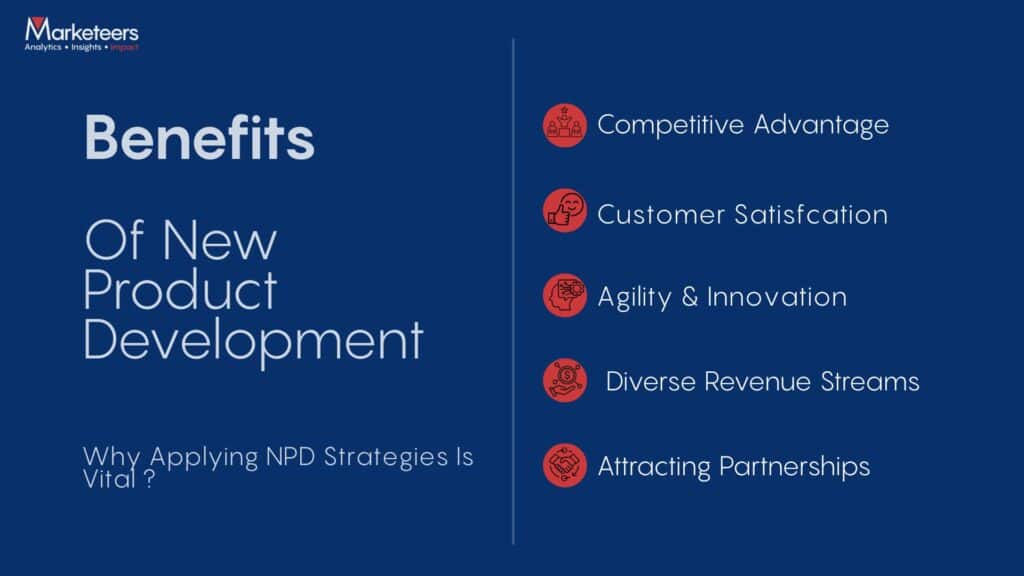
Competitive Advantage
An example of how adopting NPD efficiently actually results in a competitive advantage is the case of the notorious brand Coca-Cola. According to the brand’s innovation reports, a mesmerizing 30% of the firm’s profit growth was constituted by innovation. Products like Coca-Cola Zero Sugar aided the brand’s profitability immensely. While the phrase “competitive edge” might be overused, businesses that embody new product development strategies do benefit from a competitive edge among their peers. A robust development strategy allows businesses to adapt to new and even emerging trends. Moreover, through analysis, they can identify hidden gaps and opportunities, which overall results in competitive advantage in the market.
Satisfaction of Ever-Changing Customer Needs
If there is one company that has become a true school for understanding customers, it is Amazon. In a world where consumer needs can shift in an instant, Amazon demonstrates the power of a relentless customer-first mindset—constantly learning, testing, and refining its offerings based on real customer feedback. This disciplined approach allows the business to adapt without overspending or adding unnecessary complexity, while remaining clear and relevant to consumers. The impact is evident: Amazon’s strong focus on customer satisfaction has resulted in an estimated 90% customer retention rate, with satisfaction-driven loyalty contributing to around 35% of its total sales. The key takeaway is clear: continuous learning from customers is not optional; it is a growth strategy.
Agility & Innovation
The competitive advantage of agile businesses is that they are always hunting for the next breakthrough. Firms like Barclays, which implemented Disciplined Agile Delivery (DAD) across 800 teams, saw a 30% reduction in time-to-market. That being said, the competitive edge of businesses that are agile is that they develop their products in a way that actually makes the product seem innovative. This actually results in the product being fine-tuned pre-launch and also contributes to the overall growth of businesses that think this way.
Building a Loyal Customer Base
When you innovate to match customer preferences, buyers become brand advocates. 78% of consumers report becoming more loyal when they receive a personalized experience. Loyalty grows when customers feel that brands hear their concerns and understand their pain points. This is due to firms doing this not stagnating on a certain concept or idea of a service, which results in them having a more solid customer base than their competition in the market and actually reduces churn rate while building a group of loyal customers for the brand.
Diversification of Revenue Streams
A thorough NPD lifecycle untaps hidden market share. Disney is the gold standard here: by diversifying into parks (36% of revenue) and media networks (51%), they minimized dependency on any single stream. When businesses enter markets that are not explored, they can narrow their dependency on a single product or service and cater to wider target markets, which consequently improves overall profitability and revenue. This is beneficial because when businesses develop new products by applying a cautious and thorough product development lifecycle, they untap hidden market share and profitability streams. To elaborate, when businesses enter unexplored markets, they can narrow their dependency on a single product or service and cater to wider target markets, which consequently improves overall profitability and revenue.
Attracting Potential Business Partners & Shareholders
Efficient NPD signals to the market that you have a clear, winning strategy. Unilever’s innovation platform, launched in 2010, encouraged external co-creation; today, 60% of their research projects involve external collaborations. Businesses that adopt well-thought-out new product development strategies are more likely to draw attention from shareholders and businesses offering partnerships. This is helpful because businesses that adopt well-thought-out new product development strategies are more likely to draw attention from shareholders and businesses offering partnerships. Businesses that actually conduct new product development strategies efficiently embody a reputation that signals they have a clear and successful strategy that others can benefit from. Hence, this leads to businesses being more likely to forge partnerships with your firm due to confidence in your business.
Learning From Common New Product Development Hurdles From Different Industries
To no one’s surprise, developing a product from A to Z is not an easy task. There are several challenges and hardships that businesses must go through to develop a successful new product that actually competes within the market. These challenges include:
1. Ineffective Idea Generation
It sounds easy, but unorganized workflows or a lack of market need can kill a project early. Blockbuster lost 100% of its dominance because it couldn’t ideate a way to compete with Netflix’s streaming model. Generating an innovative product might sound like an easy task to do. Nonetheless, it is not as easy as it seems. When generating ideas from scratch, businesses often face difficulties that slow them down. These obstacles can be due to less need in the market or due to unorganized workflows, ultimately resulting in failure to develop ideas efficiently.
2. Product Good on Paper, Poor in Application
Many ideas look exceptional in a slide deck but fail in the real world. The Segway was hailed as the “future of urban transport,” but it was too slow for roads and too bulky for sidewalks. They sold only 6,000 units in their first year against a 50,000-unit projection. Thus, it is paramount for businesses to research their audience and competition before actually launching their product. Oftentimes, businesses will innovate ideas that sound exceptional when viewed on paper but lack the implications of practical implementation. This is when products often fail even when predictions say otherwise. Thus, it is paramount for businesses to research their audience and competition before actually launching their product.
3. Struggle to Manage Product Roadmap
Without the right tools, strategies crumble. We recommend the MoSCoW model (Must-have, Should-have, Could-have, Won’t-have) to prioritize features and prevent launch delays. Organizations developing a new concept or solution often do not have the right tools to create an efficient product strategy that is well thought out, which results in hindering the process and delaying the launch.
4. Cross-Functional Teams Misalignment
Misalignment kills quality and speed. BlackBerry’s downfall was famously accelerated by internal friction between the development and marketing teams, causing them to miss the touchscreen revolution entirely, resulting in their recession. It is a challenge for businesses to synergize the teams working on the new product development process steps. Misalignment affects three critical aspects of your product, if not more, such as quality and speed. To resolve this, it is important that a key decision-maker is responsible for aligning communication across departments, making sure that they are on the same page and also resolving any conflicts or external factors delaying processes.
5. Engineering & Design Challenges
Design and development must work in synergy. Samsung’s Galaxy Note 7 battery fiasco in 2016—a result of pushing engineering boundaries too fast—cost the firm $5.3 billion and wiped $17 billion off its market value. There are several challenges that can occur due to engineering and design. For example, when creating an app, the design team may miss a deadline, whereas the entire development team has to wait for reviewing a prototype. Hence, it is your responsibility as a business to make sure that design and development teams work alongside each other in synergy, as each deliverable could be affected by any delay.
6. False Pricing the Product
Pricing is a delicate formula. Price too high, and you lose volume; too low, and you lose margin. Gap suffered in 2010 by swinging between price extremes, damaging their brand image and contributing to a recession for the label. An idea turned into a product is only one part of the formula, not the whole formula. Pricing a product is not an easy task. To explain, if you make a product’s price too high, no one will buy it! Also, if you charge a very low price, you might be affected by a vast amount of losses. As a consequence, it is vital to find the sweet spot of your product’s pricing, especially for the people you want to target.
7. Post-Launch Friction
The launch isn’t the finish line. Nintendo’s Virtual Boy (1995) failed because the firm abandoned the platform rather than fixing graphic issues, resulting in one of the biggest hardware losses in their history. Hence, it is essential for businesses to plan updates and provide ongoing and good customer support after the launch and not rely on the product launch only. This reduces friction and does not make businesses jump to early conclusions.
7 Critical Product Development Challenges & How to Overcome Them
Product development is fraught with obstacles that can derail even the most promising innovations. From ineffective ideation to post-launch friction, understanding these challenges and their real-world consequences is essential for business success.
| Challenge | Description & Real-World Example | How to Overcome It |
|---|---|---|
| 1. Ineffective Idea Generation | It sounds easy, but unorganized workflows or a lack of market need can kill a project early. Blockbuster lost 100% of its dominance because it couldn’t ideate a way to compete with Netflix’s streaming model. Generating an innovative product might sound like an easy task to do. Nonetheless, it is not as easy as it seems. When generating ideas from scratch, businesses often face difficulties that slow them down due to less need in the market or unorganized workflows. | Organize workflows systematically, validate market need early through customer research, create structured ideation processes, and ensure ideas are grounded in real market demand rather than assumptions. |
| 2. Product Good on Paper, Poor in Application | Many ideas look exceptional in a slide deck but fail in the real world. The Segway was hailed as the “future of urban transport,” but it was too slow for roads and too bulky for sidewalks. They sold only 6,000 units in their first year against a 50,000-unit projection. Oftentimes, businesses will innovate ideas that sound exceptional when viewed on paper but lack the implications of practical implementation. | Research your audience and competition before actually launching your product. Test prototypes in real-world conditions, gather feedback from actual users, and validate practical applications before full launch. |
| 3. Struggle to Manage Product Roadmap | Without the right tools, strategies crumble. Organizations developing a new concept or solution often do not have the right tools to create an efficient product strategy that is well thought out, which results in hindering the process and delaying the launch. | We recommend the MoSCoW model (Must-have, Should-have, Could-have, Won’t-have) to prioritize features and prevent launch delays. Use proper project management tools and frameworks to maintain clear roadmaps. |
| 4. Cross-Functional Teams Misalignment | Misalignment kills quality and speed. BlackBerry’s downfall was famously accelerated by internal friction between the development and marketing teams, causing them to miss the touchscreen revolution entirely, resulting in their recession. It is a challenge for businesses to synergize the teams working on the new product development process steps. Misalignment affects critical aspects such as quality and speed. | A key decision-maker should be responsible for aligning communication across departments, making sure that they are on the same page and also resolving any conflicts or external factors delaying processes. |
| 5. Engineering & Design Challenges | Design and development must work in synergy. Samsung’s Galaxy Note 7 battery fiasco in 2016—a result of pushing engineering boundaries too fast—cost the firm $5.3 billion and wiped $17 billion off its market value. There are several challenges that can occur due to engineering and design. For example, when creating an app, the design team may miss a deadline, whereas the entire development team has to wait for reviewing a prototype. | Make sure that design and development teams work alongside each other in synergy, as each deliverable could be affected by any delay. Implement parallel workflows and maintain constant communication between teams. |
| 6. False Pricing the Product | Pricing is a delicate formula. Price too high, and you lose volume; too low, and you lose margin. Gap suffered in 2010 by swinging between price extremes, damaging their brand image and contributing to a recession for the label. An idea turned into a product is only one part of the formula, not the whole formula. If you make a product’s price too high, no one will buy it! Also, if you charge a very low price, you might be affected by a vast amount of losses. | It is vital to find the sweet spot of your product’s pricing, especially for the people you want to target. Conduct competitive analysis, understand customer willingness to pay, and test pricing strategies before full rollout. |
| 7. Post-Launch Friction | The launch isn’t the finish line. Nintendo’s Virtual Boy (1995) failed because the firm abandoned the platform rather than fixing graphic issues, resulting in one of the biggest hardware losses in their history. Many businesses rely on the product launch only and fail to provide ongoing support. | It is essential for businesses to plan updates and provide ongoing and good customer support after the launch. This reduces friction and does not make businesses jump to early conclusions. Treat launch as the beginning, not the end. |
The 6 Critical New Product Development Process Steps
As per what has been discussed earlier, following a well-thought-out new product development strategy is the difference between your product flying off the shelves or dying on the shelves. If you are considering developing a new product to win within a fiercely competitive market, these are the only 6 new product development process steps that you will need. These steps are:
Step 1 – Deep & Thorough Research of Consumer & Market (Empathize)
Before touching the product, it is non-negotiable that you get an in-depth understanding of your consumer and the market you are operating within. Hence, deep research to untap pain points that have not been addressed, sentiments of consumers, and their behaviors towards your product provides invaluable information and insights on how the product would be perceived, how your consumers would react, and whether or not you need to keep or change your product’s design and features. Empathizing with your customers by creating a product that caters to their needs provides innumerable benefits.
Step 2 – Identify Hidden Opportunities (Define)
The second step in the 6-step new product development process is identifying hidden gaps and opportunities. This is key because by doing so, businesses could turn insights into innovation without stagnation, overcoming competition. By defining hidden opportunities, businesses can overcome competition by finding the pain points untapped and translating these insights into innovative strategies that effectively target their customers, which results in overall customer satisfaction and retention.
Step 3 – Concept Co-Creation & Ideation (Ideate)
By cross-functional collaboration, ideas are easier to be aligned and more likely to succeed. To elaborate, this is due to the fact that when multiple people work together, several ideas are uncovered, and each could be valuable for the success of a new product. By generation and co-creation of ideas, businesses can actually develop and refine their product concepts through collaboration and meaningful insights. Why is this important? Imagine a team has a key player that scores several goals. If that team gets another player as powerful and the two players collaborate, won’t their chances of winning skyrocket? The same idea applies to this step of concept co-creation and ideation.
Step 4 – Development & Testing Product Concepts (Prototype/Bringing an Idea to Life)
Testing a new product concept and development by prototyping it and bringing it to life is essential as it aids businesses to measure appeal and sentiment of consumers effectively. This process plays an integral and often overlooked role in actually ensuring a new product’s success. An example of why this step is crucial is an FMCG firm we worked with: by prototyping the product, the packaging sentiment was notably negative. After alteration, the sentiment shifted 180 degrees for the better. If this step was not done, the business would have lost not only in financial terms but also in reputational terms. According to multiple reports, businesses that prototype their product before launch experience a 63% higher success rate.
Step 5 – Conduct Product Tests & Launch With Confidence (Test & Launch)
The next step after prototyping is to validate your product through robust and carefully carried out product tests, finalize the positioning of your product, and launch confidently without overthinking or stagnation. In this step, it is paramount to validate your product through robust product tests before launching and also to think about how the product would be positioned in the market and in consumers’ minds and then finalize your positioning. After you are sure as the sun rises of positioning and product tests, the next step is to launch your product confidently without a shadow of doubt.
Step 6 – Monitor Performance & Identify Areas of Improvement (Post-Launch)
As per our discussion earlier, the last step of new product development is not launching it into the market. To illustrate, businesses that aim to ensure success of their new product should monitor the new product’s performance to see if it is meeting the expectations or falling behind, learn about people’s feedback and whether or not the sentiment is positive or negative, and evolve their product by identifying areas of improvement based on feedback. This step, which is often overlooked, could actually make a product sell more and enhance its perceived value in the market, which enhances overall profitability and revenue of the company and creates a loyal customer base of satisfied consumers.
Looking to Develop a New Product & Win the Market?
All in all, we went through what is meant by NPD, which is the entire process of developing a new product or solution from idea to execution. Additionally, the difference between regular and new product development, the necessity of new product development strategies, the common hurdles businesses face while conducting new product development process steps, and eventually the only 6 steps you need to assure your new product’s success. If you want to uncover how Marketeers Research can actually help you develop a new product from scratch, whether you are operating in Automotive, FMCG, Retail, or any industry, check our consumer and shopper insights solutions for more information.