

In a fiercely competitive landscape like the consumer goods industry, businesses that fail to adopt a clear growth strategy are exposed to multiple risks that can hinder their performance. These risks include financial instability, missed opportunities, and stagnation. That’s why it’s crucial for businesses in such a dynamic market to adopt data-driven growth strategies to move forward. To explain, Data-Driven Growth Strategies makes organizations more likely to stand out and generate more revenue than their peers.
In this blog, we’ll explore the role of data analytics in empowering business growth, the role of data-driven growth strategies for businesses, and how organizations can empower their growth using data.
The Role of Data Analytics in Empowering Business Growth
How Data Analytics Drives Business Growth
Using data analytics in business processes can help in several ways across commercial and supply teams. Below are the key questions data analytics helps answer and the strategic benefits for FMCG businesses operating in a VUCA world.
| Key Question Answered | Strategic Insights & Benefits |
|---|---|
| Where Is Growth Coming From? |
By using data analytics effectively, businesses can gain an in-depth understanding of where growth is coming from. With an analytics-led strategy, teams can quickly identify: Where value and volume are growing or declining? For businesses operating in a VUCA world like FMCGs, understanding these trends is essential. Knowing where value and volume are growing helps businesses uncover the “sweet spot” between high-volume/low-margin and low-volume/high-margin strategies. Additionally, understanding drops in volume helps prevent reckless price reductions. Data analytics also helps businesses identify the true source of revenue growth: is revenue rising because more items are being sold (volume growth), or because prices are higher (value growth)? In summary, understanding value and volume trends is essential for FMCG businesses because it helps them avoid sacrificing long-term revenue for short-term gains. |
| Which Parts of the Business Are Driving Overall Growth? |
Leveraging data analytics to understand growth drivers is critical in an industry shaped by high volumes and intense competition. When used effectively, data analytics can reveal where growth is coming from—whether it’s the product, channel, or region. This shifts businesses from ambiguity to certainty. Key Benefits of Understanding Growth Drivers: • Maximize profitability • Identify which promotions, products, and channels are actually moving the needle (without margin erosion) • Allocate resources efficiently • Move from reactive to proactive strategies • See which items are growing and which are declining, helping prevent overstocking or understocking Understanding key growth drivers is paramount in FMCG because it allows businesses to shift from a “one size fits all” approach to a more targeted strategy that boosts revenue and strengthens market position. |
Using data analytics in business processes can help in several ways across commercial and supply teams. To name a few:
Answering the Question: Where Is Growth Coming From?
By using data analytics effectively, businesses can gain an in-depth understanding of where growth is coming from. With a analytics-led strategy, teams can quickly identify:
- Where value and volume are growing or declining?
For businesses operating in a VUCA world like FMCG, understanding these trends is essential. Knowing where value and volume are growing helps businesses uncover the “sweet spot” between high-volume/low-margin and low-volume/high-margin strategies. Additionally, understanding drops in volume helps prevent reckless price reductions.
Data analytics also helps businesses identify the true source of revenue growth: is revenue rising because more items are being sold (volume growth), or because prices are higher (value growth)? In summary, understanding value and volume trends is essential for FMCG businesses because it helps them avoid sacrificing long-term revenue for short-term gains.
- Which Parts of the Business Are Driving Overall Growth?
Leveraging data analytics to understand growth drivers is critical in an industry shaped by high volumes and intense competition. When used effectively, data analytics can reveal where growth is coming from—whether it’s the product, channel, or region. This shifts businesses from ambiguity to certainty.
By understanding growth drivers, FMCG businesses can maximize profitability, identify which promotions, products, and channels are actually moving the needle (without margin erosion), allocate resources efficiently, and move from reactive to proactive strategies. Additionally, businesses can see which items are growing and which are declining, helping prevent overstocking or understocking.
Understanding key growth drivers is paramount in FMCG because it allows businesses to shift from a “one size fits all” approach to a more targeted strategy that boosts revenue and strengthens market position.
The Role of Data-Driven Growth Strategies For Businesses
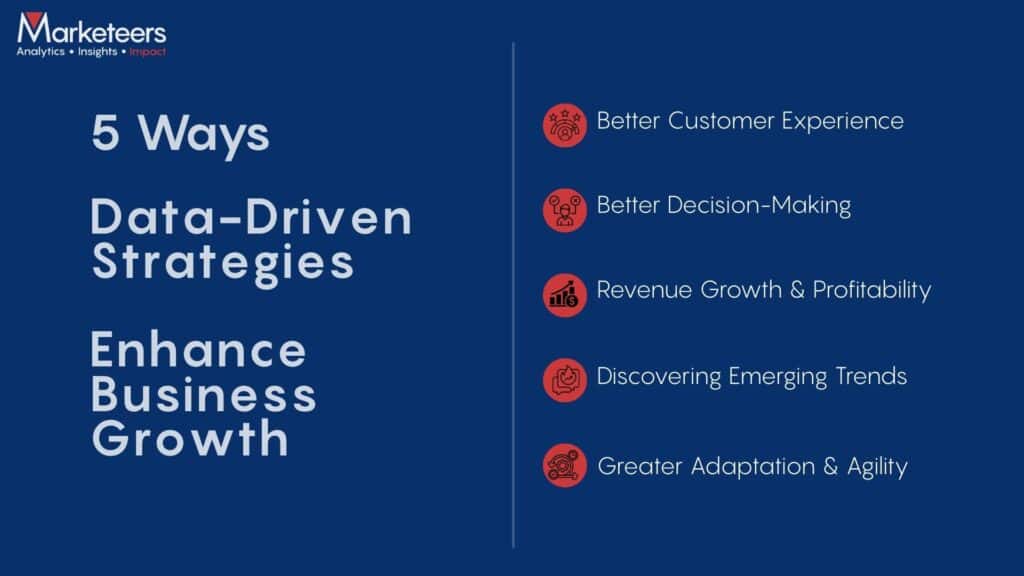
Data-driven growth strategies for businesses allows them to get a more precise view of what is driving performance. Data-driven growth strategies for businesses can help them uncover several ways to grow the business even further at scale in competitive environments such as:
- Price and mix effects
- Distribution and availability
- Promotional pressure and execution
As a result, businesses reduce assumptions and focus on the real drivers behind outcomes. For instance , Leveraging advanced data analytics and AI can support FMCG businesses in several ways, including:
Better Customer Experience and Satisfaction
Businesses that use advanced analytics and AI effectively are more likely to create personalized and targeted customer experiences, leading to higher engagement and better customer satisfaction. In FMCG, this is especially important: positive experiences increase repeat purchases and can turn customers into brand advocates—particularly in the digital age, where word of mouth spreads quickly. Customer satisfaction helps FMCG businesses differentiate themselves and build a loyal customer base.
Better Decision-Making
Businesses that adopt a data-first mindset and rely on data-driven decision-making benefit in several ways. First, they make more confident decisions because data supports benchmarking and improves understanding of how decisions impact performance. Data also provides objectivity.
This enables businesses to work toward a clear vision with less uncertainty. It also makes organizations more proactive rather than reactive. For example, data-driven decision-making helps businesses identify opportunities before competitors do and detect risks earlier—before expansion or investment.
According to a study by New Vantage Partners for Harvard Business Review, 49% of businesses that adopted data-driven methodologies benefited from cost reductions by using a data-driven approach.
Revenue Growth and Profitability
Businesses that use advanced analytics effectively can improve profitability and increase revenue for several reasons, including optimized pricing, demand forecasting, and customer retention strategies. These improvements can lead to higher conversion rates and overall sales.
Advanced analytics is also key for profit optimization in the CPG industry. According to a report by McKinsey, a Brazilian firm increased its return on sales (ROS) by 2.5% within a few weeks by using advanced analytics. A beverage company also used data analytics to create a new promotional strategy, improving trade-spend efficiency by 5–10%—which can translate into hundreds of millions of dollars.
These examples show that businesses that integrate advanced analytics and AI into their processes are more likely to grow, even in a fiercely competitive industry like FMCG.
Discovering Emerging Trends and Staying Ahead of Competition
Businesses that adopt a data-first mindset can outperform competitors in overcrowded markets. By identifying emerging trends, businesses can mitigate risks before they become major problems, improve personalization, and spot opportunities earlier.
By leveraging big data analytics, businesses can forecast future demand, gain deeper insight into customer needs and sentiment, and build a competitive edge by identifying gaps and fostering innovation in products and services. This leads to more accurate decisions, better productivity, and cost reductions.
Greater Adaptation and Agility
In a dynamic industry where changes can happen daily, agility is non-negotiable. Businesses that lack flexibility risk falling behind. Advanced analytics supports agility by making decisions easier and helping organizations adapt faster.
Agile organizations can test responses before scaling decisions, minimize disruptions, dynamically route and schedule operations, and adjust logistics and distribution plans more rapidly. They also improve risk management and performance tracking. Agile businesses are more resilient in the face of surprises and can handle unexpected changes more effectively. As a result, FMCG businesses that use advanced analytics are more likely to operate efficiently in an unpredictable environment.
Looking to empower your growth using data?
By leveraging data-driven growth strategies, businesses can turn raw data into real decision support. If you’re unsure where to start your growth journey, our data analytics solution can help unlock your path to growth.
Our solution helps identify where growth is happening by creating a shared, factual view of the market. By leveraging AI and advanced analytics, it helps businesses pinpoint true performance drivers, removing ambiguity and delivering clear insights into the real accelerators of growth.
Our solution doesn’t only help businesses see market growth clearly or understand growth drivers—it also supports promotion planning by answering critical questions, such as which promotional strategies drive revenue and which need adjustment. It also helps identify which actions create the greatest impact by proactively spotting gaps and opportunities.
Beyond uncovering hidden opportunities, the solution helps businesses answer “What should we do next?” in an efficient, priority-based way—enabling better decision-making and actions that drive tangible results. If this approach aligns with how you think, the next step is simple.
Walk us through your current workflow, and we’ll help shape a focused, one-category pilot with clear next steps.