

Did you know that several brands spend enormous amounts of their annual budget on Ramadan advertisements? This is due to Ramadan being considered a “primetime” for promotional activities. With this kind of investment, it is paramount to actually test whether the money spent reaped the expected rewards. Which leads to the role of post ad testing. Simply put, post ad-testing is a test that allows businesses to measure the impact of a campaign to make sure that all of the campaign’s elements and investments meet the expected objectives. This analysis of performance actually provides insights into the campaign’s efficiency in terms of recall, liking, and even message comprehension and the overall impact on reputation and purchase attitude of the audience. That being said, in this blog we will dive into:
- Post Ad Testing 2026: Why It Matters for Ramadan Campaigns
- Critical Metrics: Ad Recall, Brand Love & Purchase Intent
- Why Rapid Post-Ad Testing Is Essential for High-Stakes Ramadan Campaigns
Post Ad Testing 2026: Why It Matters For Ramadan Campaigns
Due to the fierce competitive nature of Ramadan ads and the way they flood the TV screens and even your mobile devices, many firms spend millions of dollars to acquire certain goals out of these advertisements. To actually validate an ad’s success, it is important to measure its efficiency, don’t you think so? Validating an ad’s success is exactly what post ad testing does as it provides insights into the impact of the ad in terms of:
- How was the ad perceived?
- How did people act when seeing the ad?
- What areas of the ad were successful and what areas need adjustments?
This is especially helpful during Ramadan as post ad testing 2026 is like sighting the crescent moon it confirms whether your campaign has truly begun to deliver results. You can predict when it should appear, plan your campaign launch perfectly, but you only know you succeeded when witnesses confirm they saw it. Without verification, you’re operating on an assumption, not certainty. In a month where every night counts, you can’t afford to guess whether your message reaped its rewards or went overlooked. So, to further explain, post ad tests are paramount as they help you:
- Determine the effectiveness of your campaign
- Optimize for future campaigns
- Benchmark your campaign against competitors
Critical Metrics: Ad Recall, Brand Affinity & Purchase Intent
Post-Ad Testing: Critical Metrics for Campaign Success
After launching your campaign, understanding how your audience responds is essential. Post-ad testing measures three critical dimensions that determine whether your investment translates into business results: recall, affinity, and purchase intent.
| Metric | What It Measures & Real-World Example | Key Questions Answered |
|---|---|---|
| Ad Recall (In Most Cases Carried Out After 24 Hours After the Campaign’s Launch) |
Think back: can you picture a Coca-Cola bottle with a name on it? Maybe you even searched for your own name, or bought one for a friend. That instant mental image you just had—that’s recall in action. Coca-Cola’s “Share a Coke” campaign wasn’t just creative; it was strategically measured. They didn’t launch those personalized bottles and hope for the best. Throughout the campaign, Coca-Cola tracked ad recall to answer critical questions: Which element stuck most—the personalized names, the sharing message, or the emotional connection? When did recall peak? Which audiences remembered it best? They discovered that personalization was the stickiest element—people didn’t just remember seeing the ad, they remembered feeling like Coca-Cola made something just for them. The result? Over 50 million personalized bottles sold and a campaign so memorable it’s still referenced years later. This is why ad recall matters for your Ramadan campaign. In a month where there’s a flood of advertisements filling TV screens and smartphones, brands that measure what’s memorable are the ones who stay on top of mind and convert a memory to action. |
• Which element stuck most? • When did recall peak? • Which audiences remembered it best? • What made the ad memorable enough to drive action? |
| Brand Affinity (Did People Like Your Ad? Were They Satisfied With It?) |
Of course, after launching your ad, you want to know whether your audience liked it or it went over their head, right? It is beneficial to think of the role of post ad testing in brand affinity as a thermometer that sees if the temperature of someone has changed. The metric of brand affinity measures the reaction of people on your ad from “I’m not really interested in this” to “Oh let me check them out!” Simply put, you want your ad to make people not only buy once but many times from your brand and like it, right? When speaking about brand affinity, we can’t overlook the sportswear giant Nike and how it created a loyal customer base that defends the brand as if defending one of their family members. Through testing their awareness and consistent innovation by creating campaigns like “Swoosh” Logo and sponsoring well-known athletes like Cristiano Ronaldo, the firm was able to generate $37.4 billion in revenue in 2020. |
• Did people like the ad itself? (Was it fun, boring, etc.) • Did they know it was you? (Did they know it was you or thought it was someone else’s ad?) • What sentiments did they have? (Was your ad meant to make them happy but it actually made them feel another emotion?) |
| Purchase Intent (Are They Willing to Buy From You After Seeing the Ad?) |
Your audience might applaud your ad, love your ad, and actually feel positive feelings regarding your brand, but what is the use of this if your ultimate goal was to make them buy from you and no one bought? Think of it as a comedy club owner who had standing ovations day and night, until he checked the receipts and the audience weren’t buying any drinks, let alone coming back the following week. Overlooking post ad testing ads and whether the audience bought from you is like applause without receipts. A notable example worth noting here is HP. The firm wanted to measure the impact of contextual advertising on their consumers’ preference and buying behavior. They hired a market research firm that measured eyesight on laptops. What they found was when they place ads in places that seem relevant, there is a higher likelihood of brand recall and favorability. As a consequence, 14% of the consumers had a bigger probability of actually buying from HP after seeing an ad within the context apart from ads that were displayed out of place. The difference in post-ad testing is not subtle. It’s the difference between entertaining your current audience and building your next one. |
• Do people actually want to buy your product now? • How badly do they want it? • Will they actually pick your brand over the others? • Today? Next week? Maybe someday? Never? • Did the ad push them from buying it or they actually would’ve before it anyways? |
There are several metrics that businesses test during their Ramadan campaigns to assess whether or not their efforts actually did pay off. One of the most essential metrics that you must measure to assure your campaign’s success are:
1. Ad recall
2. Brand affinity
3. Purchase intent.
Let’s explain each and why they can provide information on whether the Audience:
- Liked your ad
- Didn’t Like It Much
- Got the wrong or right message out of it.
Ad Recall (In Most Cases Carried Out After 24 Hours After the Campaign’s Launch)
Think back: can you picture a Coca-Cola bottle with a name on it? Maybe you even searched for your own name, or bought one for a friend. That instant mental image you just had—that’s a recall in action.
Coca-Cola’s “Share a Coke” campaign wasn’t just creative; it was strategically measured. They didn’t launch those personalized bottles and hope for the best.
Throughout the campaign, Coca-Cola tracked ad recall to answer critical questions:
- Which element stuck most—the personalized names, the sharing message, or the emotional connection?
- When did recall peak?
- Which audiences remembered it best?
The answers guided everything. They discovered that personalization was the stickiest element—people didn’t just remember seeing the ad, they remembered feeling like Coca-Cola made something just for them. That insight helped them double down on what worked.
The result? Over 50 million personalized bottles sold and a campaign so memorable it’s still referenced years later. You remembered it in seconds, didn’t you?
This is why ad recall matters for your Ramadan campaign. In a month where there’s a flood of advertisements filling TV screens and smartphones, brands that measure what’s memorable are the ones who stay on top of mind and convert a memory to action.
Brand Affinity (Did People Like Your Ad? Were They Satisfied With It?)
Of course, after launching your ad, you want to know whether your audience liked it or it went over their head, right? It is beneficial to think of the role of post ad testing in brand affinity as a thermometer that sees if the temperature of someone has changed. The metric of brand affinity measures the reaction of people on your ad from “I’m not really interested in this” to “Oh let me check them out!” Simply put, you want your ad to make people not only buy once but many times from your brand and like it, right? Testing affinity is what actually tells you whether the ad lived to its promise or not.
When speaking about brand affinity, we can’t overlook the sportswear giant Nike and how it created a loyal customer base that defends the brand as if defending one of their family members. Through testing their awareness and consistent innovation by creating campaigns like “Swoosh” Logo and sponsoring well-known athletes like Cristiano Ronaldo, the firm was able to generate $37.4 billion in revenue in 2020.
So to speak, by testing your brand affinity after your ad launch you measure:
- Did people like the ad itself? (Was it fun, boring, etc.)
- Did they know it was you? (Did they know it was you or thought it was someone else’s ad?)
- What sentiments did they have? (Was your ad meant to make them happy but it actually made them feel another emotion?)
Purchase Intent (Are They Willing to Buy From You After Seeing the Ad?)
Your audience might applaud your ad, love your ad, and actually feel positive feelings regarding your brand, but what is the use of this if your ultimate goal was to make them buy from you and no one bought? Think of it as a comedy club owner who had standing ovations day and night, until he checked the receipts and the audience weren’t buying any drinks, let alone coming back the following week. Overlooking post ad testing ads and whether the audience bought from you is like applause without receipts.
By now you know that we are fans of using examples in our text. A notable example worth noting here is HP. The firm wanted to measure the impact of contextual advertising on their consumers’ preference and buying behavior. Due to this, they hired a market research firm that measured eyesight on laptops. What they found was when they place ads in places that seem relevant, there is a higher likelihood of brand recall and favorability.
As a consequence, 14% of the consumers had a bigger probability of actually buying from HP after seeing an ad within the context apart from ads that were displayed out of place.
The difference in post-ad testing is not subtle. It’s the difference between entertaining your current audience and building your next one.
So what important questions does purchase intent actually answer?
- Do people actually want to buy your product now?
- How badly do they want it?
- Will they actually pick your brand over the others?
- Today? Next week? Maybe someday? Never?
- Did the ad push them from buying it or they actually would’ve before it anyways?
What is Rapid Post-Ad Testing & Why Is It Essential for High-Stakes Ramadan Campaigns
When planning ads for Ramadan audiences, there are a plethora of factors to consider in your post ad testing. One of the most innovative ways is rapid post ad testing, so let’s get into the nitty gritty of what is actually rapid post-ad-testing?
Simply put, rapid post ad-testing is an agile and a data-driven approach that businesses use to assess an advertisement’s efficiency shortly after launch through using real-time consumer feedback in an aim to measure whether the audience actually comprehended the message and whether or not the message reaped its fruits. Rapid post-ad testing is key as it makes it easier for you to actually check in a rapid way whether your ad was working WHILE Ramadan was happening, not after the rents were due.
As per the discussion earlier, Ramadan is a month where firms spend millions of dollars to actually get a message and an action from consumers. This is essential for high-stakes Ramadan campaigns for a multitude of reasons:
- Are people actually getting your message or scratching their heads?
- Is your ad making the expected ROI? (The utmost benefit of rapid post-ad testing)
- Does your ad carry offensive messages or do people have a negative sentiment of it?
Rapid post ad testing in a high-stakes environment like Ramadan is a necessity, not a luxury.
Let me explain: when you actually test the advertisement during Ramadan, you actually get an insight on what topics users are actively searching for. This leads to creativity, inspiration and even better message communication.
An example of this is the reputable brand Nutella, who actually used these insights in a smart way. What they actually did was that they used the insights that people during Ramadan enjoy Knafeh. What they did was a series around making traditional Ramadan desserts with the use of Nutella. Another example worth noting too is that Lurpak also used trends to make recipe-based videos during the season. Following this, they used ads to target the women who actually viewed the content (the top 5%) which actually resulted in the brand capturing the high demand for cooking content and also maximizing their audience’s reach.
Why Marketeers Online Post Ad Testing Could Help You Reduce Time & Cost
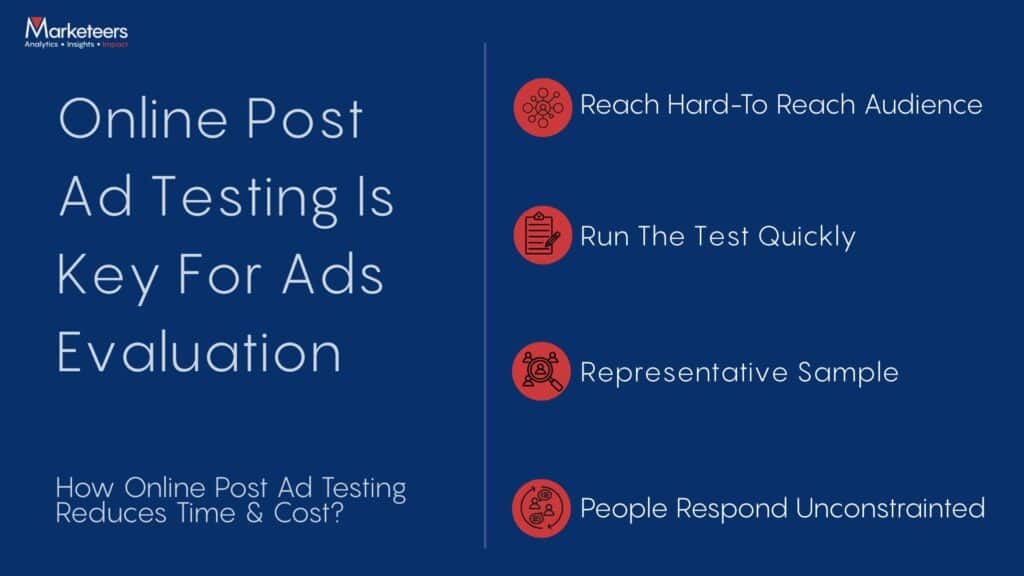
Online post-ad testing is key — and for a few pretty practical reasons. At its core, post-ad evaluation matters because it helps you:
- Reach hard-to-reach audiences
- Run the test quickly on a representative sample, so you can adjust your strategy while your ad is still airing
- Let people respond at their own pace — with no pressure or constraints, and with minimal chance of error
At Marketeers, we use both online and traditional post-ad evaluations. The main goal is to measure how effective a campaign really was in terms of:
- Recall
- Likeability & feedback
- UGC created on social media
- What to test (and improve) in future ads
We also use post-ad testing to uncover:
- What actually pulls people in
- Which communication channels they prefer for the product or service you’re talking about
- Which version of the ad feels strongest — the one that lands best, sticks, and stays memorable
Long story short, we evaluate your ad quickly and clearly, so if something needs changing (especially if it’s urgent), you can tweak it easily and fast.
Conclusion
All in all, we went through the importance of post ad testing 2026 Ramadan campaigns. What are the key metrics that actually would tell you whether your ad was a success and lived up to its promise or it was just overlooked in this compact season . Additionally, we went through how online post ads evaluation could help you reach your insights in a fast and effective way.
If you are looking for ways that we can help you uncover the real truth behind your ad this Ramadan, visit our Consumer & Shopper Insights Solutions to learn more about how we do this and how we are empowering growth in Consumer & Shopper insights in the last 30 years!