

If you are a Marketing Director or a Commercial lead you already know that taste drives purchase. A 2025 Kerry proprietary research study confirmed that consumers rank taste, alongside protein content and sugar levels, as the primary driver of repeat purchase decisions. That is not a new insight. What is new in 2026 is the cost of getting it wrong. Local brands across Egypt and the wider FMCG landscape are competing for shelf space against multinationals with formulation budgets, consumer research infrastructure, and decades of sensory data. If your product reaches retail without going through a rigorous product taste test in 2026, you are not competing on equal terms. You are guessing. This article is for Marketing Directors and Commercial leads who are either preparing a product launch or evaluating whether their current formulation is actually doing its job. We will cover what a proper sensory process looks like, why most brands skip the steps that matter most, and what that decision costs in commercial terms.
What Is Product Taste Testing?
Product taste testing in 2026 is the process of measuring consumer response to a product’s sensory profile before and after formulation adjustments. It goes beyond asking people whether they like something.
A structured taste test evaluates:
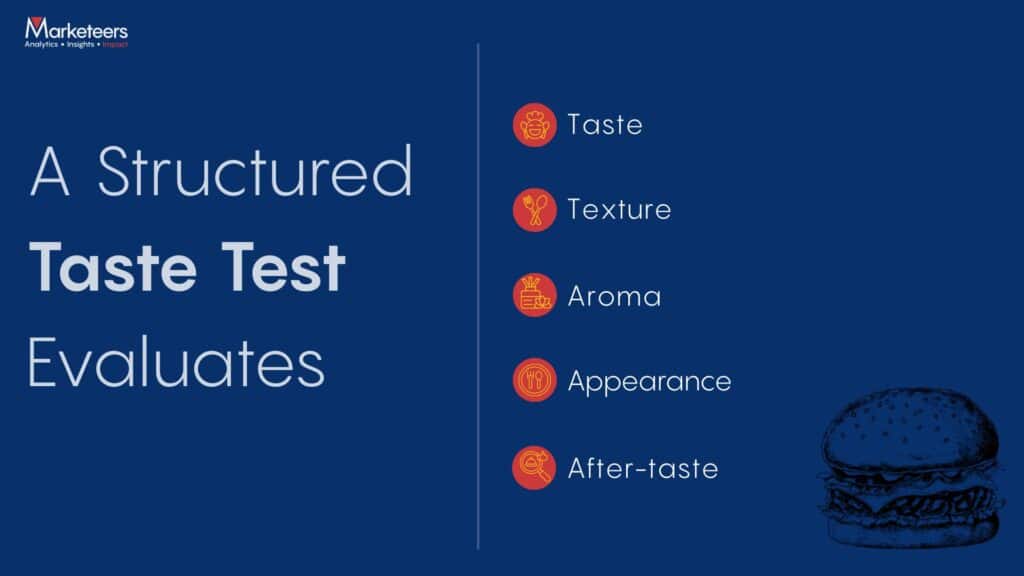
- Taste — Does the flavour profile match category expectations and consumer preference?
- Texture — How does the product feel in the mouth at first contact and through consumption?
- Aroma — Is the scent profile appealing? Is it too strong or too faint for the category?
- Appearance — Does the product look the way the consumer expects it to before they taste it?
- Aftertaste — What lingers? This is one of the most frequently overlooked attributes and one of the strongest drivers of repeat purchase or rejection.
Most brands conduct informal versions of this. A team tastes the product internally. Someone says it feels right. Production locks the formula. That is not a taste test. That is an assumption dressed as validation.
Why a Product Taste Test in 2026 Is Non-Negotiable
 Marketeers Research · Sensory Lab
of launches are reformulations — not new products
With launch costs hitting $1–2M by 2030, skipping sensory data is a commercial liability.
You may be thinking that AI-driven formulation tools, synthetic taste modelling, or faster production cycles have reduced the need for consumer-facing sensory research. They have not.
Here is why:
Consumer expectations are more specific than ever. The Kerry 2025 research found that consumers are increasingly focused on ingredient transparency, particularly around protein, sodium, and total sugar content. Meaning that consumers are not passive tasters. They arrive at the shelf with criteria.
The competitive shelf is more crowded. In Egypt specifically, local brands are now sitting directly next to multinational products in the same category. The consumer comparison happens in seconds. If your product does not perform on the attributes that drive preference in your specific market, the multinational wins by default.
PepsiCo’s Flamin Hot expansion is the right lesson here. The brand did not guess its way into chips, tortillas, popcorn, meat snacks, nuts, and crackers. It mapped the consumer ecosystem, understood which sensory profiles transferred across formats, and expanded with evidence.
What happens when you skip it?
Crystal Pepsi is the obvious case study. The product was pulled from shelves within a year because the flavour profile did not differentiate from regular cola in a way that justified the product’s existence. Skipping a structured product taste test in 2026 is no longer a minor risk; it is a direct commercial liability.
The Two Stages of a Proper Sensory Process
Marketeers Research · Sensory Lab
The Two-Stage Sensory Process
How Marketeers Research validates products before they reach the shelf
Attribute Importance Testing
Identify which attributes drive preference before any formula is locked.
- Structured consumer interviews
- Quantitative attribute mapping
- Category-specific priority order
- Market-level consumer insight
Sequential Monadic Testing
Test variants against each other in a bias-controlled rotated design.
- 300 respondents minimum
- Rotated order eliminates bias
- 100 first-position evaluations
- Competitive benchmark output
of launches are reformulations
projected launch cost by 2030
more expensive post-launch
At Marketeers Research, we run sensory work in two stages. Both are necessary. Running only one gives you incomplete information.
Stage 1: Attribute Importance Testing
Before any formula is locked, we identify which sensory attributes actually drive preference for your target consumer in your specific category and market. Not every attribute carries equal weight. In some categories, aroma drives the first decision and texture drives the repeat purchase. In others, aftertaste is the primary rejection trigger. Most clients assume they know the priority order. The data consistently tells a different story. This stage uses structured consumer interviews and quantitative attribute mapping to produce a picture of what matters most before any product attribute is tested.
Stage 2: Sequential Monadic Testing
Once attribute priorities are established, we test product variants against each other using a sequential monadic design. Every respondent evaluates all variants. The order is rotated across groups to eliminate first-taste bias. With a sample of 300 respondents, the design works as follows:
- Group 1 evaluates A, then B, then C
- Group 2 evaluates C, then B, then A
- Group 3 evaluates B, then C, then A
Each variant receives 100 first-position evaluations. This is how you separate genuine preference from the bias of tasting something first. Breaks between samples are built in to reset the palate and protect the integrity of each evaluation. The output is a before-and-after picture. You can see exactly which attributes improved after formulation adjustments, by how much, and whether the adjusted product now meets or exceeds the competitive benchmark.
The Sensory Lab Is a Commercial Decision
Most clients arrive focused on packaging, pricing, and positioning. Very few arrive focused on the product itself. That is the gap the Sensory Lab closes. If you are preparing to enter a new category or invest in a new product line, what determines your success at shelf is whether the product delivers on what the consumer expects in your market. Packaging gets them to pick it up. The product determines whether they come back.
Brands that skip sensory testing are not saving money. They are moving the cost to a later stage where it is significantly more expensive to fix.
Post-launch reformulation requires pulling product from shelf, managing retailer relationships through a disruption, and rebuilding consumer confidence in a product they already formed an opinion about. None of that is cheap. None of it is fast.
A Real Example: Local Brand, Chocolate Spread, Egypt
A local Egyptian brand came to us with a chocolate spread they had already produced. The internal team tasted it and knew something was not right, but could not identify what needed to change. The formula needed adjustment but without data, there was no clear direction. The bigger issue was how the brand had positioned its investment. They had benchmarked against multinational competitors without understanding where their product actually stood on the sensory attributes that drive preference in the Egyptian market specifically. Money had gone into pack design, visual branding, and retail placement. The product was losing revenue because the taste did not match what consumers expected from the category. The sensory data answered two questions clearly: which attributes were underperforming and in what order to address them. Pack design was secondary. The product itself was the priority. Fixing the formula before production costs a fraction of what it costs to fix it after the product is already on shelf and consumers have already formed a negative opinion.
What You Risk by Skipping Product Taste Testing
Before launch, you risk building brand equity, retailer relationships, and marketing spend on a product that does not perform on the attribute that drives repurchase. No amount of packaging investment recovers a product that consumers reject on taste.
After launch, the cost of reformulation, product recall, or full relaunch is significantly higher than the cost of running a structured sensory process before production locks. You also carry the additional cost of repairing consumer perception, which in a crowded retail environment may not be recoverable at all.
The two moments where sensory testing pays for itself most clearly are exactly the two moments most brands skip it. Just before the formula is finalised. And just before the product goes to retail.
Industry data shows that 74% of global food and beverage launches are reformulation-based, not genuinely new products. With new product launch costs projected to reach $1 million to $2 million by 2030, a reformulation decision made without sensory data is not saving budget. It is gambling with it.
Is Your Product Ready for the Shelf?
The difference between a product that sells once and a product that earns repeat purchase is whether the sensory profile was validated before the formula was locked. In 2026, a product taste test is no longer optional; it is the foundation of any defensible product decision. This article covered what a structured sensory process actually looks like, the two stages that produce defensible formulation decisions, what it costs commercially when brands skip those stages, and how a local Egyptian brand used sensory data to fix a chocolate spread that was losing revenue on taste alone. If you are preparing a product launch, entering a new category, or trying to understand why an existing product is underperforming at shelf, the Sensory Lab at Marketeers Research gives you the data to act on before the market decides for you. Explore our Consumer and Shopper Insights solutions to see how we can support your next launch.
FAQ’s
Q 1: What is the difference between a standard taste test and a sequential monadic test?
A standard taste test asks consumers to evaluate one product in isolation. A sequential monadic test asks every respondent to evaluate all variants in a rotated order. This rotation eliminates order bias and produces preference data that is both comparative and reliable. For a brand competing directly on shelf, the sequential monadic result is the one that tells you where you actually stand.
Q 2: At what stage of new product development should I conduct a taste test?
A taste test should run at two points. First during formulation before production locks, to identify which attributes need adjustment. Second after reformulation, to confirm the adjusted product meets the competitive benchmark. Running it once gives you an incomplete picture.
Q 3: Can product taste testing be used after a product has already launched?
Yes. Post-launch taste testing diagnoses underperformance by identifying the specific attributes driving consumer rejection. If a product is already on shelf and sales are below expectation, the problem is often the formulation, not the packaging or the price. A structured sensory test gives you a clear reformulation priority order instead of a series of expensive guesses.
Q 4: Does product taste testing apply to categories beyond food?
Yes. Sensory testing applies to any product where consumer experience is driven by physical sensation, including beverages, dairy, confectionery, snacks, condiments, and personal care. The sequential monadic design and attribute importance framework remain consistent across categories. What changes is the attribute set being measured and the consumer profile being recruited.
Q 5: What is the most reliable method for conducting a product taste test in 2026 before a commercial launch?
The most reliable method is sequential monadic testing combined with prior attribute importance mapping. This two-stage approach identifies what matters to the consumer before testing begins, then measures variants against each other in a bias-controlled design. It produces preference direction, attribute-level diagnostics, and competitive benchmarking in a single study. For a brand preparing a commercial launch in a competitive retail environment, that combination is the most defensible basis for a formulation decision.