

Here is a scenario that plays out more often than most FMCG managers would like to admit.
A brand in the EU runs a promotion. The stock runs out in two markets and piles up in three others. The campaign ends. The team does a post-mortem. Everyone agrees it could have gone better. Then the next promotion starts — and the same thing happens again.
This is not a team problem. It is a data problem. Specifically, it is a problem of having data but not using it in a way that actually changes decisions.
Data and analytics, when applied properly in FMCG, breaks that cycle. It replaces gut-feel forecasting with demand signals that are updated in real time. It replaces blanket promotions with targeted ones that protect margin. It replaces reactive decisions with ones made weeks in advance.
This guide covers exactly:
- What data and analytics means for FMCG
- The four types every manager should know
- The five areas where it drives the most growth, and how brands in the EU and KSA are using it right now.
What Does Data & Analytics Actually Do?
Data and analytics is the process of collecting raw information from your business — sales figures, consumer behaviour, pricing data, supply chain activity — and turning it into decisions you can act on.
In an FMCG context, that means answering questions like: which SKUs will run out before your next replenishment cycle? Which price point maximises revenue without losing volume? Which consumer segment in KSA is most likely to respond to your next promotion?
Without analytics, those questions get answered by experience and assumption. With analytics, they get answered by evidence.
The 4 Types of Data Analytics — and Why All Four Matter
Most FMCG brands are only using one or two of these. The ones growing fastest are using all four in sequence.
The Four Types of Analytics
From describing the past to prescribing the future — applied to FMCG
| Type | What It Does | FMCG Example |
|---|---|---|
Descriptive |
Tells you what happened | Sales dropped 12% in KSA in Q3 |
Diagnostic |
Tells you why it happened | Promotion timing clashed with Ramadan shopping patterns |
Predictive |
Tells you what will happen | Demand for low-sugar SKUs will rise 18% next quarter |
Prescriptive |
Tells you what to do | Reduce price on SKU X by 7% in Week 3 to protect volume |
The goal is to move from left to right. Descriptive analytics tells you what your sales numbers are. Prescriptive analytics tells you exactly what to do about them. Most brands are stuck at descriptive. The gap between those two is where revenue is being lost.
For a deeper dive into overcoming data challenges, check out this McKinsey report on data-driven FMCG strategies.
5 Areas Where Data and Analytics Drives FMCG Growth
1. Demand Forecasting
Demand forecasting is where most FMCG teams feel the pain of poor data most acutely. Overstock costs money in storage. Understock costs money in lost sales and damaged retailer relationships.
AI-powered forecasting models pull from historical sales data, seasonal patterns, weather signals, social trends, and macroeconomic indicators to give you a demand picture that is far more accurate than a spreadsheet can produce.
A practical example: Unilever operates an ice cream supply chain spanning 35 factories and an estimated 3 million freezers across 60 countries. By feeding weather data into AI forecasting models, the company adjusts ice cream demand predictions in real time to cut waste. Data from 100,000 AI-enabled freezers has driven retail orders and sales up by as much as 30%. For a mid-sized FMCG brand in the EU, even a fraction of that forecasting precision translates directly into lower logistics costs and freed-up working capital.
2. Pricing Optimisation
Price is the fastest lever in FMCG — and also the easiest to get wrong. Set it too high and you lose volume. Set it too low and you destroy margin. Set it inconsistently across markets and you create grey-market arbitrage problems.
Data & analytics allows FMCG brands to model price elasticity by SKU, by market, and by channel. You can test pricing scenarios before committing to them, and you can respond to competitor moves in near-real time rather than waiting for the next quarterly review.
For brands operating across both the EU and KSA simultaneously, this matters enormously — consumer price sensitivity in Riyadh and Paris looks very different, and a pricing strategy that works in one market can actively damage you in another.
3. Smarter Promotions
Promotions are one of the biggest cost lines in FMCG — and one of the most poorly measured. The industry average return on promotional spend is weak, largely because promotions are still planned using last year’s data and broad assumptions about shopper behaviour.
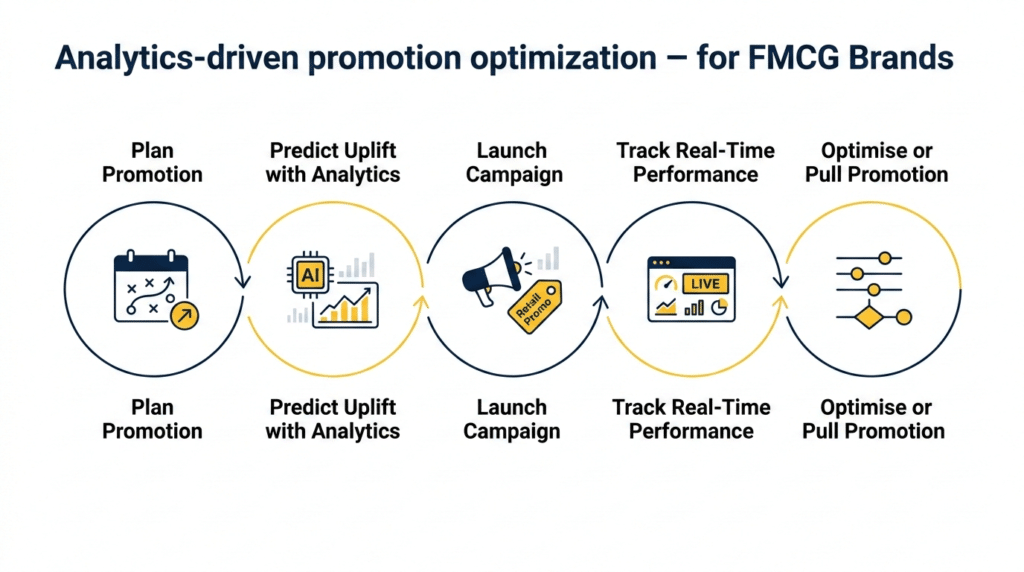
Analytics changes three things about how promotions work. First, it predicts the likely uplift before you spend the budget, so you can decide whether the promotion is worth running at all. Second, it identifies which consumer segments will actually respond to the offer, so you are not subsidising purchases that would have happened anyway. Third, it tracks performance in real time so you can pull underperforming promotions early and reinvest.
4. Consumer Segmentation and Personalization
Today’s FMCG consumer does not behave like a demographic. A 35-year-old in Cairo buys differently from a 35-year-old in Frankfurt, even if they are both buying the same product category. Treating them as the same segment is one of the most expensive mistakes in modern FMCG marketing.
Data analytics allows you to move beyond age and income brackets and segment consumers by actual behaviour — purchase frequency, basket composition, channel preference, and response to promotions. When you know which segment is most loyal, which is most price-sensitive, and which is most likely to trial a new product, you can allocate your marketing budget with precision rather than spreading it broadly and hoping for the best!
5. New Product Launch Risk Reduction
According to Harvard Business School professor Clayton Christensen, nearly 30,000 new consumer products are introduced every year — and 95% of them fail. That’s not a marketing problem. It’s a decision problem. Most of those failures are predictable, and preventable, if the right data is in place before launch.
Consumer insight data gathered at the concept and prototype stage tells you whether there is genuine demand before you have committed manufacturing budget. It tells you whether your packaging is resonating or creating friction. It tells you which market to launch in first and which to hold back.
One FMCG brand we worked with in Egypt used consumer research at the pre-launch stage to validate demand and identify a packaging issue that was creating negative sentiment among their target audience. The packaging was adjusted before launch. That single change turned a likely underperformance into a successful market entry. The cost of the research was a fraction of what a failed launch would have cost.
This is what data-driven NPD looks like in practice — not dashboards for the sake of dashboards, but intelligence that reduces risk at every decision point.
The Three Real Barriers — and How to Move Past Them
1. Your data is fragmented
Most FMCG businesses have data — they just have it in ten different places that do not talk to each other. Sales in one system. Consumer research in another. Promotional performance in a spreadsheet someone built two years ago.
The fix is not a complete technology overhaul. It is starting with the data you already have, unifying it in one place, and establishing a single source of truth for decisions. Start with one business question — demand forecasting, for example — and build from there.
2. The team does not trust the data
This is more common than any analytics vendor will tell you. Managers who have been running on experience for twenty years are not going to change their behaviour because a dashboard says something different. And sometimes they are right to be sceptical — if data quality is poor, the output of any analytics model will be poor too.
The solution is not more technology. It is building trust gradually, through small wins. Run an analytics-informed promotion alongside a traditional one. Compare the results. Let the data make its own case.
3. The cost feels too high to start
The FMCG brands that struggle most with analytics are the ones that tried to do everything at once and stalled. A full enterprise analytics transformation is expensive, slow, and disruptive.
The smarter approach is to identify one high-value problem — usually demand forecasting or promotional ROI — and solve it first with a focused, lower-cost implementation. The ROI from that first project typically funds the next one.
Why This Matters Specifically for the EU and KSA
Both markets are at an inflection point with data and analytics, but for different reasons.
In the EU, the pressure is regulatory and competitive. GDPR has raised the bar on how consumer data is collected and used, which means brands that have invested in clean, compliant first-party data have a structural advantage over those still relying on third-party sources. At the same time, retailer consolidation across Western Europe means FMCG brands have less shelf space and less margin for poorly performing SKUs — analytics is how you prove your value to the retailer with evidence, not just relationships.
In KSA, the pressure is growth-driven. Vision 2030 is reshaping consumer behaviour rapidly, with a younger, more digitally native population increasing spending on premium FMCG categories. The brands that will capture that growth are the ones building their analytics capabilities now, before the market matures and the competitive window narrows.
The challenge both markets share is the middle ground of digital maturity — past the stage of asking whether analytics matters, but not yet at the stage of executing it consistently across the business.
Frequently Asked Questions
What does data and analytics do for an FMCG brand?
Data and analytics turns raw business information — sales figures, consumer behaviour, pricing and supply chain data — into decisions you can act on. In practical terms, it helps FMCG brands forecast demand more accurately, optimise pricing by market and channel, improve promotional ROI, reduce new product launch risk, and understand which consumer segments are most valuable. The goal is to replace assumptions with evidence at every major decision point.
What are the 4 types of data analytics?
The four types are descriptive (what happened), diagnostic (why it happened), predictive (what will happen), and prescriptive (what you should do about it). Most FMCG brands are strong on descriptive analytics — they know their sales numbers — but weak on predictive and prescriptive, which is where the real growth leverage sits.
How is AI different from traditional data analytics in FMCG?
Traditional analytics processes historical data to report on what has already happened. AI-powered analytics does this at far greater speed and scale, and adds the ability to detect patterns across far more variables than a human analyst could manage — for example, correlating weather data, social media trends, and purchase history to produce demand forecasts that update in real time. The output is not more data; it is faster, more reliable decisions.
Where should an FMCG brand start with data and analytics?
Start with the decision that costs you the most money when it goes wrong. For most FMCG brands, that is either demand forecasting (stockouts and overstock) or promotional spend (poor ROI). Pick one, build a clean data foundation for it, and measure the impact. That first win funds the next capability and builds internal confidence in the approach.
How long does it take to see results from a data and analytics investment?
For focused implementations targeting a specific problem — demand forecasting, for example — most FMCG brands see measurable improvements within one to two business cycles, typically three to six months. Full analytics transformations take longer, but the approach of starting with a high-value use case and scaling progressively is specifically designed to generate early returns.
Is data and analytics only for large FMCG companies?
No. The perception that data & analytics requires enterprise-scale investment is outdated. Cloud-based analytics platforms and specialist consultancies have significantly reduced the cost and complexity of entry. Mid-sized FMCG brands in the EU and KSA are increasingly using targeted analytics solutions — focused on specific problems like promotional efficiency or consumer segmentation — and seeing strong returns without needing to build a large in-house data team.
Ready to Put Your Data to Work?
If your FMCG brand is sitting on data but not seeing it translate into better decisions, the gap is usually not more technology — it is the right framework for turning what you already know into actions that move revenue.
Marketeers Research works with FMCG brands across the EU and KSA to build the analytics capabilities that drive real growth — from demand forecasting and pricing optimisation to consumer segmentation and new product launch intelligence. Explore our Data & Analytics services to see how we can help.