

A Comprehensive Guide to Overcoming Channel Fragmentation, Margin Pressure, and Saturated Markets with Data-Driven RGM and Precision Consumer Insights.
Brand growth in 2026 is no longer achieved through isolated marketing campaigns or blunt annual price increases. What was once a manageable play of predictable mass media and linear distribution has evolved into a complex, highly volatile landscape where commercial survival depends on integrating pricing, portfolio strategy, and consumer insights into a unified growth engine.
Global Consumer Packaged Goods (CPG) and Fast-Moving Consumer Goods (FMCG) enterprises face an increasingly challenging economic environment. Persistent inflation, currency volatility, and supply chain adjustments continue to strain corporate margins. Concurrently, AI-driven retail, rapid channel fragmentation, and escalating customer acquisition costs (CAC) are reshaping how modern shoppers discover, evaluate, and purchase products.
The legacy growth playbook—broad demographic targeting, deep periodic discounts, incremental line extensions, and mass-media reach—no longer yields acceptable returns on investment. Driving sustainable brand growth today demands precision pricing, hyper-segmented consumer understanding, and dynamic commercial execution.
5 Growth Barriers Facing Brands in 2026 (And How to Overcome Them)
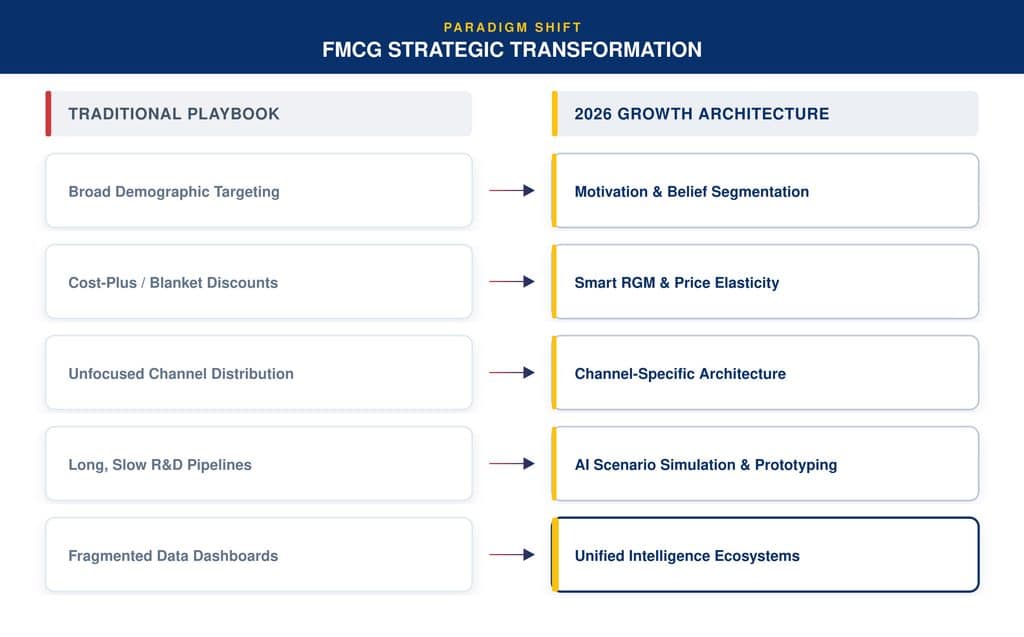
Barrier #1: Evolving Consumer Expectations & Demand Micro-Segmentation
Consumer purchasing behavior has shifted from broad demographic patterns into hundreds of distinct micro-cohorts. Modern demand is heavily shaped by functional wellness, plant-based diets, hyper-localized sustainability, and clean-label credentials.
Shoppers operate with shorter digital attention spans, make emotionally driven purchasing decisions, and rely heavily on digital communities, social proof, and creator endorsement to validate their choices. Broad demographic models (e.g., “Targeting Females 25–40”) fail to capture the underlying psychological drivers that dictate actual conversion.
- Why Legacy Strategies Fail: Organizations relying on surface-level buyer personas or lagging survey data suffer from a persistent “perception gap”—delivering products and marketing messages that miss modern consumer motivations.
- The Strategic Solution:
- Build integrated, 360-degree consumer insight ecosystems that merge real-time behavioral POS data, attitudinal feedback, and transactional histories.
- Transition to motivation- and belief-based segmentation to uncover the exact emotional triggers behind brand preference.
- Implement continuous trend tracking and AI-driven social listening to identify early category shifts before competitors adapt.
Barrier #2: Regional Pricing Complexity & Severe Margin Pressure, How Does it Effect Brand Growth?
Pricing has become the primary operational friction point for global brands, with unique structural challenges impacting major international markets:
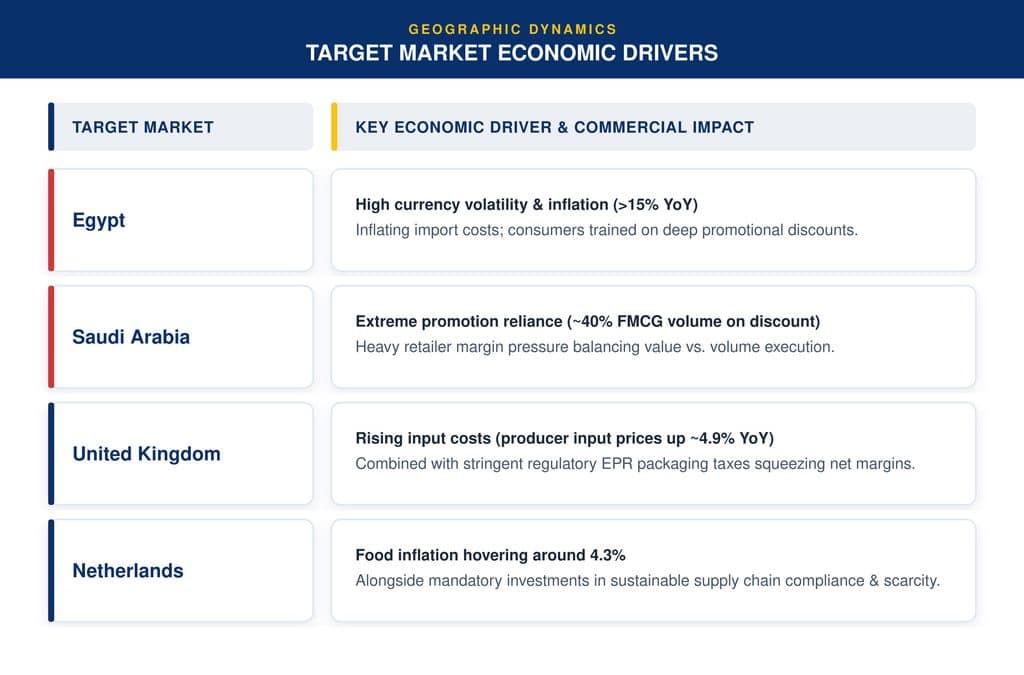
- Why Legacy Strategies Fail: Defaulting to uniform, cost-plus price increases or mirroring competitor moves ignores localized price elasticity, causing sudden drops in sales volume or severe margin dilution.
- The Strategic Solution:
- Deploy the Smart Value™ Platform to execute precision Revenue Growth Management (RGM), tailoring price pack architecture (PPA) across individual channels and geographic regions.
- Shift to value-based pricing models that capture consumer willingness-to-pay based on package convenience, functional benefits, or sustainability factors.
- Build predictive price-elasticity models to simulate volume and revenue trade-offs prior to shelf execution.
- Utilize AI-driven promotional tracking to identify which temporary price reductions drive true incremental margin versus unearned volume lift.
Data Fragmentation & Information Overload
Modern enterprises do not lack data; they lack actionable intelligence. Organizations collect vast amounts of information from POS systems, syndicate panels, consumer surveys, supply chain logs, and digital platforms. However, this data frequently remains locked in disconnected departmental silos.
When finance, marketing, and commercial sales teams operate off conflicting dashboards, decision-making slows down. Under tight deadlines, executives often default to subjective intuition or incomplete metrics.
- Why Legacy Strategies Fail: Fragmented metrics lead to misread market signals, misallocated promotional spend, and delayed responses to competitive moves.
- The Strategic Solution:
- Centralize disparate data assets into a unified commercial analytics ecosystem that provides a single source of truth across all business functions.
- Deploy automated reporting dashboards to eliminate manual spreadsheet consolidation and reduce reporting latency.
- Integrate AI decision-support technology like Smart Value™ to deliver automated recommendations for pricing adjustments, trade promotion spend, and portfolio management.
Barrier #3: Channel Explosion & Shifting Shopper Journeys
The modern shopper journey is non-linear. Consumers transition fluidly between traditional trade, modern supermarkets, direct-to-consumer (D2C) storefronts, social commerce, and quick-commerce platforms—frequently checking prices and reviews in real time on their smartphones while standing in a retail aisle.
Concurrently, the rapid growth of Retail Media Networks (RMNs) has converted retail shelf space into a digital bidding ecosystem. Digital acquisition costs (CPMs and CPCs) continue to climb across both social media channels and retail ad networks, eroding net marketing profitability.
- Why Legacy Strategies Fail: Attempting to execute a single, uniform marketing strategy across all channels inflates acquisition costs and results in poor conversion across digital and physical touchpoints.
- The Strategic Solution:
- Establish channel-specific pricing, packaging, and promotional playbooks designed for the unique shopper expectations and margin structures of each sales channel.
- Optimize product detail pages (PDPs), search taxonomy, and rich content to capture high-intent digital shoppers.
- Apply strict ROI-based measurement frameworks to retail media spend to ensure advertising budgets generate profitable baseline sales growth, not just vanity impressions.
Barrier #4: Category Saturation, Private Label Surge, & Rapid Product Cycles
Established brands face a double-edged competitive threat: major retail chains are expanding high-margin, premium private-label offerings, while agile, digital-native challenger brands enter niche categories at unprecedented speed.
Furthermore, product innovation cycles have compressed dramatically. Trends that previously took years to mature now peak within months, leaving slow-moving brands burdened with obsolete inventory and outdated product lines.
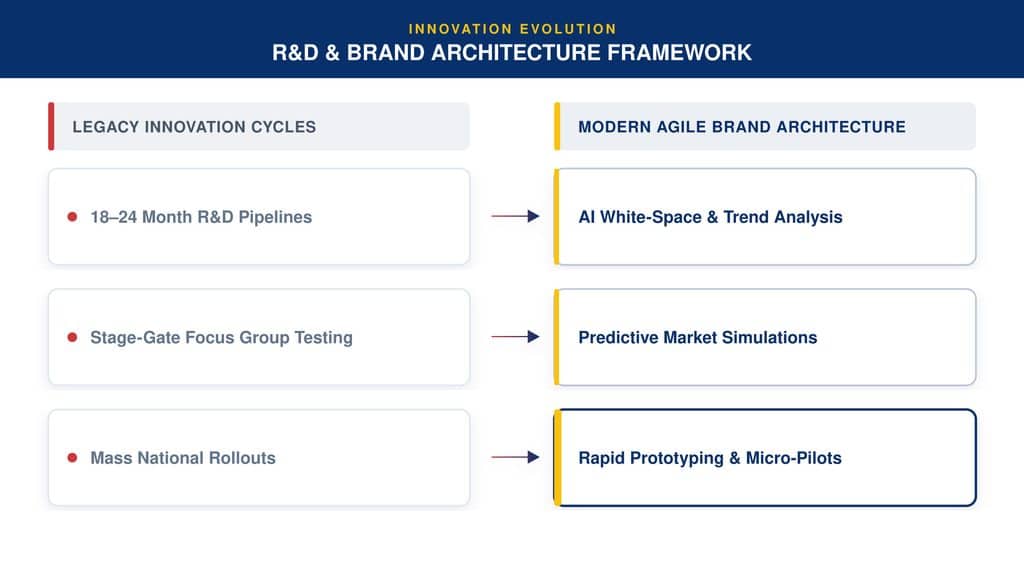
Why Legacy Strategies Fail: Rigid, multi-year R&D stage-gate processes prevent legacy brands from capitalizing on emerging consumer trends before agile competitors dominate the shelf space.
The Strategic Solution:
- Ground pipeline development in real-time market data and social sentiment signals to identify genuine category white spaces.
- Leverage the Smart Shopper™ engine to simulate market reaction, model demand, and validate concepts prior to commercial scaling.
- Implement rapid concept testing and agile prototyping frameworks to shorten go-to-market timelines and minimize innovation failure rates.
Barrier #5: Shift in Retailer Power Dynamics & Trade Margin Demands
Retail consolidation has concentrated market control among a smaller group of powerful global store operators. Equipped with proprietary point-of-sale data, loyalty program insights, and retail media networks, retailers hold distinct leverage in joint business planning (JBP) negotiations.
Retailers increasingly demand higher promotional allowances, guaranteed margin thresholds, and extensive trade support—making distribution maintenance just as challenging as securing initial shelf placement.
- Why Legacy Strategies Fail: Entering retailer negotiations without granular category insights or clear profitability proof leaves manufacturers vulnerable to margin demands or product delisting in favor of private-label alternatives.
- The Strategic Solution:
- Prepare data-rich joint business plans backed by granular category insights to demonstrate how your brand drives total category value, basket size, and shopper frequency.
- Utilize the Smart Value™ and Smart Shopper™ platforms to provide retailers with empirical evidence of promotional efficiency, demand elasticity, and margin optimization.
- Transition commercial discussions from transactional price negotiations to collaborative, insight-led growth partnerships.
Turning Commercial Barriers into Market Leadership
Unlocking sustainable brand growth in 2026 requires moving away from reactive, isolated strategies toward a unified, data-driven commercial infrastructure. The organizations that succeed will be those that integrate pricing strategy, consumer insights, and channel execution into a continuous feedback loop.
By systematically dismantling these five commercial barriers—mastering RGM levers, modernizing segmentation models, streamlining innovation pipelines, and unifying operational data—your enterprise can establish a long-term competitive advantage.
👉 Ready to future-proof your commercial strategy? Explore how Marketeers Research empowers global enterprises with advanced insights, Smart RGM, and the Smart Value™ Platform.