

Why structural supply shifts in Egypt’s poultry sector surface as margin pressures—and how brand leaders can spot early commercial signals before market share erodes.
Driven by currency fluctuations, volatile feed imports, and evolving consumer spending habits, Egypt’s poultry sector is undergoing a major structural transformation. For processors, adjacent food brands, and modern trade channels, this transition alters the entire commercial playbook. When the poultry value chain breaks its traditional baseline, brands that react slowly often suffer unearned margin loss and declining retail velocity.
Navigating the poultry market in Egypt requires tracking how cost and behavioral shocks travel from feed importers down to the final household shopper—allowing leadership teams to pivot pricing, packaging, and channel strategies before market share erodes.
1. Deconstructing the Egyptian Poultry Value Chain: Tier by Tier
To understand why consumer brands experience margin drag, one must trace how cost and behavioral shocks propagate through the five core tiers of the value chain:
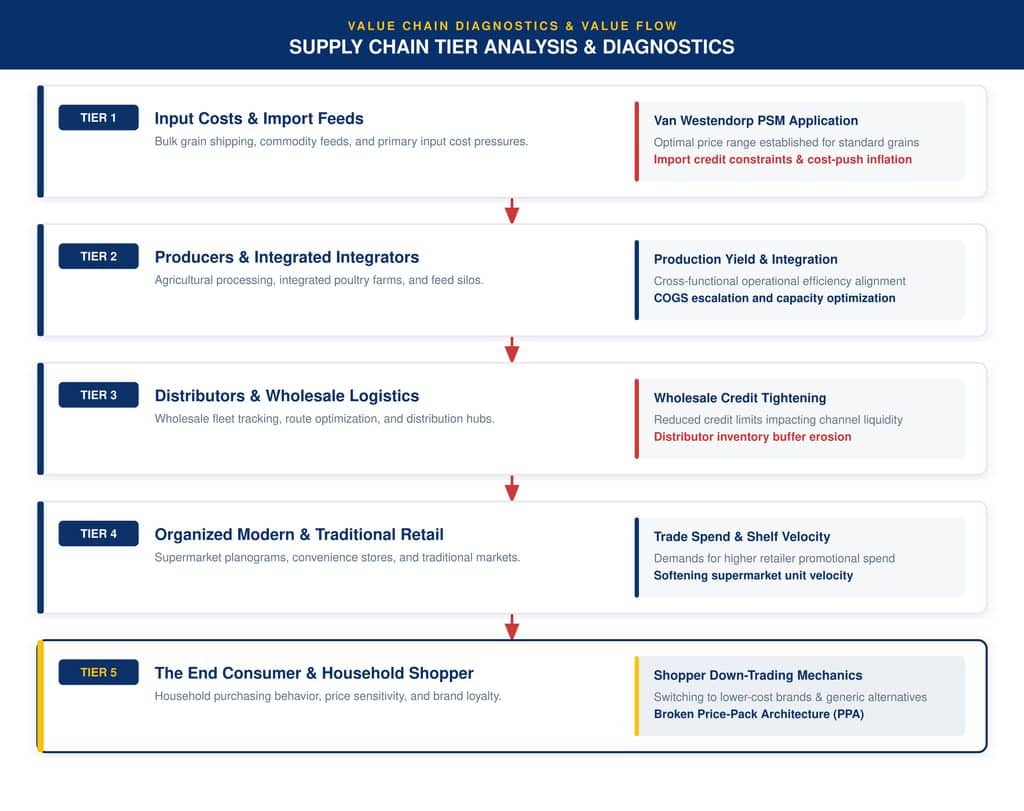
Tier 1: Input Costs & Feed Import Dynamics
The foundation of Egypt’s poultry sector relies heavily on imported soy and yellow corn. Shifts in global commodity markets, foreign exchange liquidity, and customs clearance timelines dictate basic feed availability. When feed costs surge, the immediate financial burden hits hatcheries and feed mills first, setting off a cost wave that ripples down the entire commercial pipeline.
Tier 2: Commercial Producers & Integrators
Facing higher input costs, large-scale commercial integrators and independent farm operators are forced to adjust stocking densities, modify grow-out cycles, or trim operational capacity. These supply shocks alter livestock availability and drive up live-bird gate prices, directly impacting the raw material acquisition costs for packaged poultry processors and downstream food manufacturers.
Tier 3: Distributors & Wholesale Logistics Networks
As raw supply prices rise, cold-chain logistics providers, independent middle-tier brokers, and wholesale distributors face working capital constraints. To maintain their operational cash flow, distributors frequently tighten credit terms with retailers, reduce delivery frequencies to fringe geographic regions, or selectively push higher-margin SKUs while deprioritizing slower-moving brand variants.
Tier 4: Retail Channels (Modern vs. Traditional Trade)
Retailers act as the immediate pressure valve for the value chain. Hypermarkets, supermarket chains, neighborhood bakkals, and wet-market vendors (frargi) experience squeezed margins. Modern trade operators resist supplier price increases to protect foot traffic, leading to delayed listing acceptance or demands for higher trade allowances. Conversely, traditional trade vendors pass cost swings directly to shoppers, causing immediate retail price turbulence.
Tier 5: The End Consumer & Household Shopper
At the terminal end of the chain, household shoppers adapt to price volatility through aggressive behavioral trade-offs. Facing constrained monthly food budgets, Egyptian consumers shift between live-bird markets, unbranded chilled cuts, frozen packaged chicken, and protein alternatives. Understanding this behavioral tipping point is where brand survival is ultimately decided.
2. Why Brands Read Value Chain Shifts Late: Signals Disguised as Cost Problems
When structural shifts ripple through the poultry ecosystem, senior leadership rarely receives an explicit alarm. Instead, early supply-side signals are misdiagnosed as routine operational or financial friction.
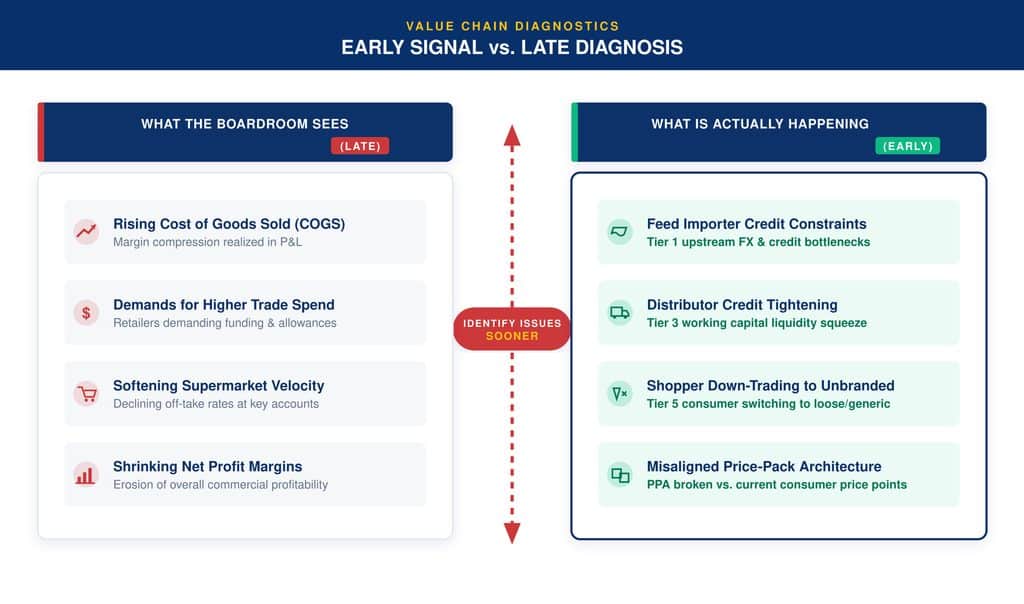
A marketing director notices a 15% increase in Cost of Goods Sold (COGS) and assumes it is a temporary supplier pricing issue. Simultaneously, sales leads report that hypermarkets are requesting additional promotional allowances to maintain shelf placement. The executive team responds with classic defensive tactics: approving short-term trade subsidies or implementing a blanket 10% price increase.
Both responses miss the root cause. The real issue is not merely higher production costs; it is that the value chain has restructured. Shoppers are actively reallocating their disposable income, altering their protein purchasing frequencies, and migrating between retail channels. By treating a systemic value chain shift as a localized cost-plus accounting problem, brands delay strategic action. By the time margin contraction forces a board-level review, the brand has already lost valuable market share to agile competitors who adjusted their price-pack architecture months earlier.
3. The 3 Commercial Exposure Questions Executive Teams Must Answer
To evaluate your brand’s vulnerability during a poultry value chain realignment, leadership must move beyond internal financial statements and answer three diagnostic questions:
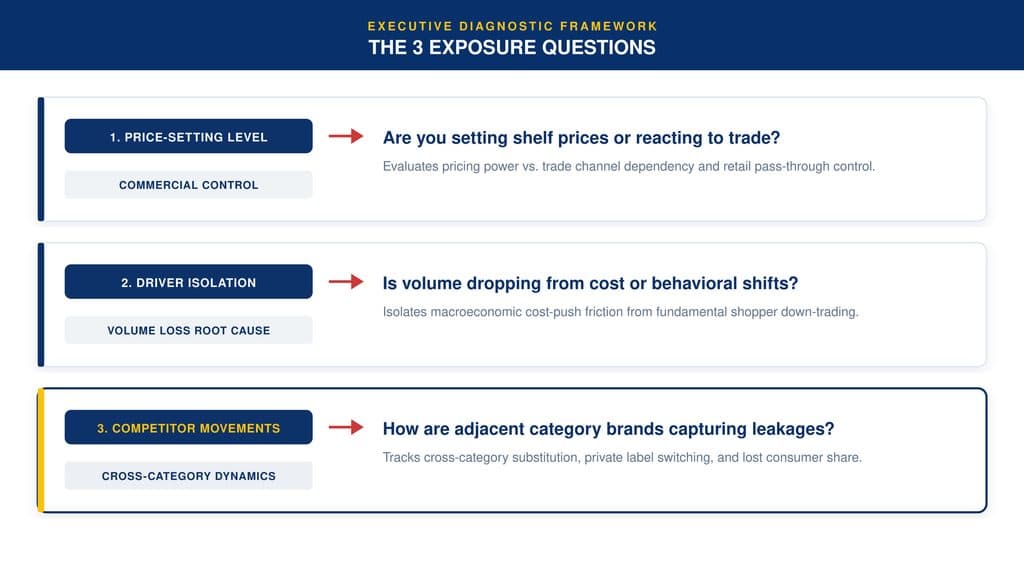
Question 1: At What Level Is Your Shelf Price Actually Being Set?
Are your retail shelf prices governed by your brand’s commercial strategy, or are they effectively being dictated by intermediary distributor margins and retailer markups? If distributors and retail buyers are expanding their own margins to offset rising overhead costs, your end-consumer price may have crossed critical psychological pricing thresholds without your knowledge—destroying consumer demand while your brand realizes none of the price premium.
Question 2: Is Consumer Behavior Changing Faster Than Your Input Costs?
Is your declining sales volume purely a mathematical result of list-price elasticity, or have consumers fundamentally shifted how they use the category? In Egypt’s protein landscape, when packaged fresh chicken prices cross specific affordability barriers, shoppers do not simply buy less—they alter meal preparation habits, stretch meat portions with rice or legumes, switch to frozen imports, or substitute with processed alternatives (such as bouillon, canned goods, or frozen beef SKUs).
Question 3: How Are Competitors and Adjacent Categories Capturing Value Leakage?
While your brand manages margin compression, where is your lost volume flowing? Are low-cost local processors capturing price-sensitive shoppers through reduced package weights? Are private labels gaining traction in modern trade? Or are adjacent category players—such as spice mix manufacturers offering “meat-extending” recipe solutions—capturing consumer spend that previously belonged to raw protein brands?
4. Strategic Action Paths Based on Market Positioning
Once commercial leaders identify how value chain shifts are affecting their category, they must choose an explicit strategic path rather than defaulting to passive price increases:
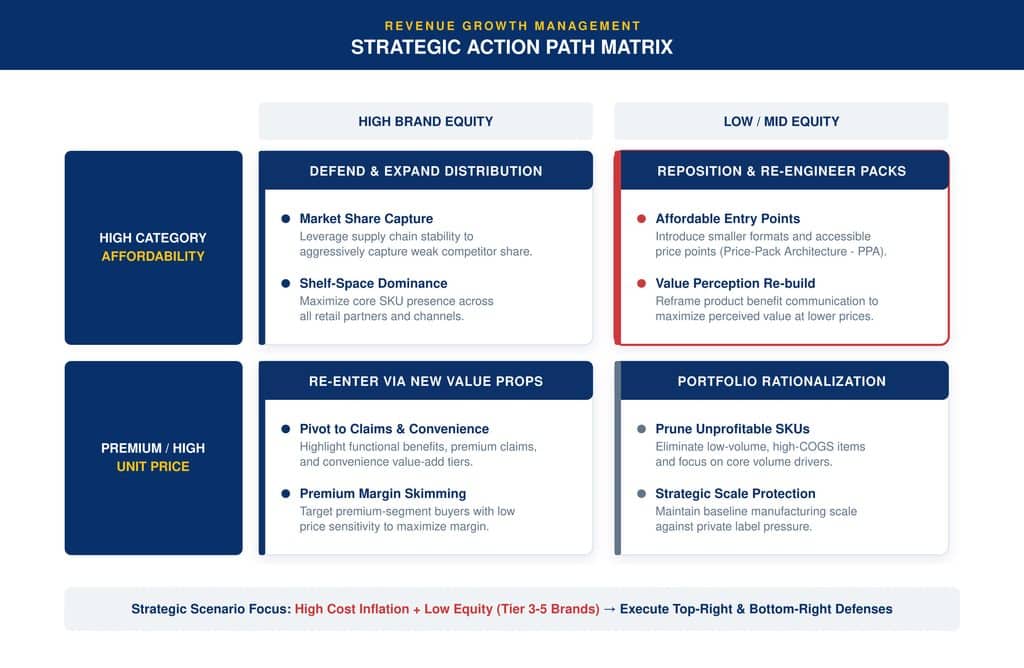
Path A: Hold and Defend Distribution (High Brand Equity, Strong Capital Position)
If your organization possesses integrated supply chain access or strong working capital, market volatility presents an opportunity to capture market share. When unbranded or financially strained competitors pull back distribution due to cash flow pressures, double down on retail coverage. Secure primary shelf placement, lock in Joint Business Planning (JBP) agreements with modern trade retailers, and emphasize brand trust, food safety, and consistent quality to capture displaced shoppers.
Path B: Reposition via Price-Pack Architecture (Mid-Tier Volume Brands)
If your primary shopper demographic is experiencing severe purchasing power erosion, direct price increases will trigger steep volume losses. Instead, re-engineer your packaging strategy. Introduce single-serve portions, smaller weight variants (e.g., shifting from 900g to 700g packs), or value-add family bundles that preserve accessible price points on retail shelves while protecting gross margin per kilogram.
Path C: Re-Enter Categories with New Value Propositions (Premium & Processed Brands)
When raw protein prices reach historic highs, premium packaged poultry brands must justify their price premium through functional differentiation. Pivot marketing communications from generic quality claims toward explicit consumer value drivers: recipe versatility, extended shelf life, zero wastage, or time-saving convenience. Alternatively, introduce entry-level value lines designed to re-engage price-sensitive households who have temporarily exited the premium segment.
5. The Critical Insights Required for Confident Execution
Navigating value chain turbulence without empirical market data introduces unneeded commercial risk. Making strategic choices requires clear visibility across three intelligence layers:
- Live Cross-Elasticity & Price Perception Thresholds: Understanding the exact price points where shoppers abandon packaged poultry for alternative protein categories or unbranded formats.
- Channel-Specific Retail Velocity Tracking: Real-time visibility into how inventory moves across modern trade, traditional outlets, and quick-commerce platforms—allowing commercial teams to reallocate trade spend toward high-performing channels.
- Shopper Trade-off Mapping: Quantitative clarity on how Egyptian households are adjusting meal planners, brand loyalty, and shopping frequency in response to broader macroeconomic shifts.
Strategic Resources & Category Insights
To deepen your commercial planning across pricing, revenue growth management, and consumer intelligence, explore these analysis guides from the Marketeers Research Knowledge Hub:
- Decode Consumer Value Perception: Explore How FMCGs Tap into Consumers’ Minds with Psychological Pricing to understand price perception, left-digit bias, and value gap analysis.
- Align Commercial Architecture: Read The Art of Revenue Growth Management (RGM) for Maximum Impact to integrate pricing, trade terms, and distribution planning.
External Industry Benchmarks
- Monitor macroeconomic trends, currency indices, and inflation data on the Central Bank of Egypt Data Center.
- Review national research standards for market analysis on CAPMAS.
Protect Your Brand’s Margin and Market Share
Structural shifts within the poultry value chain don’t have to result in unearned margin erosion or lost distribution. By identifying early market signals, measuring real consumer price perception, and adapting your commercial architecture with precision, your brand can navigate industry realignment with confidence.
👉 Ask us what this value chain shift means for your specific brand and category.