

How Precision Price Elasticity, Advanced Data Architecture, and Empirical Scenario Simulations Drive Sustainable Enterprise Profitability in Volatile Markets.
The modern Consumer Packaged Goods (CPG) and Fast-Moving Consumer Goods (FMCG) landscape operates in a permanent state of volatility. Commercial directors and Revenue Growth Management (RGM) leads face compounding operational pressures: persistent currency devaluations across emerging markets, raw material input cost spikes, aggressive retail consolidation, and shifting consumer price sensitivities. In this environment, relying on legacy pricing mechanisms—such as blanket percentage price increases or retroactive cost-plus calculations—inevitably leads to volume erosion and brand dilution.
To maintain market leadership and defend profit margins, forward-thinking enterprises deploy Revenue Growth Management (RGM) as a continuous, tech-enabled commercial capability. While RGM encompasses multiple growth levers—including trade terms, promotional effectiveness, price-pack architecture (PPA), and assortment mix—pricing remains the single most impactful lever for driving immediate top-line revenue and bottom-line operating margin expansion.
According to global commercial benchmarks compiled by McKinsey & Company, a 1% improvement in price realization yields an average 8% to 11% increase in operating profit—an impact far greater than an equivalent 1% increase in sales volume or reduction in variable costs. Yet, achieving this precision requires moving away from gut-feel decision-making toward an evidence-based, data-driven pricing architecture.
The Operational Reality: Navigating Pricing in a VUCA Market
In a Volatile, Uncertain, Complex, and Ambiguous (VUCA) commercial environment, setting shelf prices is no longer a static yearly exercise. When macroeconomic shifts occur—such as steep inflationary waves or foreign exchange liquidity squeezes—the gap between objective product cost and consumer value perception widens rapidly.
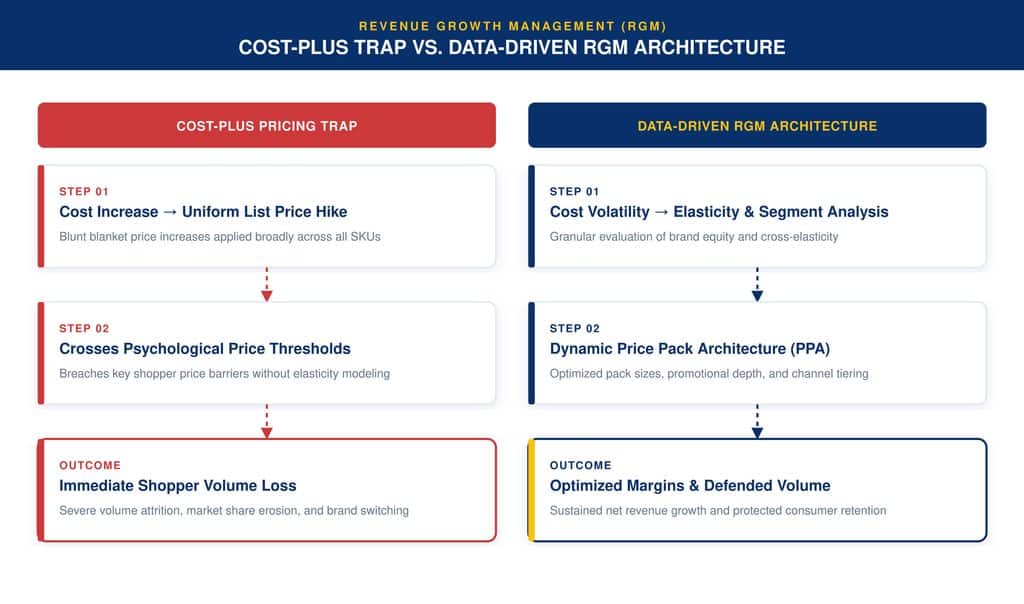
The Failure of Cost-Plus Hikes
When costs rise, the default response for many manufacturers is a uniform, portfolio-wide price increase. However, this blunt approach triggers severe market friction:
- Breaching Psychological Thresholds: Uniform increases frequently push core SKUs over critical consumer price anchors (e.g., crossing from 19.99 to 24.50 in local currency), triggering immediate demand drop-off or category exit.
- Accelerating Down-Trading: Highly price-sensitive consumers immediately switch to lower-cost local alternatives or retailer private-label brands.
- Unearned Margin Loss: Leaving premium, price-inelastic SKUs underpriced while over-pricing price-sensitive staple SKUs leaves substantial gross margin on the table.
To avoid these pitfalls, enterprise commercial teams must evaluate how distinct consumer segments react to price adjustments across individual SKUs and retail channels.
The 5 Levers of Revenue Growth Management (RGM)
Executing a comprehensive RGM strategy requires orchestrating five interconnected commercial levers, with pricing acting as the core anchor:
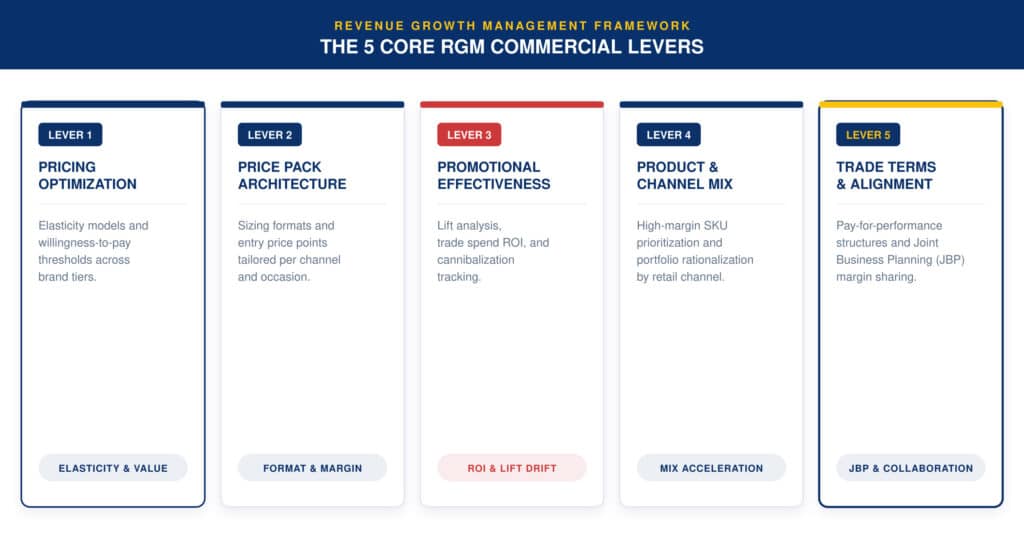
1. Strategic Pricing Optimization
Pricing optimization involves establishing list prices based on empirical price elasticity curves and willingness-to-pay (WTP) metrics rather than internal accounting targets. By understanding cross-price elasticity—how a price change in “Product A” impacts volume in “Product B” or a primary competitor’s offering—brands can capture maximum margin without sacrificing baseline volume.
For an in-depth breakdown of cognitive framing and left-digit bias in retail, explore our analysis on How FMCGs Tap into Consumers’ Minds with Psychological Pricing.
2. Price Pack Architecture (PPA)
PPA matches product packaging sizes, formats, and price points to specific shopper purchasing occasions and channel realities. Rather than increasing list prices on standard packages, PPA re-engineers product weight and fill formats:
- Entry-Level Magic Price Points: Single-serve, smaller weight formats designed for cash-constrained shoppers nearing the end of their pay cycles.
- Bulk & Value Bundles: Larger multi-packs designed for higher-income households seeking lower cost-per-unit yields while protecting manufacturer dollar margins.
To explore how tailored pack structures defend volume during inflationary cycles, read Supercharging FMCGs with Tailored Pricing Strategies.
3. Promotional Effectiveness & Trade Spend
Promotions account for one of the largest balance sheet expenditures in CPG, yet industry studies indicate that up to 50% of trade promotions fail to generate positive net ROI. Advanced RGM frameworks replace blanket discounts with targeted promotional mechanics that drive true incremental volume lift rather than simply subsidizing baseline sales.
4. Product & Channel Assortment Mix
Not all revenue is equal. Optimizing assortment mix ensures high-margin SKUs receive primary shelf placement and trade investment across high-growth distribution channels, such as e-commerce, quick-commerce, and modern hypermarkets.
5. Trade Terms & Joint Business Planning (JBP)
Modern RGM aligns manufacturer trade terms with retailer performance. By structuring pay-for-performance agreements around category growth, shelf compliance, and promotional execution, brands build collaborative partnerships with retail buyers instead of engaging in destructive margin battles.
Learn how to navigate modern channel expansion and retailer power shifts in Brand Growth Strategies: Navigating Market, Consumer, and Pricing Barriers.
Big Data, Artificial Intelligence, and Empirical Pricing
To transition RGM from a retroactive financial auditing exercise into a forward-looking decision engine, companies are investing heavily in data analytics, Artificial Intelligence (AI), and Machine Learning (ML).
Industry surveys show that many leading CPG enterprises prioritize investments in AI and ML specifically to enhance RGM analytics and predictive forecasting.
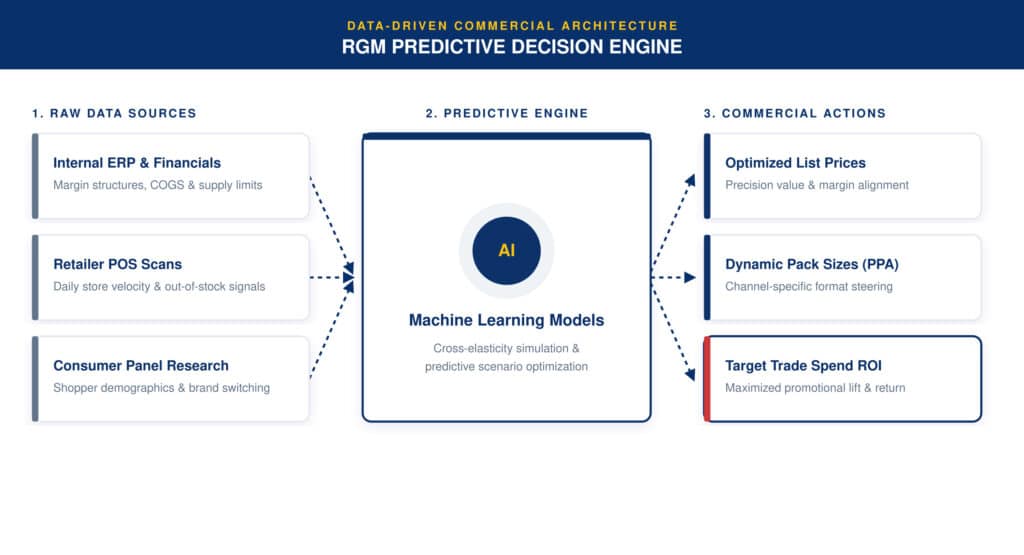
From Retrospective Reports to Predictive Scenario Modeling
Traditional business intelligence tools answer historical questions: What was our net revenue last quarter? Modern AI-driven RGM platforms answer forward-looking commercial questions: What will happen to our total volume, gross margin, and retailer share if we decrease package weight by 8% while raising list price by 3% in modern trade?
By utilizing predictive analytics, revenue managers can run hundreds of virtual market simulations before executing changes on the physical shelf, significantly de-risking commercial strategies.
The Value of Experimental Research and In-Market Testing
While machine learning models provide rapid baseline forecasts, validating pricing decisions requires empirical consumer research. Integrating historical Point-of-Sale (POS) data with primary market research—such as Discrete Choice Conjoint Analysis and virtual shelf testing—allows commercial teams to measure actual consumer trade-off behaviors across competing brand choices.
To understand how primary behavioral research uncovers deep shopper motivations, read What a Usage & Attitude Study Actually Tells You About Consumers.
To ensure research validity and ethical data governance, enterprise research frameworks must adhere to international quality standards, such as the guidelines established by ESOMAR World Research Standards.
Overcoming Implementation Challenges in Enterprise RGM
Implementing a mature, 360-degree RGM program across a CPG organization involves navigating several structural hurdles:
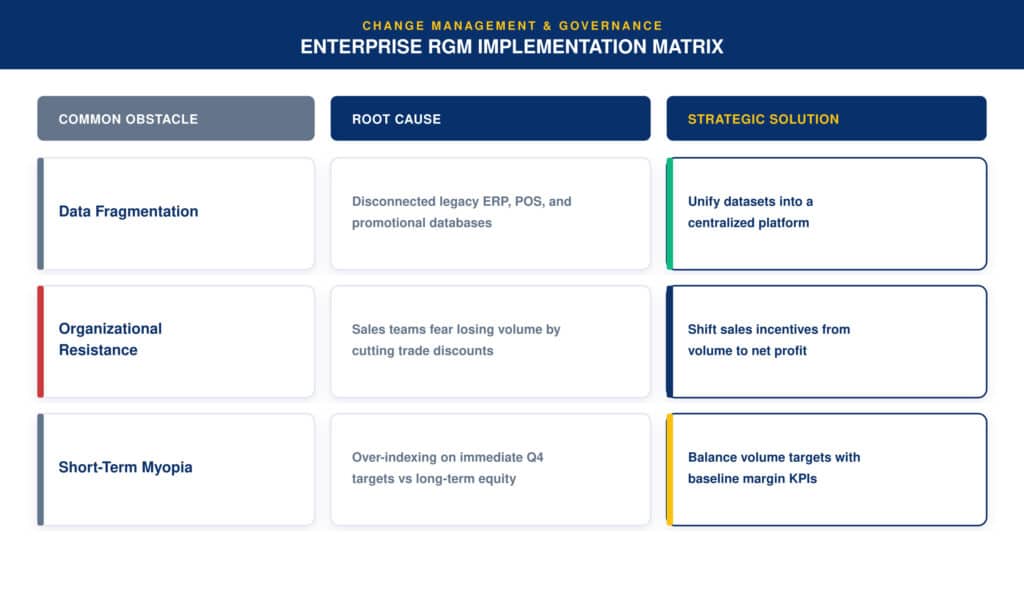
- Eliminating Internal Data Silos: Finance, sales, and marketing departments frequently operate on conflicting spreadsheets. Centralizing internal commercial records and external panel data into a single source of truth ensures cross-functional alignment.
- Aligning Incentive Structures: If commercial sales teams are compensated purely on gross sales volume rather than net profit contribution, they will resist price increases and over-index on promotional discounts. Incentive structures must align with net margin goals.
- Tracking Regional Macroeconomic Indicators: In volatile regions, pricing architectures must respond to macro trends. Teams should regularly audit economic indicators, price indices, and currency updates from authoritative bodies like the Central Bank of Egypt Data Center or regional statistical agencies to adjust inflation-linked pricing models proactively.
Drive Sustainable Revenue Growth with Marketeers Research
Mastering Revenue Growth Management requires the right balance of empirical data, predictive technology, and strategic expertise. The Smart Value™ Platform from Marketeers Research provides an end-to-end commercial decision engine designed to help CPG/FMCG leaders optimize pricing, protect margins, and accelerate sustainable growth.
By combining AI-powered predictive modeling, conjoint price testing, and unified data architecture, our platform enables your enterprise to:
- Model exact price elasticity thresholds and cross-elasticity impacts across your portfolio.
- Test proposed Price-Pack Architecture (PPA) adjustments in simulated retail environments.
- Maximize trade spend ROI by identifying and eliminating margin-dilutive promotions.
- Unify sales, marketing, and finance teams around a single source of commercial truth.
Transform Your Pricing Architecture Today
Stop relying on retrospective reporting or uniform cost-plus price hikes to protect your margins. Validate consumer elasticity, simulate market scenarios, and unlock the full potential of your portfolio.