

Modern Fast-Moving Consumer Goods (FMCG) organizations are no longer starved for information. Between Point-of-Sale (POS) scanners, distributor portal metrics, syndicated retail audit feeds, and e-commerce channel statistics, commercial leaders are navigating an unprecedented volume of market signals. Yet, despite massive investments in enterprise software, a fundamental challenge remains: having access to data is not the same as making the right business decision.
For executive leadership, the value of data analytics in FMCG does not lie in building more complex dashboards or accumulating isolated metrics. The real competitive advantage emerges when data is organized directly around high-stakes commercial choices—such as optimizing portfolio margins, reallocating trade spend, or calculating price elasticity.
When analytics platforms operate without clear alignment to commercial execution, teams end up drowning in descriptive metrics (what happened) while missing the critical predictive intelligence (what to do next). Transitioning from passive performance measurement into an active decision engine is what separates market leaders from reactive brands in fast-moving regional markets.
The Shift from Dashboard Overload to Decision-Led Data Analytics
In many enterprise commercial teams, a common paradox unfolds: analysts spend up to 80% of their time aggregating disparate datasets, leaving only 20% for strategic interpretation. This operational lag frequently results in missed sales windows, misallocated promotional budgets, and slow responses to shifting consumer demand.
To drive sustainable category growth, forward-thinking brands are shifting away from technology-first analytics toward a decision-led framework. Instead of asking “What data do we have?”, commercial leaders must ask “What business choice are we trying to resolve today?”
Organizing FMCG data analytics around strategic decisions rather than technology stacks allows teams to:
- Eliminate Analytical Friction: Filter out vanity metrics and focus exclusively on data that directly influences gross margins, volume lift, or shelf share.
- Accelerate Go-To-Market Speed: Replace weekly spreadsheet reconciliations with decision-ready frameworks that enable rapid commercial pivots.
- Protect Operating Margins: Evaluate price sensitivity and trade spend efficiency before committing capital to channel execution.
By establishing a structured, decision-first architecture, commercial teams can reliably transform raw consumer signals into profitable growth. Discover how our Data Analytics Service turns complex market data into clear strategic direction through custom enterprise solutions..
Why FMCG Decision-Makers Need Decision-Led Analytics
In an era of rising inflation, volatile supply chains, and fragmented media channels, the margin for error in consumer goods is razor-thin. According to global research by McKinsey & Company, commercial teams that effectively embed advanced analytics into their core decision-making processes routinely achieve an EBITDA increase of 10% to 20%.
Despite this potential, many brands struggle to extract measurable value from their software stacks. The disconnect often stems from viewing data as a passive reporting mechanism rather than a proactive commercial driver.
Standard reporting tools tell you that a specific SKU lost 5% market share last quarter in a key retail account. Decision-led analytics, on the other hand, isolates the root cause—identifying whether the drop was caused by a competitor’s promotional depth, an out-of-stock issue, or a shift in consumer price sensitivity—and prescribes the exact commercial adjustment needed to recover volume.
Transitioning to a decision-centric model requires aligning business analytics in FMCG across three operational tiers:
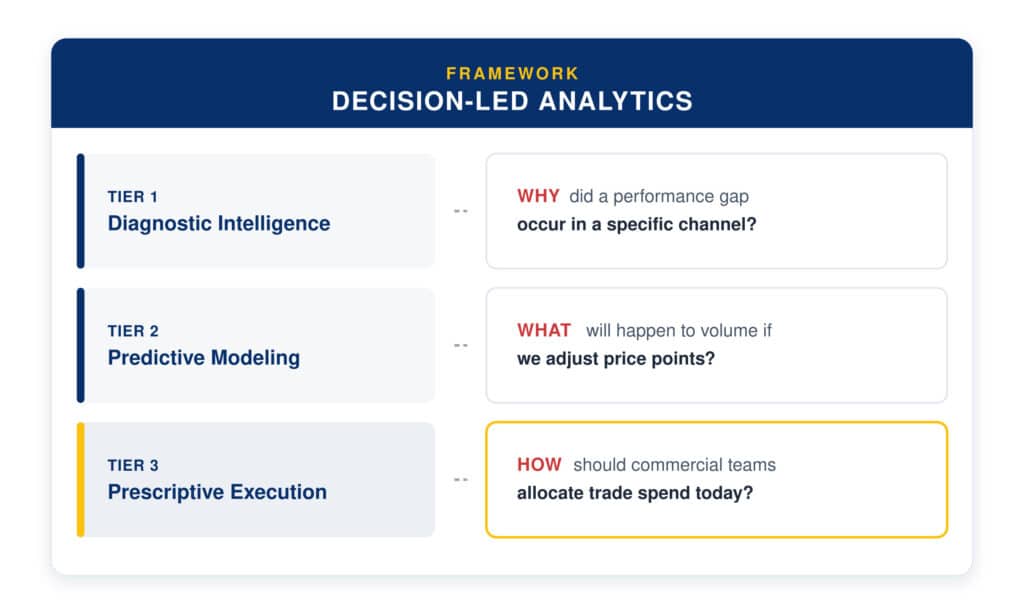
When commercial organizations organize their analytics capabilities around concrete business choices, they eliminate spreadsheet clutter and enable rapid, high-yield execution. For a deeper look at moving beyond static dashboards, read our guide on data analytics in FMCG: from performance measurement to decision engine.
Core FMCG Decision Framework: Analytics Applied by Business Choice
To understand the real-world impact of FMCG data analytics, we must evaluate how enterprise data directly resolves high-stakes commercial choices across key operational areas.
1. Portfolio & Assortment Decisions: What to Launch, Keep, or Rationalize
Managing an extensive portfolio of Stock Keeping Units (SKUs) is a constant balance between capturing category growth and protecting operating margins. NielsenIQ’s analysis of U.S. product launches found that only 30% sustain or grow their sales from year one into year two, meaning they retain at least 90% of their year-one sales. The other 70% lose ground, often due to poor shelf positioning or cannibalization of existing brand offerings.
The Commercial Decision
Brand managers and category leaders must answer critical portfolio questions:
- Which SKUs contribute true incremental volume to the category versus merely cannibalizing existing sales?
- Where are the clear “white spaces” in retail channels for new product line extensions?
- Which underperforming SKUs should be rationalized to free up capital and supply chain capacity?
How Analytics Serves the Decision
By combining Point-of-Sale (POS) data, distributor inventory logs, and consumer panel tracking, advanced analytics models evaluate SKU performance across channel-specific environments. Rather than evaluating sales in isolation, algorithmic assortment optimization measures the incrementality index of every item in the portfolio.
Real-World Impact
Commercial teams can systematically prune low-margin SKUs while optimizing store-level planograms, ensuring that every centimeter of shelf space yields maximum gross profit.
2. Pricing & Revenue Growth Management (RGM): How to Price Without Sacrificing Volume
Pricing is the single most powerful lever for driving profitability in fast-moving consumer goods. However, aggressive price increases implemented to offset inflation can trigger severe volume loss if executed without granular elasticity modeling.
The Commercial Decision
Revenue Growth Management (RGM) teams face high-stakes pricing questions:
- What is the precise price elasticity threshold for our flagship product line across different retail tiers?
- How far can we adjust price points before consumers switch to private label alternatives or low-cost competitors?
- What is the optimal price gap to maintain against major category rivals?
How Analytics Serves the Decision
Leveraging predictive business analytics in FMCG allows RGM teams to run cross-elasticity simulations prior to executing shelf price adjustments. By analyzing historical price changes alongside macroeconomic factors (such as regional inflation rates and disposable income fluctuations), machine learning algorithms project volume outcomes for various pricing scenarios.
Real-World Impact
Brands can confidently adjust price points to protect margins during inflationary cycles, minimizing consumer churn and avoiding costly price wars. To explore how advanced data modeling accelerates commercial expansion, read our insights on data-driven growth strategies for businesses and the role of data analytics in FMCG.
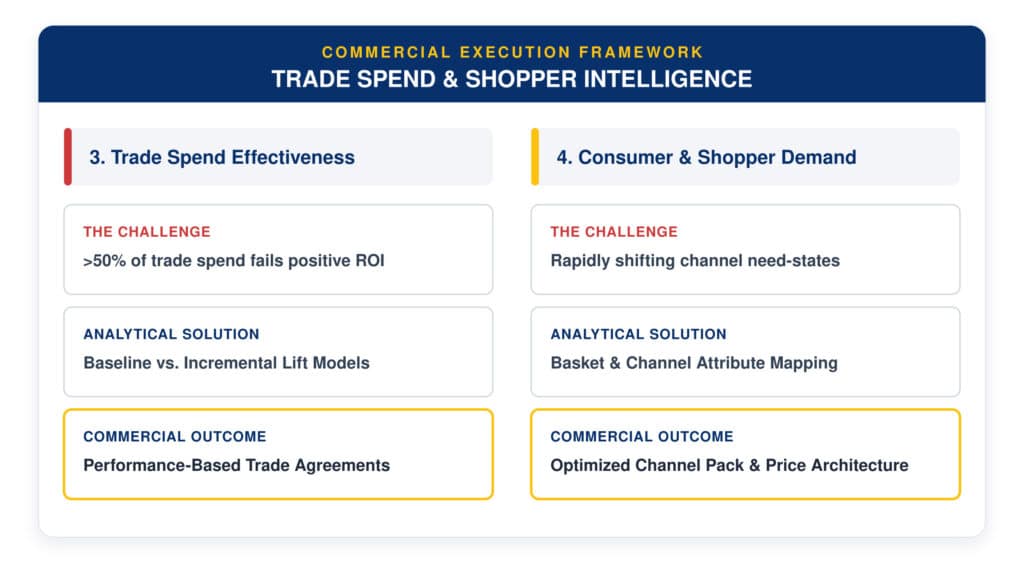
3. Trade Spend & Promotional Effectiveness: Where to Allocate Commercial Budget
Trade promotions represent one of the largest expenditures on an FMCG income statement, often accounting for 10% to 20% of total gross revenue. However, industry benchmarks from Gartner reveal that over 50% of trade promotional spend fails to generate positive net ROI, frequently subsidizing purchases that consumers would have made anyway at full price.
The Commercial Decision
Commercial, sales, and trade marketing teams need to evaluate promotional efficiency:
- Which promotional mechanics (e.g., “Buy One Get One”, temporary price reductions, or multi-packs) deliver true incremental volume lift versus baseline subsidization?
- Are trade spend discounts being passed through to end consumers by retail partners, or absorbed into retailer margins?
- How can commercial teams reallocate promotional budgets from underperforming accounts to high-converting channels?
How Analytics Serves the Decision
By isolating baseline sales from promotional uplift using automated decomposition algorithms, FMCG data analytics allows commercial leaders to measure the net profit impact of every historical campaign. Predictive models simulate future promotional calendar scenarios, projecting volume lift, trade margin split, and net financial return prior to signing retail agreements.
Real-World Impact
Trade marketing teams transition from flat annual promotional allowances to dynamic, performance-based trade agreements—stopping margin leakage and maximizing net commercial return.
4. Consumer Demand & Shopper Insights: How to Win at the Point of Sale
Consumer purchasing habits across regional markets are shifting faster than ever due to channel fragmentation, digital adoption, and macroeconomic pressures.
The Commercial Decision
Category managers and trade strategists must resolve core execution choices:
- What specific shopper need-states drive brand switching within primary retail channels?
- How are shifting shopping frequency patterns altering basket sizes across hypermarkets, modern trade, and traditional corner stores?
- Which product attributes (e.g., pack size, price tier, health claims) are growing fastest in specific geographic territories?
How Analytics Serves the Decision
Integrating consumer panel tracking, basket analysis, and location-based channel data enables brands to map changing shopper behaviors at granular levels. To see how forward-thinking brands leverage automated intelligence to optimize revenue streams, read our roadmap on the role of AI & data analytics in FMCG growth and revenue optimization.
Real-World Impact
Commercial leadership can align product availability, pack formats, and point-of-sale messaging directly with real-world consumer triggers, securing store-level execution that maximizes conversion.
Bridging Raw Signals and Strategic Execution
Collecting clean POS feeds, syndicated market data, and consumer panel logs is only half the battle. The true differentiator for enterprise FMCG brands is translating those complex inputs into intuitive, decision-ready frameworks that commercial teams can act on immediately.
When data analytics remains trapped inside IT or data science silos, execution slows down. Commercial leaders need insights presented in the language of the business—margins, volume lift, share points, and trade ROI.
Marketeers Research bridges the gap between raw data ingestion and high-stakes commercial execution. Discover how our Data Analytics Service turns complex market data into clear strategic direction through custom enterprise solutions.
Frequently Asked Questions (FAQ)
Q1: What is the primary difference between traditional reporting and decision-led data analytics in FMCG?
- Answer: Traditional reporting focuses on descriptive metrics—tracking what happened in past sales cycles (e.g., historical volume declines or revenue totals). Decision-led analytics organizes data around active commercial choices, providing diagnostic, predictive, and prescriptive answers to resolve upcoming strategic dilemmas like price adjustments or SKU rationalization.
Q2: How do FMCG brands measure the ROI of investing in advanced business analytics?
- Answer: ROI is evaluated through direct commercial outcomes: reduced trade spend leakage, optimized inventory holding costs, improved promotional lift, and protected operating margins during inflationary pricing cycles.
Q3: Which departments benefit most from specialized FMCG data analytics frameworks?
- Answer: While Revenue Growth Management (RGM) and sales teams rely on analytics for pricing elasticity and trade spend optimization, brand managers use them for portfolio assortment decisions, and supply chain leaders leverage them for real-time demand forecasting.
Technology is the vehicle, but commercial decisions are the destination. Accumulating massive software stacks and sprawling dashboards will not protect operating margins or drive sustainable category growth.
By organizing data analytics around high-stakes commercial choices—such as precise assortment management, elastic pricing guardrails, and efficient trade spend allocation—FMCG brands can transform raw market signals into a permanent competitive advantage.
Ready to transition your organization from reactive reporting to proactive decision-making? Contact the Marketeers Research team today to discuss a custom analytics roadmap tailored to your commercial goals.