
Apple’s business success is not an accident. It is the result of years of planning and marketing tactics that truly move the needle. These strategies are not only about selling high-value goods; they are methodologies that have been tested repeatedly and have ultimately contributed to Apple’s remarkable success.
In this blog, we’re going to explore how Apple’s mastery of Psychological biases has played a key role in its business success. We’ll examine how Apple applies its understanding of consumer behavior and psychological strategies in its marketing efforts to influence purchasing decisions and drive sustainable growth. We’ll focus specifically on Apple’s psychological bias mastery, as research shows that using cognitive bias strategies can lead to a 37% boost in conversions, according to the American Marketing Association.
Apple’s Consumer Behavior Understanding Processes
Apple uses several processes to understand consumer behavior, allowing the company to gain deeper insights into customers’ preferences and pain points. Apple leverages various tactics to better understand its audience, such as using data analytics across its ecosystem and collecting ongoing insights through support channels. These efforts help Apple continuously improve its products and experiences, creating powerful and targeted customer interactions.
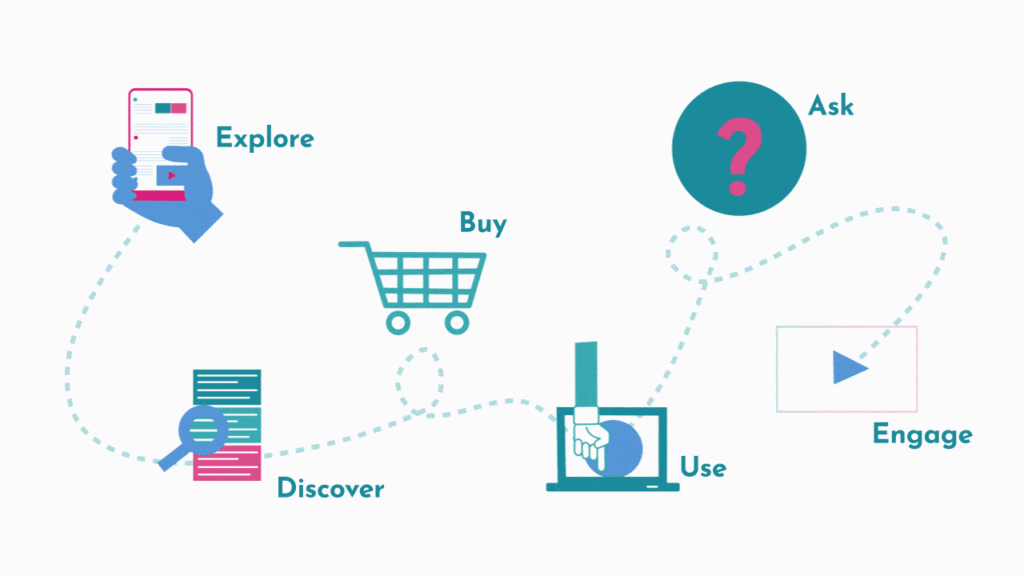
Below are some of the key processes Apple uses to understand consumer behavior:
CSAT Surveys (Customer Satisfaction Surveys)
As part of Apple’s efforts to create tailor-made experiences for its audience, the company leverages feedback and satisfaction surveys as measurement tools to assess customer behaviors and expectations. Conducting these surveys is critical for gaining a clear understanding of consumers’ needs, maintaining high levels of customer satisfaction, and building long-term brand loyalty.
Analysis of Audience Feedback
As mentioned above, Apple uses customer satisfaction surveys to better understand what its audience likes and dislikes. After collecting feedback, Apple analyzes the data to identify trends, improvement areas, and customer pain points. For instance, this feedback can lead to software updates, issue resolution, and the introduction of new features based on customer requests.
In addition to survey feedback, Apple also collects feedback from its stores. This in-store feedback is used to further train employees, refine service quality, improve products, and enhance the overall customer experience.
Listening Attentively to Customer Concerns
Apple places a high priority on listening attentively to its customers. Communication and feedback are embedded into Apple’s culture, making them integral to its customer understanding and essential for ongoing development and innovation.
Apple’s Cognitive Bias Techniques
Apple uses several psychological bias techniques, each designed to influence consumer behavior in ways that support business success.
These techniques include:
Endowment Effect
Apple allows customers to interact with products freely in its stores. Showrooms are open to visitors, and customers are encouraged to try devices on display. Apple trains staff not to rush consumers or limit their experience in any way. As a result, customers begin to feel a sense of ownership. This perceived ownership increases product evaluation and strengthens the desire to purchase.
This effect can also be explained by loss aversion: the longer a customer interacts with a product, the harder it becomes to let go of it.
Takeaway: To avoid the endowment effect, focus on your actual needs, evaluate the item objectively, and consider the product’s real value rather than the emotional attachment created during the experience.
Status Quo Bias
Many Apple customers remain loyal to Apple products because they feel comfortable with the ecosystem and are resistant to change. A behavioral pattern often referred to as “Apple addiction” has been linked to high dependence on Apple devices, such as the iPhone. This makes it difficult for consumers to switch to other products, reinforcing long-term loyalty.
This loyalty, built over years, has contributed to Apple becoming one of the most influential companies in the world.
Takeaway: To avoid status quo bias, increase your awareness by evaluating all available options carefully. This will help you avoid choosing the default option simply because it feels familiar. In these cases, it’s also better not to attach a product to personal status or identity.
Anchoring Bias: Influencing Shoppers with Apple’s Pricing Secrets
Anchoring bias is the tendency to rely heavily on the first piece of information encountered (the “anchor”) when making decisions. This bias can strongly influence pricing perceptions and consumer evaluations.
Apple effectively uses anchoring by introducing premium-priced products before presenting more affordable options, shaping consumer expectations and influencing purchasing decisions.
(Source: CNBC)
Takeaway: To counter anchoring bias, emphasize your offer’s value and avoid irrelevant comparisons. You can also set higher initial prices and then offer discounts to create a strong reference point.
Scarcity Bias: Driving Apple’s Sales
Scarcity bias is most effective on people who experience FOMO (fear of missing out). It increases the perceived value of products that appear limited in availability. Apple uses scarcity marketing by limiting product quantities to generate hype and exclusivity, often using time-based tactics such as limited-time promotions and discounts.
(Source: Markettailor)
Takeaway: You can leverage scarcity by offering limited-edition products or emphasizing limited supply to encourage faster purchasing decisions.
Social Proof Bias: Apple Marketing’s Role in Building Trust
Social proof is a psychological tendency where individuals mimic the actions of others, believing those actions represent the correct or desirable choice. Apple frequently leverages this tendency by featuring celebrities and specific user groups—such as developers or artists—in its marketing campaigns. This reinforces the association between success, status, and Apple’s products.
(Source: Medium)
Takeaway: Social proof is a powerful tool for marketers. Use testimonials, user reviews, and expert endorsements strategically to build trust and influence consumer choices.
Availability Bias: Apple’s Winning Marketing Tactic
Availability bias influences decision-making by making outcomes seem more likely based on readily available information rather than objective data or statistics. Apple maintains strong availability in consumers’ minds through extensive advertising and media coverage, ensuring its products remain top-of-mind when customers make purchase decisions.
Takeaway: Through effective marketing, customer reviews, and word-of-mouth recommendations, you can make positive product information easier to access and strengthen brand connection—helping you leverage availability bias.
This table summarizes the cognitive biases that define Apple’s confirmation bias mastery. From the endowment effect to availability bias, it highlights how Apple leverages psychological principles to influence consumer behavior, along with practical strategies you can apply to your own marketing efforts.
| Cognitive Bias | How Apple Uses It | Marketing Takeaways |
|---|---|---|
| Endowment Effect | Apple allows customers to view products without restrictions. Showrooms are open for customers to try and test products on display. Staff are trained not to rush consumers or limit their experience, creating a sense of ownership. This increases product evaluation and purchase urge. Loss aversion makes it harder to let go the longer a customer plays with the product. |
|
| Status Quo Bias | Many Apple customers stick to the brand due to how it affects their status quo. The “Apple Addiction” phenomenon shows high dependence on products like iPhone, making it hard for consumers to switch to other brands. This loyalty built over years results in Apple being one of the most influential firms globally. |
|
| Anchoring Bias | Apple introduces premium-priced products before more affordable options, influencing consumer choices by setting high price anchors. Customers rely heavily on the initial price information encountered when making purchase decisions, making mid-tier options seem more reasonable by comparison. |
|
| Scarcity Bias | Apple limits product quantities to generate hype and exclusivity, targeting people with FOMO (fear of missing out). They use time-based scarcity tactics like limited-time promotions and discounts, driving consumers to assign higher value to items perceived as limited. |
|
| Social Proof Bias | Apple features celebrities and specific user groups like developers or artists in marketing campaigns. This leverages the psychological tendency where individuals mimic others’ actions, perceiving them as indicators of correct or desirable choices. Success and appeal of featured individuals transfers to product desirability. |
|
| Availability Bias | Apple uses extensive advertising and media coverage to ensure products stay top-of-mind for consumers. This skews judgments by making decisions seem more likely based on available information rather than objective statistics. Constant visibility influences purchase decisions. |
|
Conclusion
Overall, Apple’s psychological bias mastery plays a major role in its business success. The company consistently leverages psychological tools and methodologies to influence consumer decision-making processes. These tools include the endowment effect, status quo bias, anchoring bias, scarcity bias, social proof bias, and availability bias. Apple applies these strategies effectively to shape consumer behavior and maintain its strong market position.
In essence, market research is an indispensable tool for understanding consumer behavior and the psychological biases that influence decision-making. It equips businesses with the knowledge needed to make informed decisions in a competitive landscape. Success stories like Apple’s serve as powerful reminders of the transformative impact of applying these insights strategically.
Interested in learning more?