
In a VUCA world, change is ongoing and often unexpected. This creates a need for agility to overcome fierce competition. Agility might be an overused and often misunderstood word. So, what do we mean by agility, actually, and what is the competitive edge of businesses that are agile?
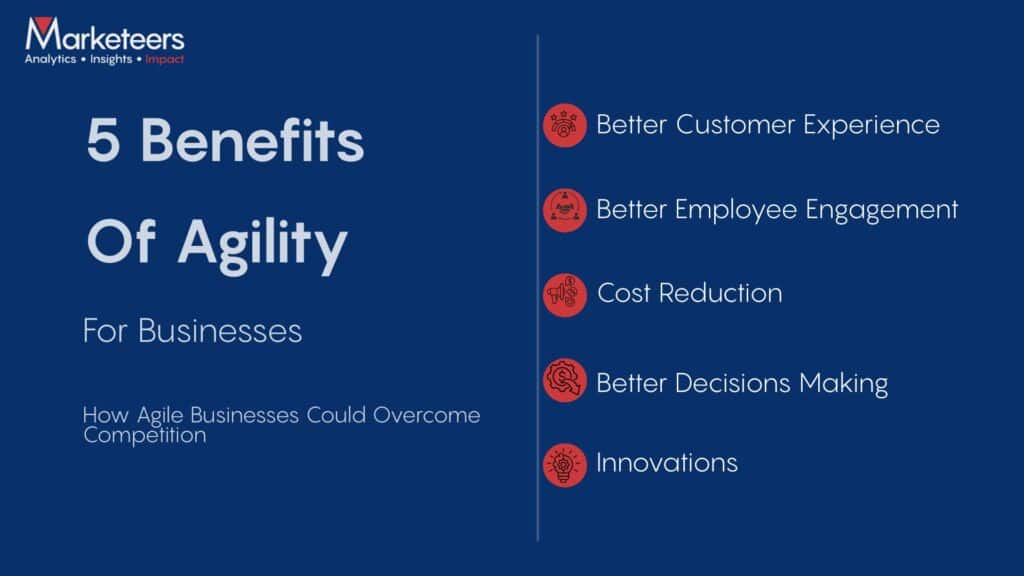
In short, agility can be defined as the ability to adapt and respond rapidly to change. Agility is beneficial for businesses for several reasons that we will discuss throughout this article. These benefits include:
- Better Customer Satisfaction
- Better Employee Engagement
- Cost Reduction
- Better Decision-Making
- Innovations
We will also dive deep into the best practices to actually transform your business into an agile one.
5 Business Agility Benefits
To restate, business agility advantages are countless, and each results in a business’s digital transformation. Agile businesses have several advantages amongst their competitors. To note a few:
Better Customer Satisfaction
Businesses that are agile and can adapt to changes rapidly have several advantages amongst their competitors. Businesses who record better customer satisfaction record better customer loyalty, as when they receive a service that is of high quality, they can be loyal. Additionally, businesses that are agile reduce costs dramatically, as better customer satisfaction results in less effort and time for customer retention and acquiring new customers. In fact, attracting customers is 5 times more costly for businesses than retaining an existing one. Not only do businesses who serve customers better benefit from this, they benefit from becoming more popular, as once a customer is satisfied, he or she might refer the business to more people in a positive way and spread word of mouth for the business.
Better Employee Engagement
Business agility benefits are not short of only the customer, but it can be beneficial for employees too. Businesses who adopt agility in their strategies can actually aid in developing a culture of empowerment and ownership. This is due to the fact that being agile results in people taking the initiative, which consequently results in great outcomes. It has been recorded that 46% of customers who have a great workplace, which can be due to agility and several other reasons, are willing to put in more effort than they do and are more likely to adapt to change quickly. Also, better employee engagement means better performance, innovation, and ultimately revenue growth.
Cost Reduction
Agile workforce advantages are not limited to employee engagement and customer satisfaction. Businesses who adopt an agility first mindset are more likely to reduce costs too. This can be due to the ability to foster a culture of innovation, which makes people able to adapt more quickly to trends and industry changes. This consequently results in better efficiency, which reduces churn rate of customers and results in overall cost reduction. Businesses who can reduce overall cost could record an overall increase in net profit margins by 15%. Hence, businesses who are agile actually have a better chance at enhancing their overall profitability.
Better Decision-Making
Organizational agility benefits are not only limited to reducing costs or improving employee engagement. In fact, agile businesses can make better decisions compared to the ones that do not adopt an agile approach. Given this, businesses who are agile record faster, more data-driven decision making. This is due to these businesses using data and feedback loops to analyze actions and outcomes and to adapt based on the information, consequently resulting in overall enhancement in processes and avoidance of costly mistakes. By constant review and data-driven actions based on feedback loops, agile firms could improve their processes in an iterative manner, resulting in overall improvement in their decision making processes.
Innovations
Agile businesses have a competitive edge amongst their competitors too in terms of innovations. Businesses with this mindset encourage innovations constantly. Companies who are able to adapt to changes faster have a higher chance of actually innovating at a faster and more efficient pace. Businesses who innovate actually do record various positive outcomes. The most critical is that they record an unbelievable number of 550% higher revenue in comparison to the ones who do not. Agility drives innovation, as businesses who are agile have a higher probability of actually innovating products which ultimately lead to more revenue.
How To Transform Your Business Into An Agile One?
Transforming Into An Agile Business: The Four Essential Pillars
Small to mid-sized businesses often face endless lists of actions, leading to confusion and burnout. To transform into a more agile organization, businesses must focus on four critical pillars that enable rapid adaptation, efficiency, and sustainable growth in an unpredictable business landscape.
| Agility Pillar | What It Means & How To Implement | Key Benefits |
|---|---|---|
| Prioritization (If you say three things, you do not say anything) | The majority of small to mid businesses have an endless list of actions to take, as if reading a full book of execution steps. This often leads to confusion and burnout. In order to transform your business into a more agile one, prioritization is integral. Businesses need to aim to prioritize only the most impactful actions that must be taken. Additionally, to make this process ongoing, when priorities are completed, you approach the following ones systematically. | Eliminates confusion and burnout, creates clear focus on high-impact actions, enables systematic progress, prevents resource dilution, and ensures teams work on what truly moves the needle. |
| Automation (Focus On What Matters Most) | Agile businesses narrow down their focus on the most important aspects without wasting time on routine work or work that will not move the needle. Processes that do not need thinking or can be automated via AI or any other way are better automated so employees can focus on what matters most without spending time on tasks that do not contribute to acquiring the ultimate goal. Automation is not limited to tasks only—even meetings can be streamlined using tools that allow collaboration in a non-lengthy, straight-to-the-point way. | Frees up employee time for high-value work, reduces time spent on repetitive tasks, increases productivity and efficiency, minimizes human error, and allows focus on strategic initiatives rather than routine operations. |
| Farsighted Vision (Planning for the unexpected is key) | Not to sound pessimistic, but the future is unexpected and often holds surprises. To transform into a more agile business, it is paramount to plan for the ambiguous and unexpected. This is done by flexible planning of budgets, plans, and reviews, which ultimately offers a better chance of dealing with changes easily and rapidly. An agile business has the flexibility to respond to unexpected events without endless frictions. To be farsighted, it is beneficial to quarterly review your strategy, continue planning proactively, and be flexible in your approaches. | Builds resilience against market changes, enables rapid response to unexpected events, reduces friction during transitions, allows strategic pivots when needed, and maintains business continuity through uncertainty. |
| Agility-First Mindset (Your Mindset Determines Your Reality) | Businesses who want to be agile need to adopt this mindset to succeed. Businesses need to develop a mindset of constant change and adoption. To adopt an agility mindset, bear in mind several pillars: keeping employee morale high, creating an optimized and sustainable workflow, maintaining a continuous improvement mindset, and encouraging employees to share their thoughts and innovations freely without bias or judgment. This mindset of agility is the key and foundation for organizations to actually be agile. | Creates a culture of continuous improvement, fosters innovation and creative thinking, maintains high employee morale and engagement, enables rapid adaptation to change, and builds organizational resilience from the ground up. |
To restate, businesses that are agile actually have a competitive edge due to the organization’s ability to withstand changes, adapt to customer demands, and be resilient in the face of unexpected changes in a VUCA world. Now that we know the benefits of agility, how could a business actually transform into a more agile one?
Prioritization
(If you say three things, you do not say anything)
The majority of small to mid businesses have an endless list of actions to take, as if reading a full book of execution steps to take. This often leads to confusion and burn out. In order to transform your business into a more agile one, prioritization is integral. To do this, businesses need to aim to prioritize only the most impactful actions that must be taken. Additionally, to make this process ongoing, when the priorities are completed, you approach the following.
Automation
(Focus On What Matters Most)
Agile businesses are the ones that can narrow down their focus on the most important aspects without wasting time in routine work or work that will not move the needle. To clarify, processes that do not need thinking or can be automated via AI or any other way are better to be automated so the employees could focus on what matters most without spending lots of time on tasks that do not contribute in acquiring the ultimate goal. Automation is not limited to tasks to do only, even in terms of meetings. Businesses can use tools that actually allow collaboration in a non-lengthy, straight to the point way.
Farsighted Vision
(Planning for the unexpected is key)
Not to sound pessimistic, but the future is unexpected and often holds surprises. That being said, to transform into a more agile business, it is paramount to plan for the ambiguous and the unexpected. This is done by flexible planning of budgets, plans, and reviews, which ultimately offers a better chance of dealing with changes easily and rapidly. An agile business has the flexibility to respond to unexpected events without endless frictions. To be farsighted, it is beneficial to quarterly review your strategy, continue planning proactively, and be flexible in their approaches.
Your Mindset Determines Your Reality
(Agility-First Mindset)
Businesses who actually want to be agile need to adopt this mindset to succeed. To explain, businesses need to actually develop a mindset of constant change and adoption. To adopt an agility mindset, you need to bear in mind several pillars that could help you in this transformation process. To state, keeping employee morale high, creating an optimized and sustainable workflow, and a continuous improvement mindset. Also, encouraging employees to share their thoughts and innovations freely without bias or judgement. This mindset of ability is the key and foundation for organizations to actually be agile.
Conclusion
All in all, agility is a great approach for businesses who want to gain a competitive edge amongst their competitors. This can be due to the fact that these businesses actually could enhance their processes, driving more sales and revenue. To re-mention, businesses who are agile could enhance their customer experience resulting in better customer satisfaction and retention, they could reduce employee turnover and stabilize their internal processes, they could reduce their overall and operational costs, also they could make better decisions which result ultimately to brand growth.
We also discussed ways to actually transform your organization into a more agile one. These ways include prioritization of the most essential components to focus on, automating processes that are routine and do not move the needle, planning for the future and being flexible in approaches, avoiding stagnation. Furthermore, to adopt an agility first mindset to transform into an agile organization.
Agility is essential for teams who want to grow and beat competition. If you are looking for ways to empower your growth journey, marketeers research is the right place. Visit Our Homepage for our latest news now!