

Most fintechs in Egypt know their own users well.
They can see each sign-up and each late payment.
What they cannot see is everyone else: the people who opened the app and left, and the people who never looked at all.
That blind spot is getting expensive.
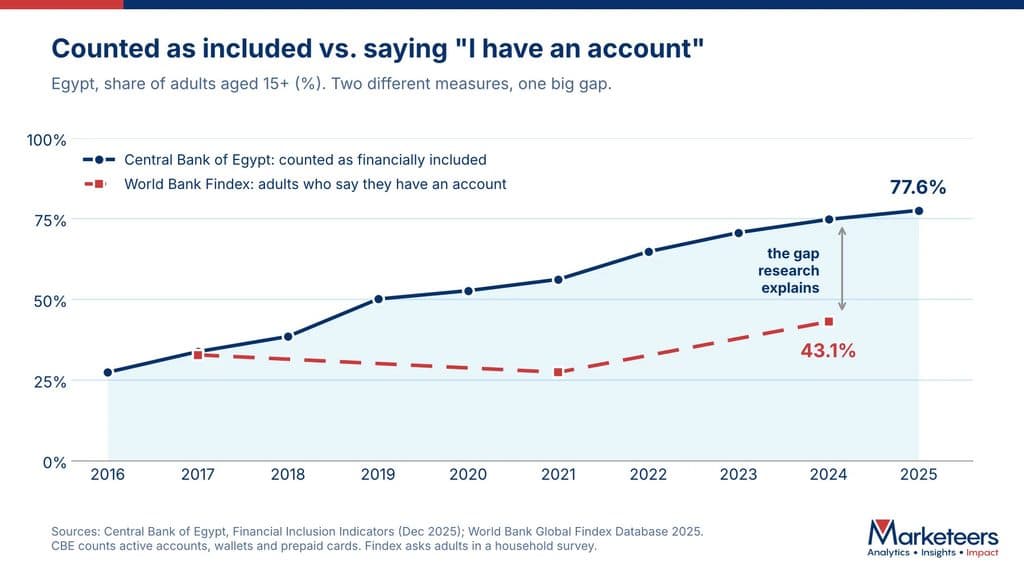
The Central Bank of Egypt (CBE) counted 79% of citizens aged 15 and over as financially included in June 2026.
Yet in the World Bank’s Global Findex survey, just 43.1% of Egyptian adults said they had an account in 2024.
Consumer finance grew 57% in 2025 to EGP 96.3 billion, according to the Financial Regulatory Authority (FRA).
Plenty of customers are making choices right now, and most fintechs never hear from them.
Fintech customer research in Egypt closes that gap.
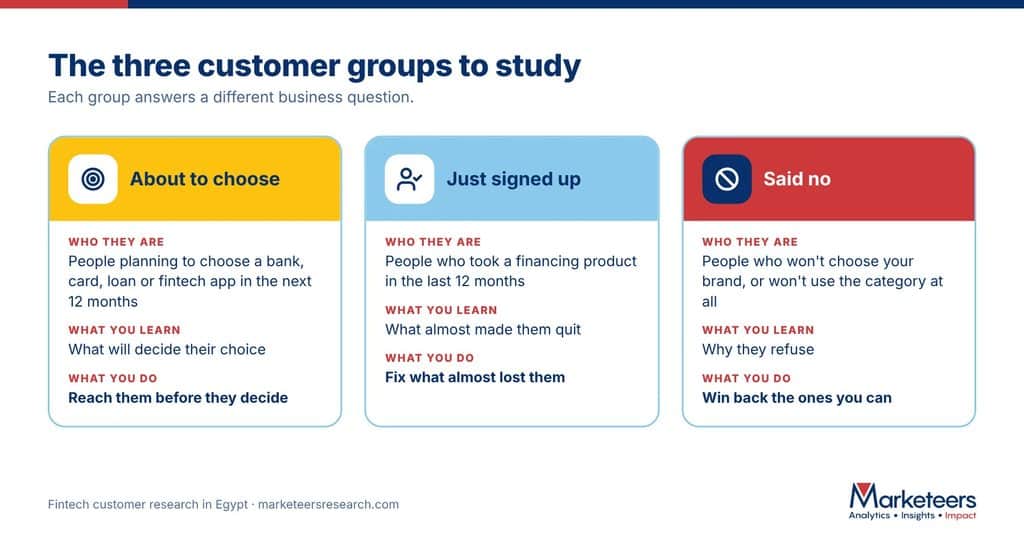
It studies three groups:
- People about to choose a financial provider
- People who took the step with a competitor
- People who said no.
This guide is for growth, product and marketing leaders at established fintechs in Egypt.
It covers what to ask each group, how to split the answers and how to decide what to fix.
| Key takeaways Your app data shows the people who already chose you. Customer research shows the rest of the market. National averages hide big gaps by region, gender and income, so split every finding. Repeat the same study at set intervals. That is how you see whether a fix worked. |
What is fintech customer research?
| Definition: Fintech customer research is the study of how people choose, use and leave digital financial services. It goes beyond your own app data. It talks to people who are not your customers yet, people who just chose a competitor and people who are rejecting the category. It asks what they need and what would change their mind. |
Your internal data cannot do this job.
It covers just the people who already said yes.
Good consumer research in Egypt fills in the rest of the picture: who you can still win, what nearly lost you the customers you have, and which refusals are worth chasing.
Why fintech customer research in Egypt matters now
Egypt’s market for digital money has grown fast.
The CBE reports that financial inclusion rose from 27.4% in 2016 to 79% in June 2026.
That is 56.4 million of 71.4 million citizens aged 15 and over, per the CBE’s financial inclusion data.
Digital channels grew with it.
By the end of 2025, Egypt had 60 million registered mobile wallets.
Wallet transactions reached EGP 4 trillion that year, according to the CBE’s December 2025 indicators.
In October 2026, the CBE also reported that InstaPay had nearly 22 million registered customers by the end of June 2026.
Owning a wallet is a different thing from using one.
The World Bank Global Findex Database 2025 found that 36.3% of Egyptian adults made or received a digital payment in 2024. Just 5.2% paid a shop or merchant digitally.
Competition is changing shape too.
FinTech Egypt’s 2023 Landscape Report counted 177 fintech startups and payment providers, which raised USD 796.5 million in 2022.
Then, in February 2026, FRA Decree No. 43 of 2026 paused new consumer finance licence applications for one year. For now, growth will come more from winning share than from new players entering.
Even the regulator relies on customer research.
The CBE built its Financial Inclusion Strategy for 2022 to 2025 on consumer surveys. It ran them with the Central Agency for Public Mobilization and Statistics (CAPMAS) in late 2020, according to the CBE strategy page.
The three customer groups every Egyptian fintech should study
Each group answers a different business question.
Group 1: Customers about to choose (reach them before they decide)
This group is larger than most teams expect. The Global Findex 2025 found that 56.1% of Egyptian adults borrowed money in 2024. Yet just 10.4% borrowed from a formal provider, while 38.4% borrowed from family or friends.
Many of these people will look for a formal option soon. Whoever understands them earlier has the edge.
What to ask them:
- Which providers or apps are you weighing up?
- What would make you trust one over another?
- Which fees, limits or terms matter most to you?
- Who influences your choice, and where would you sign up?
Use the answers to shape your offer, your message and your channels before the decision is made.
Group 2: Customers who just signed up (fix what almost lost them)
Sign-ups are rising fast. The FRA reports consumer finance worth EGP 96.3 billion in 2025, up 57% on 2024. From January to June 2026 it reached EGP 66.8 billion, up 75.2% on the same months of 2025, per the FRA monthly reports (in Arabic).
Plenty of those sign-ups nearly did not happen. Recent customers still remember the step that almost made them quit, so ask them soon.
Older research carries a warning here. A 2012 study by the Consultative Group to Assist the Poor (CGAP) looked at four branchless banking providers. It found that 80% of customers who were active in the month after sign-up had stopped by their fourth month. The study is old and not from Egypt, but the lesson travels: the early weeks shape long-term use.
What to ask them:
- What nearly stopped you from signing up?
- Where did the process slow down: ID checks, documents or approval?
- Which other options did you compare?
- What surprised you in your early weeks, good or bad?
Then fix the steps that almost lost them. Onboarding rules matter here: FRA Decree No. 140 of 2023 sets the rules for digital identity and digital contracts in non-bank finance.
Group 3: People who said no (learn why, and win back the ones you can)
This group is easy to overlook, yet it holds some of the clearest lessons. People say no in two ways. Some reject your brand. Others reject the whole category. You need to know which is which.
The Global Findex 2025 shows why many Egyptians stay outside formal finance. Among adults without an account in 2024, 90.1% said they did not have enough money and 20.4% said financial services were too expensive.
Among all adults, 6.3% cited a lack of trust in financial institutions and 6.1% cited missing documents. And 27.9% said they pay in shops with cash because they are used to it.
Some of these reasons can change. A clearer price, a simpler ID check or a trusted agent can move people. Very low income is a different case. It calls for a different product, or a different target.
What to ask them:
- Did you consider us? What made you stop?
- What do you use instead, including family, friends or shop credit?
- What would change your mind?
- How do you feel about sharing money details in an app?
Win back the people you can reach. Stop spending on the ones you cannot.
How customers differ across Egypt
National numbers hide big gaps. The Global Findex 2025 found clear splits in account ownership in 2024.
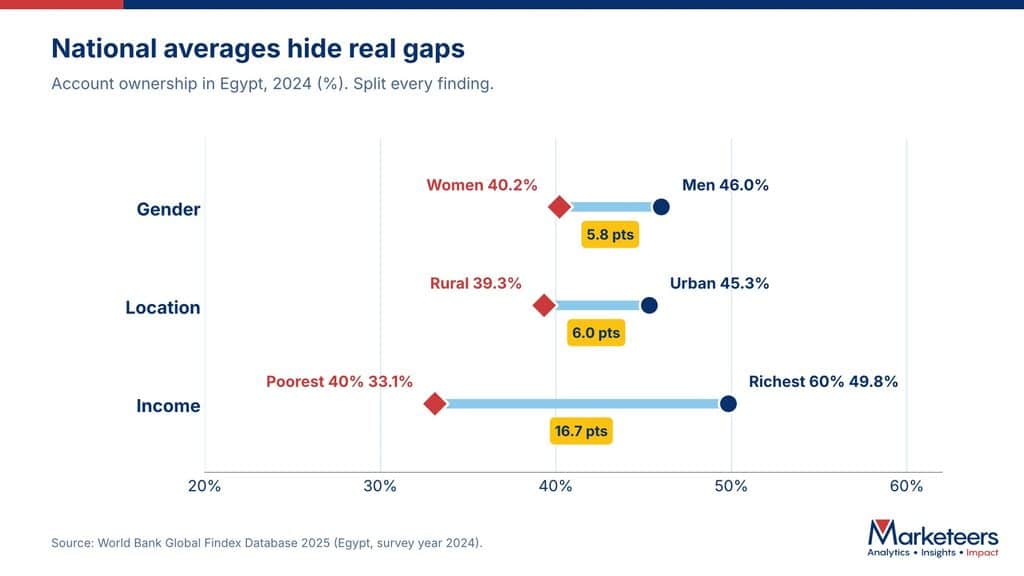
Phones follow a similar pattern. In 2024, 55.7% of Egyptian adults owned a smartphone, compared with 44.6% of women. The CBE’s June 2026 data puts inclusion at 72.5% for women and 58% for young people aged 15 to 35.
So split every finding. Compare Greater Cairo, Alexandria, the Delta, the Canal cities and Upper Egypt. Compare age groups, and compare people who bank with people who rely on a wallet alone. Our guide on why demographics alone don’t explain Egyptian consumers shows how attitudes cut across these lines.
Which research methods work for fintech customer research?
Match the method to the decision you need to make.
From findings to action: what to fix
Research pays off when it changes a decision. A simple score helps you choose. Rate each problem from 1 to 5 on three things. Reach is how many people it affects. Money is the revenue at stake. Ease is how simple it is to fix. Add the scores and start with the highest total.
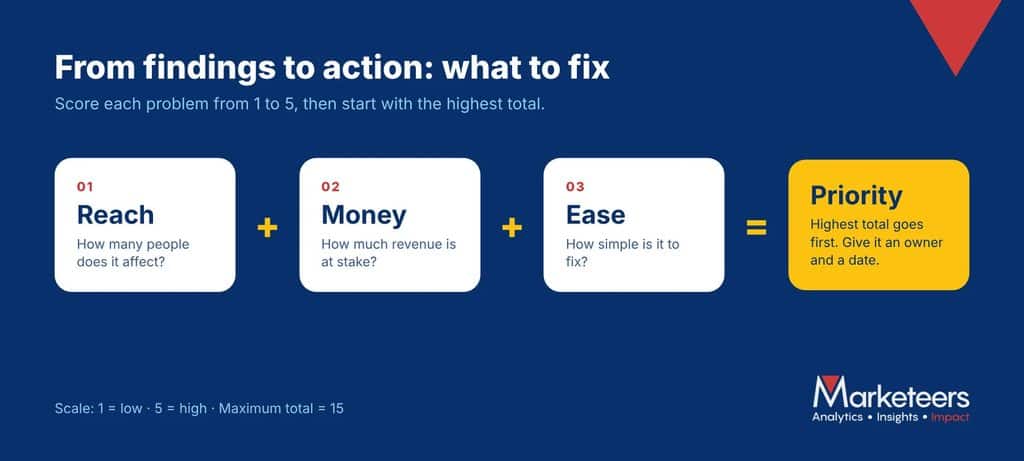
Give each top problem an owner and a date. Share the results with product, marketing and risk teams together, so everyone works on the same fix.
Frequently asked questions about fintech customer research in Egypt
What is fintech customer research?
Fintech customer research studies how people choose, use and leave digital financial services. It covers people who have not chosen a provider yet, people who just signed up and people who said no. It shows what drives each choice, what nearly made new customers quit and which refusals a fintech can still win back.
How many Egyptians are financially included?
The Central Bank of Egypt counted 79% of citizens aged 15 and over as financially included in June 2026. This counts active accounts at banks, Egypt Post, mobile wallets and prepaid cards. In the World Bank’s Global Findex survey, 43.1% of Egyptian adults said they had an account in 2024. The two use different methods.
Why do people in Egypt say no to formal finance?
In the World Bank’s Global Findex 2025, 90.1% of Egyptian adults without an account said they lacked enough money. Some 20.4% said services were too expensive. Among all adults, 6.3% cited a lack of trust and 6.1% cited missing documents. Habit matters too: 27.9% pay with cash because they are used to it.
How do you research people who are not your customers?
Recruit them from the general population, not from your own lists. Use screening questions to find people who considered your category and chose another option, or none. Keep your brand hidden so answers stay honest. Then compare their reasons with those of people who chose you.
How often should a fintech repeat customer research?
Repeat the same core questions at set intervals, often every six or twelve months. Fast-moving teams may add short checks each quarter. Keep the questions and sample design stable between rounds. That way, a change in the results reflects a real shift in the market rather than a change in method.
Start with the customers you cannot see
Your app tells you about the people who already chose you. Fintech customer research in Egypt tells you about everyone else, including the people who almost quit and the people who said no. Split the results by region and demographic, repeat the study, and fix the problem that costs you the most.
Marketeers Research has served clients since 1994, across more than 40 countries. Our team runs usage and attitude studies and market assessments for financial services in Egypt. If your team is planning next year’s growth, inquire to know more about customer research for your fintech.