

Decoding Price Perception, Closing the Value Gap, and Testing Cognitive Anchors Before Changing Shelf Prices.
In high-velocity Fast-Moving Consumer Goods (FMCG) categories, setting a shelf price is rarely a purely mathematical exercise. While finance departments evaluate cost-plus formulas and profit margins, consumers evaluate prices through cognitive biases, emotional triggers, and perceived value.
Under macroeconomic volatility and high inflation—such as the currency devaluation cycles seen across emerging markets like Egypt—price elasticity becomes highly volatile. A direct percentage increase on a price tag can trigger an outsized drop in sales volume if it crosses a cognitive threshold or widens the perceived value gap—the discrepancy between what a product costs and what a consumer believes it is worth.
Understanding psychological pricing allows commercial decision-makers, brand managers, and revenue growth management (RGM) teams to shape price perception, protect baseline sales volume, and optimize margins without triggering customer drop-off.
What Is Price Perception (And Why It Trumps Absolute Cost)
Price perception is the subjective psychological process through which a shopper interprets a monetary figure. Consumers do not evaluate numbers in isolation; they assess them relative to internal reference prices, recent shopping experiences, and environmental cues.
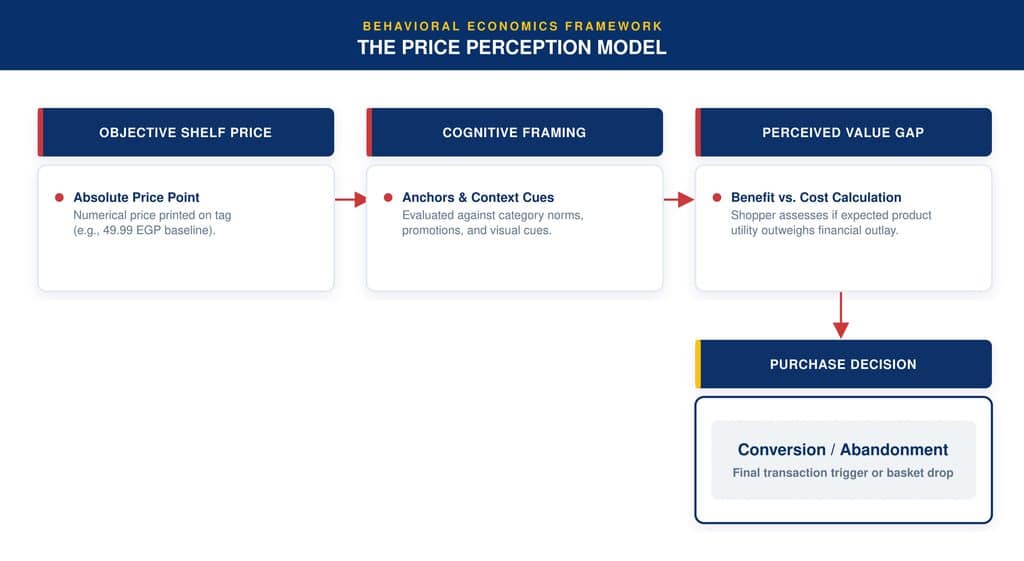
When a brand raises its price, the consumer’s reaction is dictated by three underlying cognitive principles:
- The Reference Price Anchor: The baseline price a consumer expects to pay based on past purchases or adjacent shelf choices.
- Loss Aversion: According to Behavioral Economics principles established by Prospect Theory, consumers feel the pain of a price increase roughly twice as intensely as they appreciate an equivalent price drop or gain.
- The Value Gap: If the perceived benefit of a product fails to scale alongside a price increase, the value gap widens, prompting shoppers to switch to lower-tier alternatives, private labels, or unbranded bulk goods.
5 Psychological Pricing Tactics (And Their FMCG Application)
While framing tactics can influence consumer choices, executing them in CPG/FMCG requires adapting generic retail theories to high-frequency, low-involvement purchases.
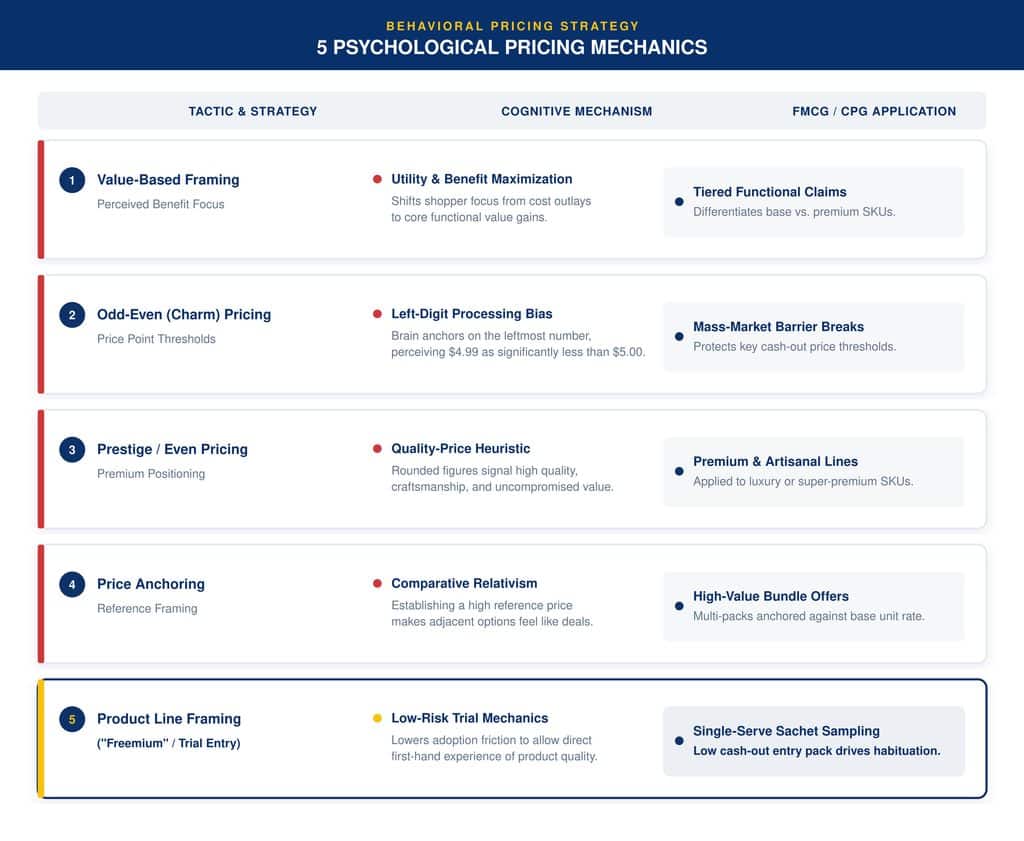
1. Value-Based Framing: Aligning Price with Perceived Utility
Unlike cost-plus pricing, value-based pricing sets shelf costs according to perceived consumer benefits. In FMCG, value is multi-dimensional—encompassing sensory preference, functional efficacy, brand trust, and convenience.
- FMCG Application: Positioning a concentrated liquid detergent at a 30% higher shelf price than traditional powders by framing the price around “cost per wash” rather than package weight.
2. Odd-Even (Charm) Pricing: Capitalizing on Left-Digit Bias
Charm pricing uses odd endings—typically ending in .99, .95, or .90—to trigger the left-digit processing effect. Because human brains read from left to right, a price of 19.99 EGP is encoded closer to 19 EGP than 20 EGP, significantly lowering perceived cost.
- FMCG Application: Highly effective for mass-market staple goods where consumers are hyper-sensitive to price thresholds.
- The Caveat: Research published by the American Marketing Association (AMA) demonstrates that charm pricing signals discounts or budget options. If applied to super-premium categories, it can weaken brand equity.
3. Prestige Pricing: Signal Quality Through Round Numbers
Prestige pricing uses even, rounded figures (e.g., 100 EGP instead of 99.99 EGP) to leverage the quality-price heuristic: consumers naturally assume higher-priced, round-numbered items possess superior quality and craftsmanship.
- FMCG Application: Ideal for artisan chocolates, premium skincare, imported beverages, or organic line extensions where emotional connection and status outweigh pure price sensitivity.
4. Price Anchoring: Establishing Comparative Value
Shoppers rarely evaluate absolute prices; they judge value by comparing available options. Price anchoring involves introducing a high reference point (such as a original list price or a super-premium SKU) to make adjacent or discounted prices look attractive.
- FMCG Application: Highlighting a “Was 150 EGP / Now 115 EGP” shelf tag or placing a premium line next to a core SKU to make the mid-tier option feel like a bargain.
5. Product Line Framing & Sampling (“The FMCG Freemium”)
While software companies use free software tiers to convert paid users, FMCG brands adapt this concept through low-barrier trial formats.
- FMCG Application: Offering ultra-affordable single-serve sachets, mini trial packs, or in-store sampling to eliminate purchase risk. Once consumers experience the product efficacy, they transition to higher-margin multi-serve family packs.
Why Guesswork Fails: How to Test Price Perception Before Shifting Prices
Executing a psychological pricing adjustment based on intuition is risky. If an anchor fails or a charm price dilutes brand perception, volume can drop rapidly.
Leading commercial organizations deploy systematic research frameworks to test consumer price perception before altering retail prices:
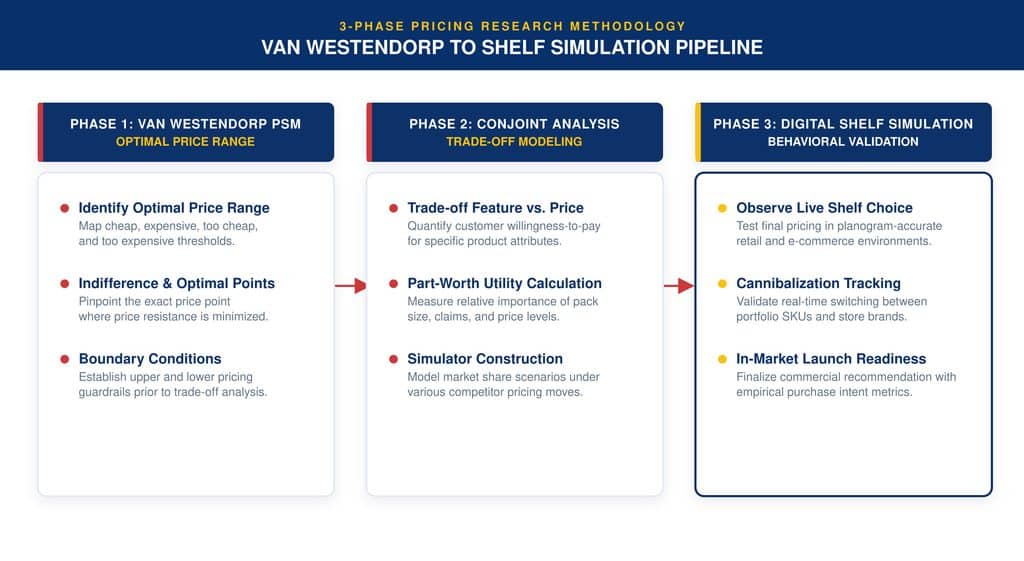
1. Van Westendorp Price Sensitivity Meter (PSM)
By asking consumers four targeted questions regarding when a product feels “Too Cheap,” “A Bargain,” “Expensive,” or “Too Expensive,” the Van Westendorp model identifies the Point of Marginal Cheapness and the Indifference Price Point. This maps the exact psychological corridor within which a brand can adjust prices without damaging quality perceptions or losing volume.
2. Discrete Choice Conjoint Analysis
Conjoint testing presents consumers with varying product profiles—combining different prices, package sizes, claim callouts, and competitor alternatives. Statistical modeling then reveals the exact dollar value consumers place on individual product attributes, isolating how much premium messaging can offset a price hike.
3. Interactive Virtual Shelf Simulation
Before rolling out new pricing architecture across retail trade, brands can deploy simulated digital retail environments. By tracking real-time eye-fixations, basket addition rates, and cross-shopping behavior, commercial teams observe how price perception translates into actual purchasing decisions under realistic competitive density.
Optimize Your Price Perception with Marketeers Research
Unlocking profitable growth in dynamic markets requires empirical clarity into how consumers interpret value. The Smart Value™ Platform from Marketeers Research gives commercial decision-makers and RGM leads the data tools required to test, model, and execute psychological pricing strategies safely.
By leveraging predictive analytics, trade-off modeling, and deep consumer insights, our platforms enable your team to:
- Determine exact psychological price thresholds and elasticity limits across consumer income tiers.
- Measure brand perception impact before changing list prices or promotional mechanics.
- Identify optimal Price-Pack Architecture (PPA) formats to maintain accessible shelf price points.
- Eliminate wasted trade spend by testing promotional anchors in simulated environments.
Related Strategic Resources
Expand your commercial strategy with additional research insights from the Marketeers Research Knowledge Hub:
- Master Revenue Growth Management: Read our comprehensive guide on The Art of Revenue Growth Management (RGM) for Maximum Impact to align pricing, trade spend, and portfolio strategy.
- Explore Price Architecture: Read Supercharging FMCGs with Tailored Pricing Strategies to master pack sizes, value tiering, and inflation management.
- Understand Consumer Behavior: Read What a Usage & Attitude Study Actually Tells You About Consumers to align pricing tactics with real household usage patterns.
Validate Your Pricing Strategy Today
Don’t let price perception shifts erode your market share. Validate consumer value thresholds, run predictive scenarios, and build a resilient pricing architecture with confidence.
👉 Ready to test your price perception and promotional mechanics? Contact the team at Marketeers Research today to schedule a demo of our Smart Value™ Platform.