

How Data-Driven Price Architecture, Dynamic Elasticity Modeling, and Agile Testing Unlock Sustainable Profitability in High-Inflation Markets.
Gone are the days when a uniform, “one-size-fits-all” pricing strategy could deliver consistent growth for Fast-Moving Consumer Goods (FMCG) and Consumer Packaged Goods (CPG) brands. Today, commercial decision-makers face unprecedented operational pressures: persistent currency devaluations, raw material cost surges, shifting household budgets, and rapid channel fragmentation.
In volatile economic environments, relying on blanket percentage price increases or blanket promotional discounts is a fast track to volume erosion and brand dilution. As Brown University economics professor Emily Oster famously noted:
“The key to good decision making is evaluating the available information-the data-and combining it with your own estimates of pluses and minuses. As an economist, I do this every day.”
Applying this analytical mindset to FMCG revenue strategy requires moving beyond guesswork. Supercharging brand performance demands an integrated, data-driven pricing strategy fmcg architecture—one that aligns pack sizes, product tiers, price elasticities, and promotional mechanics to match what specific consumer segments are genuinely willing to pay.
The Commercial Reality: Why Static Cost-Plus Models Fail
Historically, CPG brands responded to rising input costs with cost-plus tailored pricing: calculate increased manufacturing expense, add a fixed target margin, and apply a uniform shelf price increase across the entire SKU portfolio.
In high-inflation environments, such as Egypt, where currency adjustments directly inflate imported raw material costs, this blunt approach creates immediate market friction:
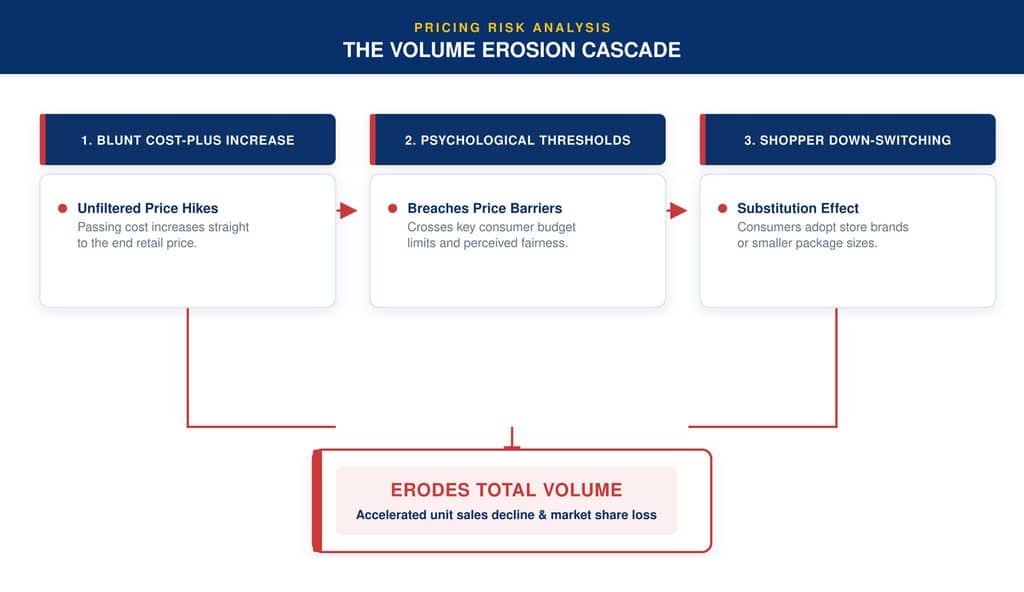
Destruction of Volume Baseline: Blanket price hikes frequently push products over critical psychological price thresholds (e.g., crossing from 19.99 EGP to 24.50 EGP), triggering immediate shopper drop-off or category abandonment.
Acceleration of Private Label Switching: When branded goods raise prices uniformly, cost-conscious consumers shift to lower-cost local alternatives or retailer private labels.
Unearned Margin Dilution: Increasing prices on highly price-sensitive (elastic) staple SKUs while leaving premium, inelastic SKUs underpriced leaves significant margin on the table.
3 Core Levers of Modern Pricing Architecture
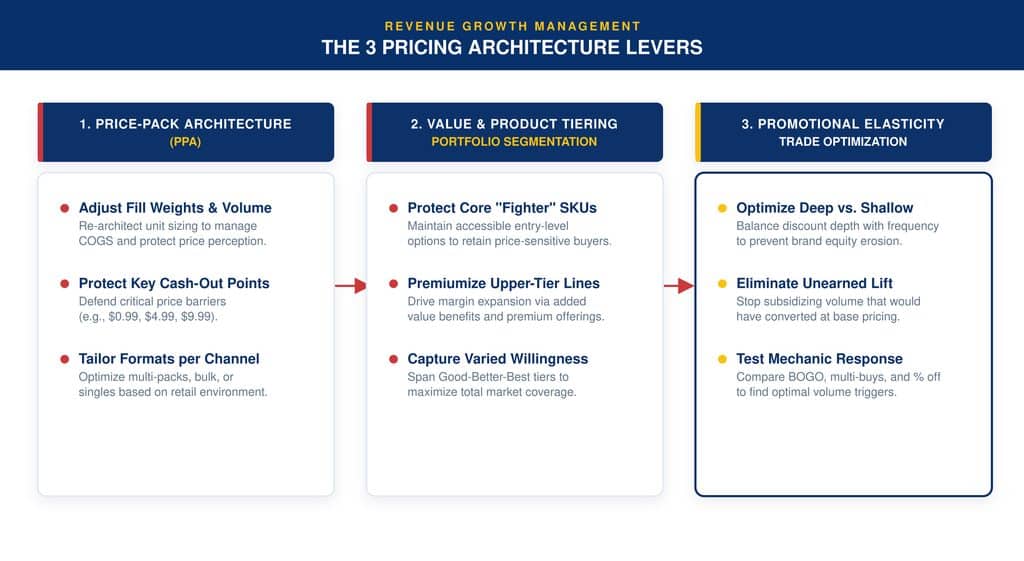
To protect market share and gross margins when operating costs move, commercial teams must master three structural pricing levers: Price-Pack Architecture (PPA), Value Tiering, and Promotional Elasticity Optimization.
Lever 1: Price-Pack Architecture (PPA)
Instead of altering headline prices on standard packages, PPA re-engineers product weight, volume, and packaging formats to preserve accessible price points:
- Shrink-Fit & Value Packs: Adjusting a 500g package to 420g allows a brand to absorb raw material inflation while maintaining an accessible price point at the register.
- Single-Serve Magic Price Points: Launching smaller, single-serve formats designed specifically for cash-strapped consumers nearing the end of their monthly pay cycle.
- Bulk Volume Offerings: Introducing large-format, multi-buys designed for higher-income households seeking lower cost-per-unit yields.
Lever 2: Value Tiering & Portfolio Alignment
Not all SKUs within a brand portfolio perform the same role. A data-driven pricing strategy fmcg segments the portfolio into functional tiers:
- Fighter Brands / Entry SKUs: High elasticity, price-sensitive products kept strictly competitive to defend brand market share against low-cost alternatives.
- Core Volume Drivers: Moderate elasticity SKUs balanced carefully between volume throughput and margin contribution.
- Premium & Super-Premium Line Extensions: Highly inelastic products featuring functional, health, or sensory upgrades where higher margins can be extracted without sacrificing sales volume.
Lever 3: Dynamic Promotional Optimization
Promotional spend represents one of the largest balance sheet expenditures for FMCG brands, yet over 59% of trade promotions are loosing money globally. By analyzing historical promotional elasticity, brands can replace deep, generic discounts with targeted promotional mechanics (e.g., multi-buy bonuses, cross-category bundles, or digital instant rebates) that protect net revenue.
Choosing the Right Pricing Strategy: A Decision Framework
Selecting which tailored pricing lever to pull requires analyzing two primary variables: Product Price Elasticity and Consumer Value Perception
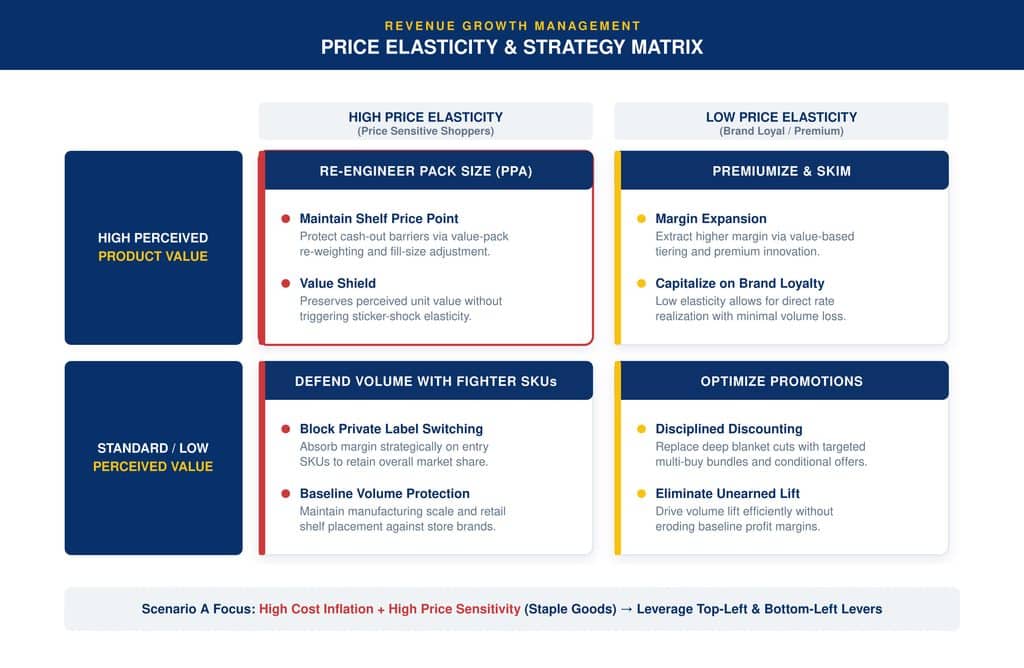
Scenario A: High Cost Inflation + High Price Sensitivity (Staple Goods)
- The Strategic Choice: Price-Pack Architecture (PPA).
- Execution: Do not increase shelf price directly. Downsize package fill weight slightly or introduce entry-level single-serve SKUs to preserve critical price points.
Scenario B: Differentiated Brand + Low Price Sensitivity (Niche/Wellness)
- The Strategic Choice: Value-Based Premium Pricing.
- Execution: Pass cost increases through direct list price adjustments while doubling down on functional marketing claims (e.g., organic, added vitamins, clean label) to justify premium positioning.
Scenario C: High Category Competition + Mixed Channel Dynamics
- The Strategic Choice: Channel-Specific Dynamic Architecture.
- Execution: Deploy value-focused bulk packs to modern hypermarkets, while keeping single-serve, high-margin formats in traditional trade neighborhood stores (bakkals).
How to Test and Validate Pricing Changes Before Market Rollout
Executing a tailored pricing adjustment without pre-market validation exposes CPG enterprises to severe sales risk. Leading commercial organizations rely on structured, data-driven testing protocols to simulate consumer reaction prior to shelf execution:
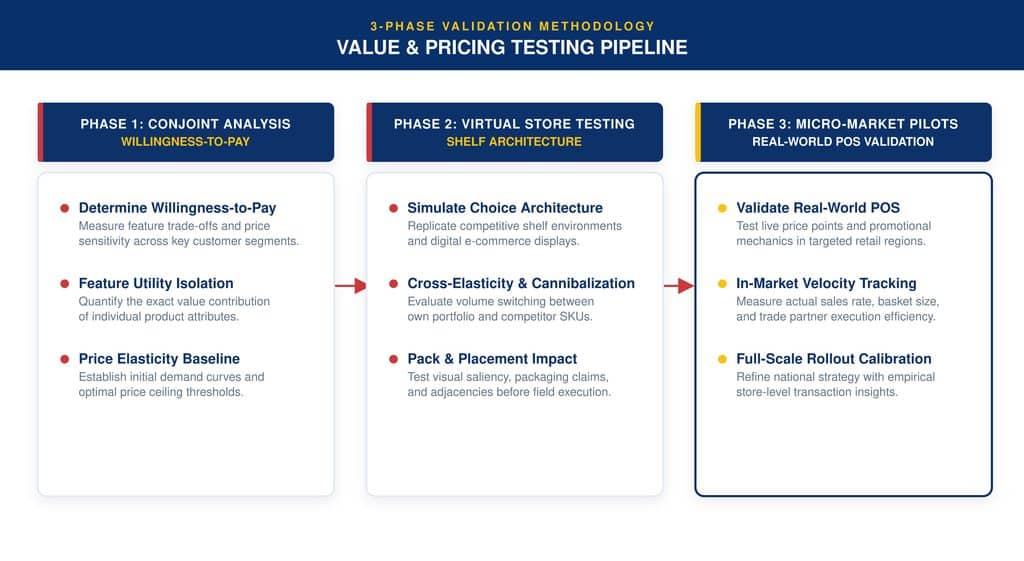
- Discrete Choice Conjoint Analysis: Surveying targeted consumer panels with varying combinations of price, pack size, and brand features to determine exact willingness-to-pay (WTP) curves and cross-price elasticities.
- Virtual Shelf & Choice Architecture Simulation: Utilizing interactive digital shelf environments to observe how consumers trade down or switch when facing new price configurations alongside key competitors.
- Controlled Micro-Market Retail Pilots: Executing small-scale price adjustments across select retail channels or geographic regions to track actual POS transactional data before committing to national rollouts.
Supercharge Your Revenue Growth with Marketeers Research
Setting optimal prices in volatile, unpredictable markets requires continuous, real-time market data. The Smart Value™ from Marketeers Research give commercial decision-makers the empirical clarity needed to build resilient price architectures.
By combining advanced consumer insights, price elasticity modeling, and scenario simulation tools, our platforms enable you to:
- Determine exact price elasticity thresholds across different consumer income tiers.
- Model the net profitability impact of proposed Price-Pack Architecture changes.
- Eliminate wasted trade promotion spend by identifying high-ROI promotional mechanics.
- Protect baseline sales volume while defending brand equity during inflationary cycles.
Related Strategic Resources
Explore more operational insights on commercial execution, pricing, and consumer behavior from the Marketeers Research Knowledge Hub:
- Deconstruct Consumer Perception: Explore How FMCGs Tap Into Consumers’ Minds with Psychological Pricing to master threshold pricing, anchor mechanics, and value perception.
- Uncover Shopper Drivers: Read The Price Game: Exploring the Dynamics of Pricing in Decision-Making to understand the cognitive drivers behind brand switching and down-trading.
- Decode Post-Inflation Behavior: Discover What a Usage & Attitude Study Actually Tells You About Egyptian Consumers to align your price tiers with real-world household habits.
External Industry Benchmarks & Strategic References
- Review world research standards and pricing study guidelines via ESOMAR World Research Standards.
- Examine macroeconomic indicators, price index data, and economic stability trends on the Central Bank of Egypt Data Center.
Transform Your Tailored Pricing Strategy Today
Stop relying on intuition or legacy cost-plus formulas to protect your margins. Validate your price points, model market scenarios, and secure sustainable revenue growth.
👉 Ready to optimize your FMCG pricing strategy? Contact the experts at Marketeers Research today for a customized pricing consultation.