

The modern enterprise is navigating a period of structural realignment. Unlike previous technological revolutions that primarily automated manual labor and repetitive physical tasks, the rapid integration of generative AI in the workplace targets cognitive, analytical, and creative workflows.
Generative AI refers to algorithms (such as Large Language Models and diffusion networks) capable of parsing massive unstructured datasets to synthesize original content, code, strategic scenarios, and strategic assets. Where traditional artificial intelligence operated within static, predefined logic gates to classify information, generative systems function as dynamic reasoning partners.
The economic implications are massive. Research from Goldman Sachs estimates that generative AI could ultimately raise global Gross Domestic Product (GDP) by 7%—representing nearly $7 trillion in economic value—while lifting annual labor productivity growth by 1.5 percentage points over a decade-long adoption curve. Meanwhile, global workplace studies from McKinsey reveal an unprecedented adoption rate: active employee usage of AI tools surged from 30% to over 76% in recent years.
Enterprise transformation, however, is not achieved simply by purchasing software licenses. Unlocking real value requires commercial leaders to restructure operations, reskill talent pipelines, and rethink decision architectures.
Quantifying the Impact on Enterprise Productivity
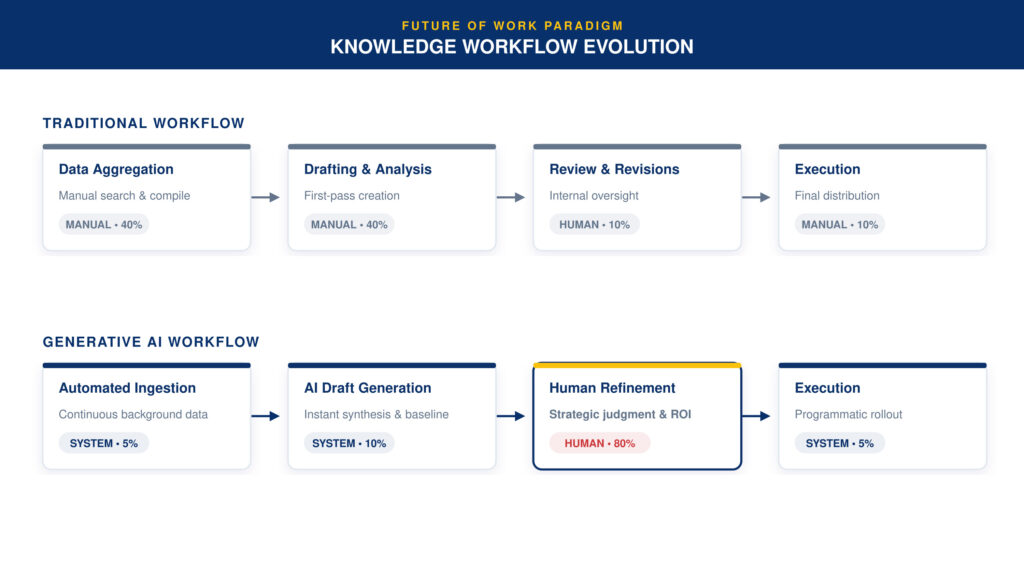
Productivity in knowledge work has historically been constrained by manual data handling, report drafting, and administrative friction. The enterprise-wide rollout of generative AI in the workplace redefines baseline operational speed by shifting workers from primary execution to critical oversight.
Automation of High-Volume Cognitive Workflows
Every organization maintains a heavy administrative load—drafting customer communications, aggregating cross-departmental status updates, generating standard financial summaries, and inputting metadata into Enterprise Resource Planning (ERP) databases. Generative AI models handle these low-variance, time-intensive operational routines with remarkable precision.
By delegating baseline draft creation and automated data extraction to AI agents, organizations compress project lifecycles from weeks to hours.
Speed, Scale, and Error Reduction
The key advantage of deploying generative platforms lies in their processing capacity. Where human analysts require days to evaluate thousands of customer feedback transcripts, unstructured contracts, or regional sales sheets, generative models summarize, categorize, and extract patterns instantly.
This speed reduces operational latency across departments:
- Human Resources: Automated parsing of candidate resumes against job specifications.
- Legal & Compliance: Instant identification of risk clauses across supplier agreements.
- Customer Support: Automated generation of contextualized responses to complex inquiries.
Field Evidence: Enterprise Productivity Outcomes
Major global enterprises are demonstrating early gains through structural AI deployment:
- Adobe: Integrated generative models directly into creative suite workflows (Firefly), enabling professional visual designers to generate layout concepts and asset variations in minutes rather than days.
- GitHub: Implementation studies of GitHub Copilot among software engineering teams demonstrated that developers completed tasks up to 55.8% faster when assisted by generative code suggestion engines.
Dynamic Decision-Making and Real-Time Market Alignment
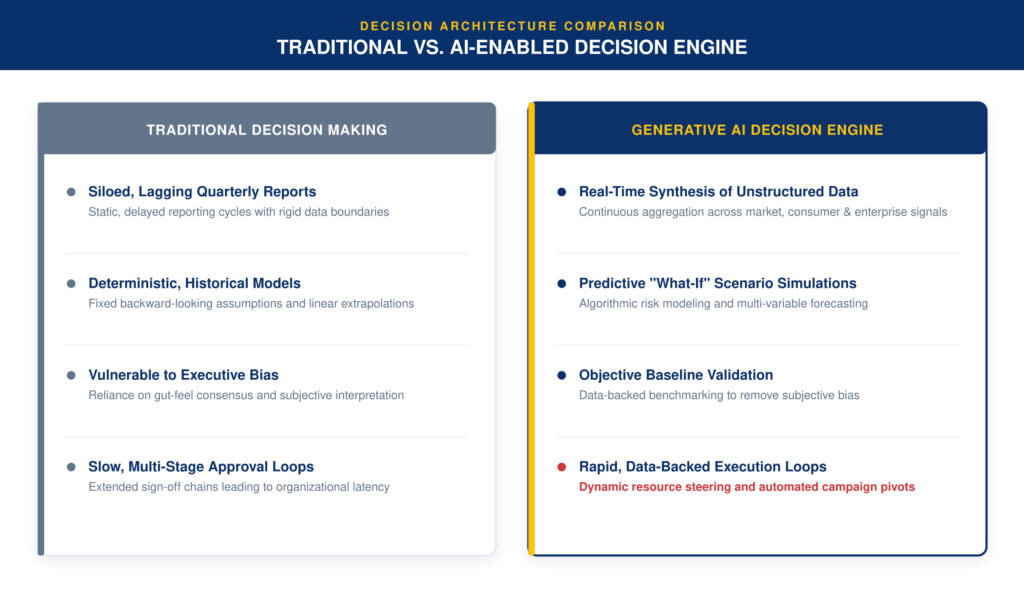
Making sound commercial decisions quickly determines market share. Yet, many corporate leadership teams operate with built-in analytical delays—diagnosing market shifts months after they occur through lagging quarterly reports.
Integrating generative AI in the workplace bridges the gap between raw market data and active strategic execution.
From Retrospective Reporting to Predictive Scenario Modeling
Traditional business intelligence tools show what happened in the past. Generative AI tools allow commercial and financial teams to ask natural-language questions about what could happen under varying market conditions.
By unifying internal sales data with external market feeds, enterprise leaders can run real-time predictive scenarios:
- “How will a 5% increase in raw material import costs impact regional gross margins?”
- “Which pricing and packaging tiers optimize volume during inflationary periods?”
Strategic Integration: Data Analytics & Enterprise RGM
To explore how centralized enterprise data architecture fuels smarter pricing, margin protection, and channel execution, review our deep-dive guides:
Mitigating Executive Cognitive Biases
Human decision-making is naturally vulnerable to cognitive biases, including status quo bias, sunk cost fallacy, and confirmation bias. Generative models evaluate multi-variable datasets without emotional attachment to legacy strategies. Presenting executives with objective, scenario-tested options grounds leadership discussions in empirical data rather than subjective consensus.
Shifting Talent Architectures and Changing Job Roles
The widespread adoption of generative AI in the workplace alters labor demand, skill requirements, and organizational design. Rather than causing total job displacement, the technology drives role evolution—changing the daily responsibilities across almost every corporate function.
Evolution of Skill Sets and Core Competencies
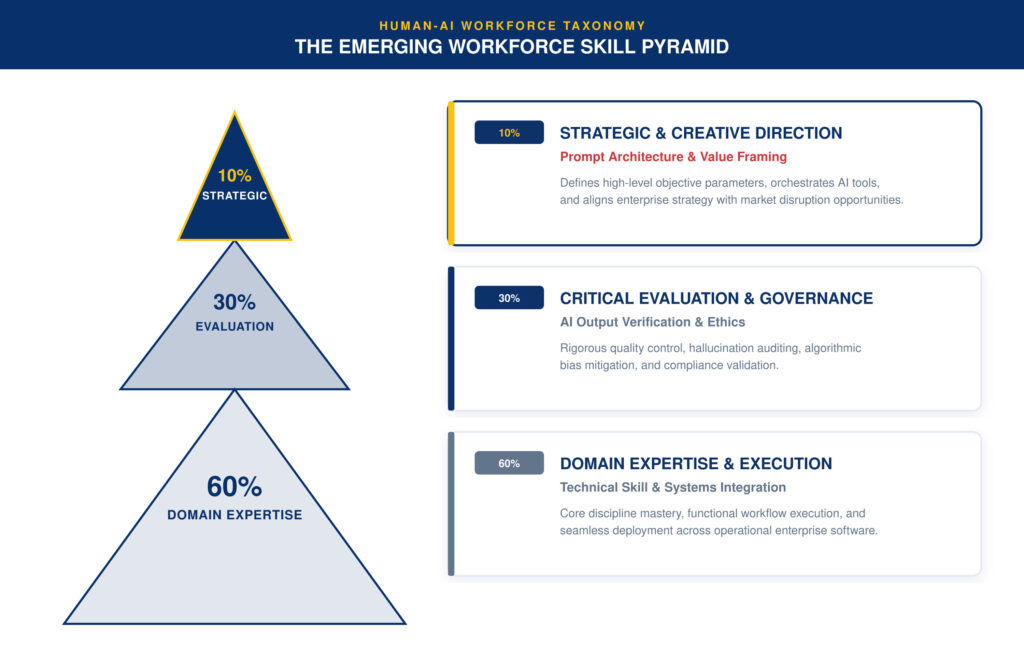
As routine synthesis, drafting, and coding are automated, the market value of pure technical execution decreases relative to high-level strategic oversight. According to research from the World Economic Forum, analytical thinking, creative thinking, and systems resilience represent the top core skills demanded by modern employers.
Modern professionals must develop AI Fluency:
- Prompt Architecture & Context Framing: Formulating precise, highly contextualized queries to yield accurate AI outputs.
- Critical Verification & Fact-Checking: Evaluating AI-generated insights for factual hallucinations, logical gaps, or hidden biases.
- Cross-Functional Domain Expertise: Connecting disparate data streams across sales, supply chain, and marketing to solve enterprise-level challenges.
New Career Pathways and Emerging Job Families
The expansion of generative technologies is creating brand-new professional categories:
- AI Ethicists & Compliance Officers: Governing algorithm fairness, data privacy standards, and regulatory compliance.
- AI Workflow Architects: Re-engineering operational business processes around autonomous AI agent capabilities.
- Data Curation & Annotation Specialists: Structuring proprietary enterprise knowledge graphs to fine-tune proprietary internal models.
Entry-Level Talent Disruptions
The shifting baseline particularly impacts early-career roles. A 2025/2026 McKinsey workforce report indicates that 51% of surveyed enterprises reported a reduced need for entry-level administrative positions due to generative automation.
To counter this, forward-thinking organizations are redesigning graduate development programs—shifting junior staff away from manual data preparation and training them immediately in data analysis, client management, and strategic execution.
Supercharging Creativity and Business Innovation
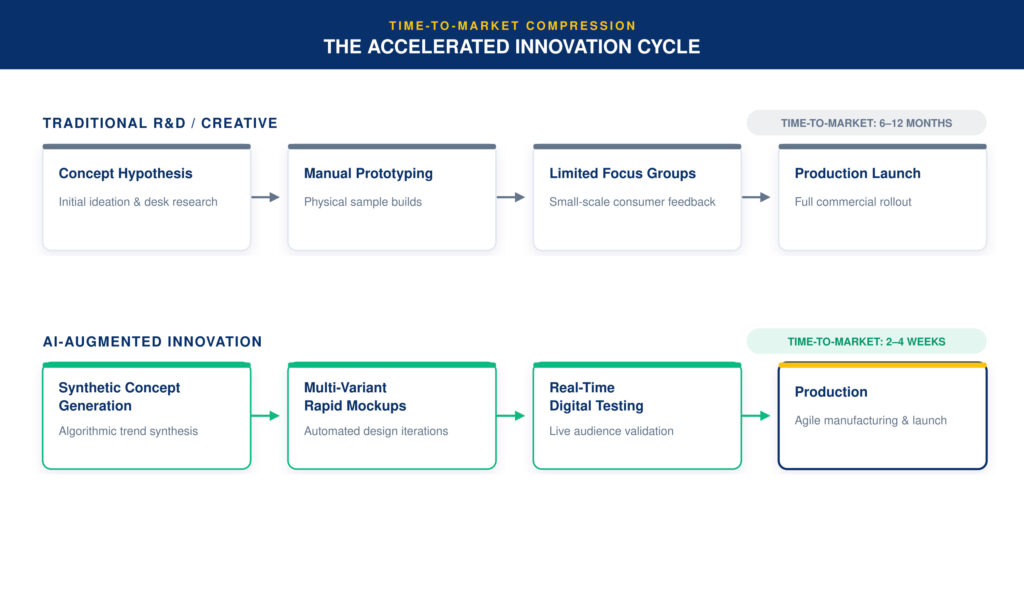
A common misconception is that artificial intelligence is strictly analytical and inherently uncreative. In practice, deploying generative AI in the workplace democratizes creative execution and speeds up innovation cycles across research and development (R&D), product design, and brand marketing.
Expanding Concept Generation and Ideation
In traditional product development, generating, testing, and refining concepts is a bottleneck. Generative AI functions as a force multiplier during ideation phases:
- Marketing & Packaging: Visual engines synthesize hundreds of package design variations, localized promotional messaging angles, and ad copy alternatives in seconds.
- Product R&D: Industrial designers and consumer packaged goods (CPG) brands use generative tools to explore novel formulation parameters, functional packaging shapes, and material cost trade-offs.
Cross-Industry Application Case Studies
- Pharmaceutical Development: Research institutions use generative molecular engines to design novel candidate drug compounds, reducing early-stage discovery timelines from years to months.
- Automotive Engineering: Design teams input structural constraints (weight, stress tolerances, aerodynamics) into generative design engines to yield optimized component geometries that human engineers would not typically conceive.
Navigating Operational Challenges, Ethics, and Risks
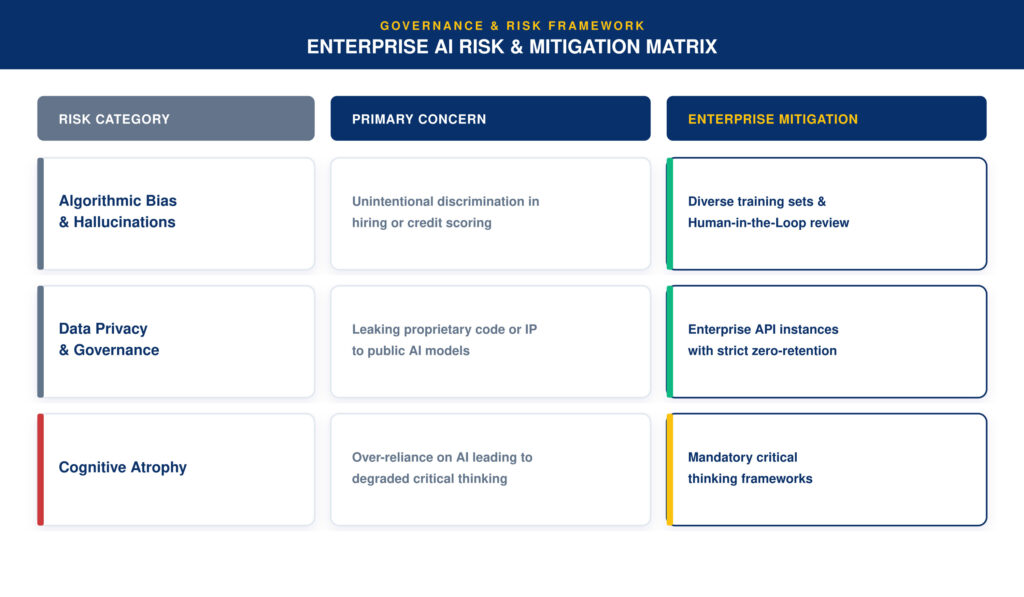
While the benefits are significant, integrating generative AI in the workplace introduces complex operational, legal, and human capital risks that require active executive management.
Data Privacy and Intellectual Property Protection
When employees input internal financial data, client lists, or software code into unvetted, publicly available AI applications, they risk exposing proprietary trade secrets. Organizations must establish strict data governance policies, deploying secured enterprise-grade AI environments with zero-data-retention clauses to protect corporate intellectual property.
Algorithmic Bias and Hallucinations
Generative models learn from historical datasets, meaning they can perpetuate historical societal, gender, or racial biases if left unmonitored. Furthermore, because these models predict sequence probability rather than absolute truth, they occasionally generate incorrect facts (“hallucinations”). Enterprise governance must enforce a strict “Human-in-the-Loop” (HITL) requirement for all high-stakes decisions.
Cognitive Atrophy and Organizational Risk
Over-reliance on automation risks eroding fundamental human capabilities. If junior staff never learn manual data modeling or primary research synthesis, an organization risks building long-term skill gaps. Progressive corporate learning strategies emphasize using AI to challenge human ideas rather than simply replace human thought.
Workforce Well-Being, Culture, and Mental Health
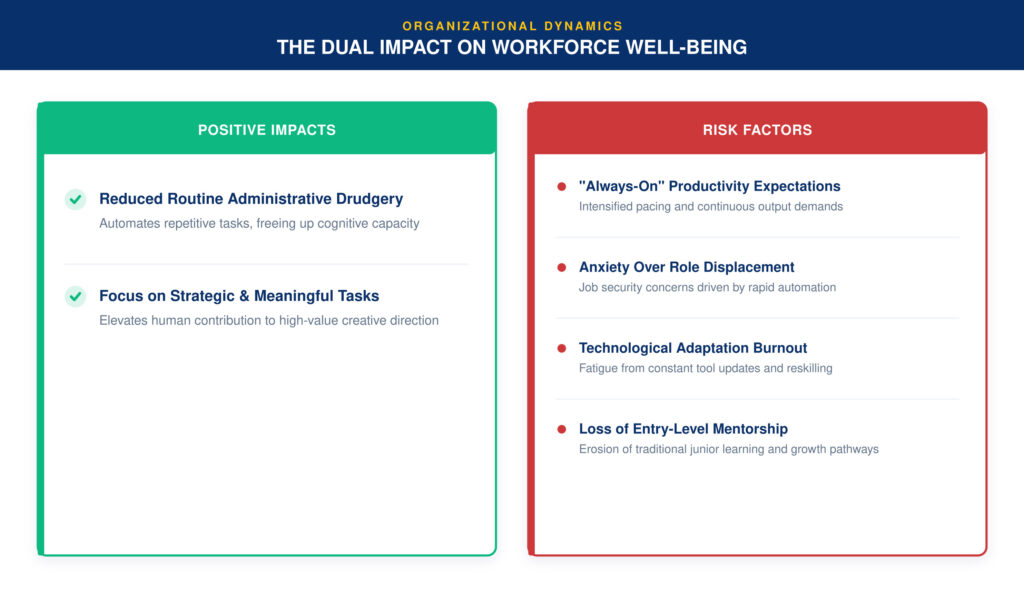
The psychological impact of deploying generative AI in the workplace is nuanced. While eliminating repetitive tasks reduces daily frustration, the pressure to constantly adapt to evolving software tools creates genuine cognitive fatigue.
Balancing Efficiency Gains with Employee Burnout
Automating routine work frees up employee bandwidth. However, if management responds by simply increasing workload expectations, employee burnout accelerates. Organizations should reinvest efficiency gains into strategic planning, employee professional development, and healthier work-life balance.
Retention Dynamics Among AI-Proficient Talent
Talent retention dynamics have shifted dramatically among tech-literate staff. McKinsey workforce studies show that highly proficient AI creators and heavy users exhibit a higher intent to quit compared to non-users.
These workers recognize that their skills command premium compensation across the broader job market. Keeping high-performing AI talent requires clear career progression, access to modern technology stacks, and competitive compensation architectures.
Strategic Roadmap: How Companies Prepare for the Future of Work
Successfully embedding generative AI in the workplace requires a clear, phased implementation framework. Organizations that deploy AI through disconnected, ad-hoc pilot programs often fail to capture measurable ROI.
Summary: Building a Future-Ready Enterprise
Generative AI in the workplace represents a fundamental restructuring of business operations, talent architecture, and competitive dynamics. Organizations that embrace this shift as a holistic operational discipline—centralizing data, upskilling teams, and executing with strategic agility—will continue to lead tomorrow’s market.
To learn how your organization can build a resilient, data-driven decision engine, connect with our analytics team Now!