

In a rapidly changing, ever-evolving, complex world, it is a challenge for organizations to prepare for change and develop efficient strategies that truly move the needle. A phenomenon used to describe this world—the VUCA world—was initially established by the U.S. Army War College, describing our environment as VUCA: volatile, uncertain, complex, and ambiguous. The term later evolved into a common one in complex environments such as governments and organizations.
When we speak about VUCA, the FMCG industry is one of the main industries that comes to mind due to the complexity of its nature. In such complex environments, it is critical for businesses to adopt the latest innovations that aid decision-making processes.
Today, in the VUCA world, Western Europe tackled supply chain disruptions, prompting consumers to focus on essentials, while Eastern Europe saw a 4% decline in FMCG sales in 2022, driving private label growth amid rising inflation (FMCG Pulse by NIQ). Businesses operating within the FMCG industry should adopt innovations that generate the most results, including IoT, AI, and data analytics.
In this blog post, we will dive deep into the role of data analytics in FMCG, how to operate in VUCA environments, the benefits of data analytics in FMCG and VUCA environments, and how data analytics can lead to business growth and success.
Role and Importance of Data Analytics in the FMCG Industry
In a fiercely competitive environment like consumer goods, data is vast and critical. Because of this, data analysis and the use of data analytics are paramount to overcoming competition and moving forward. Using data analytics to analyze large volumes of data opens several opportunities for FMCG businesses, supporting overall success and growth.
Businesses operating in VUCA environments can benefit from data analytics by:
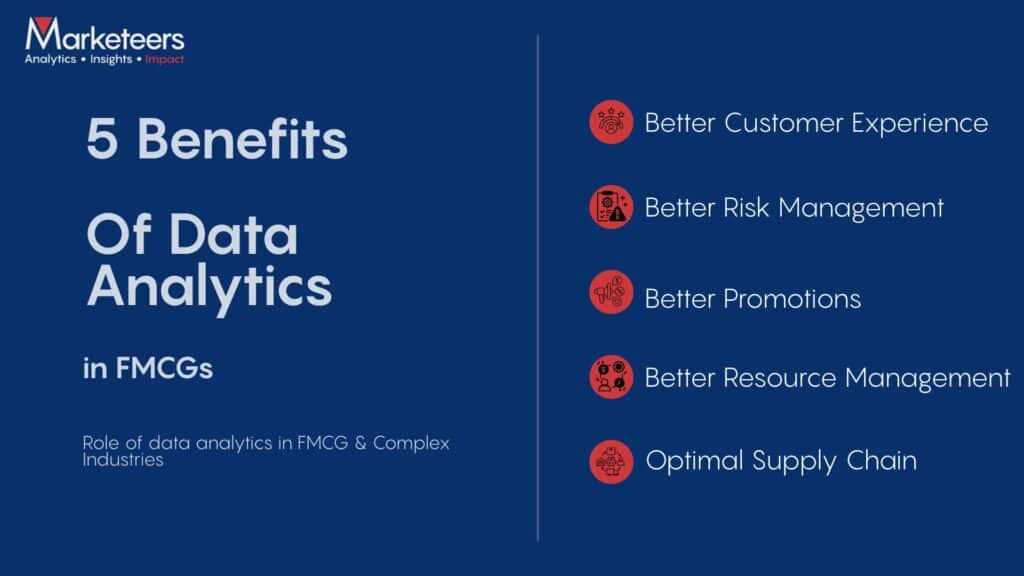
1. Understanding Customer Needs
Real-time processing and predictive analytics empower FMCG companies to anticipate evolving needs, positioning them as agile leaders amidst market uncertainties. In today’s VUCA world, FMCG companies should rely on data analytics to delve deeper into consumer behavior and gain profound insights into customer preferences. This enables precise product customization, more effective new product introductions, and stronger brand loyalty.
Additionally, data analytics allows businesses to uncover hidden patterns in consumer behavior through analysis of various touchpoints such as website visits and social media interactions. Not only does data analytics support understanding consumer requirements, but it can also help optimize marketing efforts by identifying the most efficient digital marketing channels to leverage. This ultimately leads to a better customer experience and higher satisfaction through personalized messaging across different initiatives.
2. Strategic Pricing and Risk Management
In the complex realm of FMCG, data analytics can offer profound market insights by leveraging predictive tools to anticipate market fluctuations. This helps ensure financial stability and empowers businesses to assess profitability.
Furthermore, determining the ideal product price becomes easier when key aspects—such as target buyers, product quality, competitor pricing, and market demand—are meticulously analyzed. Data produced on a daily basis is vast and could reach nearly 200 zettabytes in the years to come. Using data analytics for pricing and risk management enhances decision-making by generating scenarios, identifying patterns, and predicting changes that may occur.
Data analytics also helps minimize risks through compliance with regulations, as it allows firms operating in sensitive environments to identify regulatory gaps and address them in real time. By using data analytics, businesses can monitor regulatory status, detect fraud, and assess risks effectively. Businesses leveraging data analytics can also benefit from risk reporting, ensuring that stakeholders receive the latest updates regarding risks—enabling faster problem-solving and resolution.
3. Precision in Promotional Activities
Promotions are critical for engaging consumers effectively in the VUCA world. Data analytics generates reports that help sales and marketing teams in FMCG businesses set strategic promotional pricing. Moreover, by understanding patterns in specific customer needs, teams can identify peak sales periods and trends to craft promotions accordingly.
This enables personalized campaigns that drive higher engagement, increased sales, and improved ROI. Advanced techniques such as customer segmentation and predictive modeling help create promotions that target the right audience more effectively.
4. Efficient Allocation of Resources
Data analytics can align manpower, marketing budgets, raw materials, and inventory with areas of high demand. Precise insights facilitate informed decision-making, ensuring operational efficiency and cost savings.
With strategic planning guided by data, FMCG companies can reduce waste and enhance overall productivity, maximizing ROI in a volatile VUCA world. In short, data analytics can support efficient resource allocation by aiding in problem understanding, and in collecting, cleaning, and visualizing large amounts of data.
5. Optimized Supply Chain Management
Data analytics, with its real-time insights and historical analysis, offers unparalleled visibility into supply chain processes. By accurately forecasting demand patterns, FMCG businesses can streamline production, inventory management, and distribution. This precision mitigates the risks associated with overstocking or stockouts, ensuring operational efficiency even amidst disruptions.
It has been recorded that firms that implement data analytics services can enhance operational efficiency by around 30%. Businesses can use data analytics to optimize supply chain management through demand forecasting, risk prediction, and traffic optimization. This consequently provides real-time insights, optimizes inventory management, and improves overall logistics performance.
How Can Businesses Operate in The VUCA World
As discussed earlier, VUCA environments are fast-paced, fiercely competitive, and uncertain. To operate in such environments, essential steps must be taken. To succeed in VUCA environments, businesses should:
Research Trends Constantly
It is paramount for businesses operating within VUCA environments to stay alert to new innovations and trends on a regular basis. Many FMCG corporations do this, but only yearly or a few times per year. However, in such environments, the key to success is to always be on the lookout for new innovations, trends, and changes. Doing so only once a year will not deliver the expected results.
Therefore, businesses in the consumer goods industry must stay on a constant journey of discovering new tools and solutions to thrive in such fierce environments. Researching trends and innovations is the first—and most integral—part of any strategy, especially in rapid industries like FMCG.
Cross-Functional Collaboration
Businesses operating within the consumer goods industry should deliberately ensure that all departments collaborate in their processes. This can be achieved in several ways, but before doing so, organizations should provide clear guidelines and processes to enable smooth collaboration.
By involving multiple teams, there is room for broader information collection, more ideas, and stronger partnerships in achieving business objectives. After collaboration, decision-makers should encourage discussions and debates about the ideas generated. This should happen regularly so that when a new innovation or idea emerges, it is discussed sooner rather than later—helping the business keep up with competition.
When employees collaborate with one another, it becomes a recipe for smarter and more productive work.
Do Not Create a Fixed Strategy
In dynamic environments like VUCA, a fixed strategy can do more harm than good due to the ever-evolving nature of such environments. A strategy that allows room for modification and adaptation will consistently outperform a static one.
To achieve this, it is crucial to avoid stagnation and allow room for continuous improvement. It is also important to stay updated with industry changes, involve members from different departments in shaping the strategy, and maintain a flexible mindset to achieve business goals. Adapting your strategy continuously is key to success in a VUCA world.
How Can Data Analytics Lead to Business Growth?
Every business aims to grow and move forward. Data analytics is integral for businesses that aim to succeed—or sustain their success—because it can minimize costs, increase productivity, and optimize processes.
Despite data being essential for success, many businesses still struggle to structure scattered data. These businesses are estimated to be around 95%. Data analytics leads to business growth by enhancing customer experience, minimizing risks, reducing operational costs, and optimizing supply chain management.
Conclusion
In a VUCA world like the one we live in, the role of data analytics in driving business growth within the FMCG industry cannot be overlooked. Data analytics can support growth in several ways, such as improving customer experience through an in-depth understanding of customer needs and behavior, enabling strategic pricing and risk management, and supporting more effective promotions.
To operate successfully in a dynamic and fiercely competitive world like the VUCA world, businesses must stay on the lookout for trends, encourage organization-wide collaboration, and avoid stagnant and outdated strategies. By leveraging data analytics and operating effectively in challenging environments, success can be achieved when these steps are executed well.