

How to Turn Lagging Brand Health Metrics into Diagnostic Roadmaps for Market Share Recovery and Commercial Growth.
Investing in continuous brand tracking only to discover declining brand health, falling top-of-mind awareness, or weakening consideration scores is a scenario no commercial leader wants to face. For brand managers, CMOs, and marketing strategists, seeing a dip in brand performance can feel alarming, especially when marketing budgets are under scrutiny and sales targets are tight.
However, discovering a weak brand tracking score is not a dead end. In fact, when approached with a data-driven mindset, negative or stagnant tracking metrics serve as a vital early-warning system.
The real danger in modern commercial execution is not discovering a weak score; it is relying on outdated post-campaign autopsies or ignoring early shifts in consumer sentiment until they manifest as unearned sales volume erosion. By treating brand tracking as an ongoing diagnostic tool rather than a static report card, leadership teams can identify the exact root causes of underperformance and execute targeted commercial turnarounds.
1. The Critical First Step: Acknowledge the Signal and Shift from Defense to Diagnostics
When brand tracking data reveals a decline in performance, the most critical step leadership can take is to acknowledge the problem immediately and shift organizational focus from defensive justification to diagnostic action.
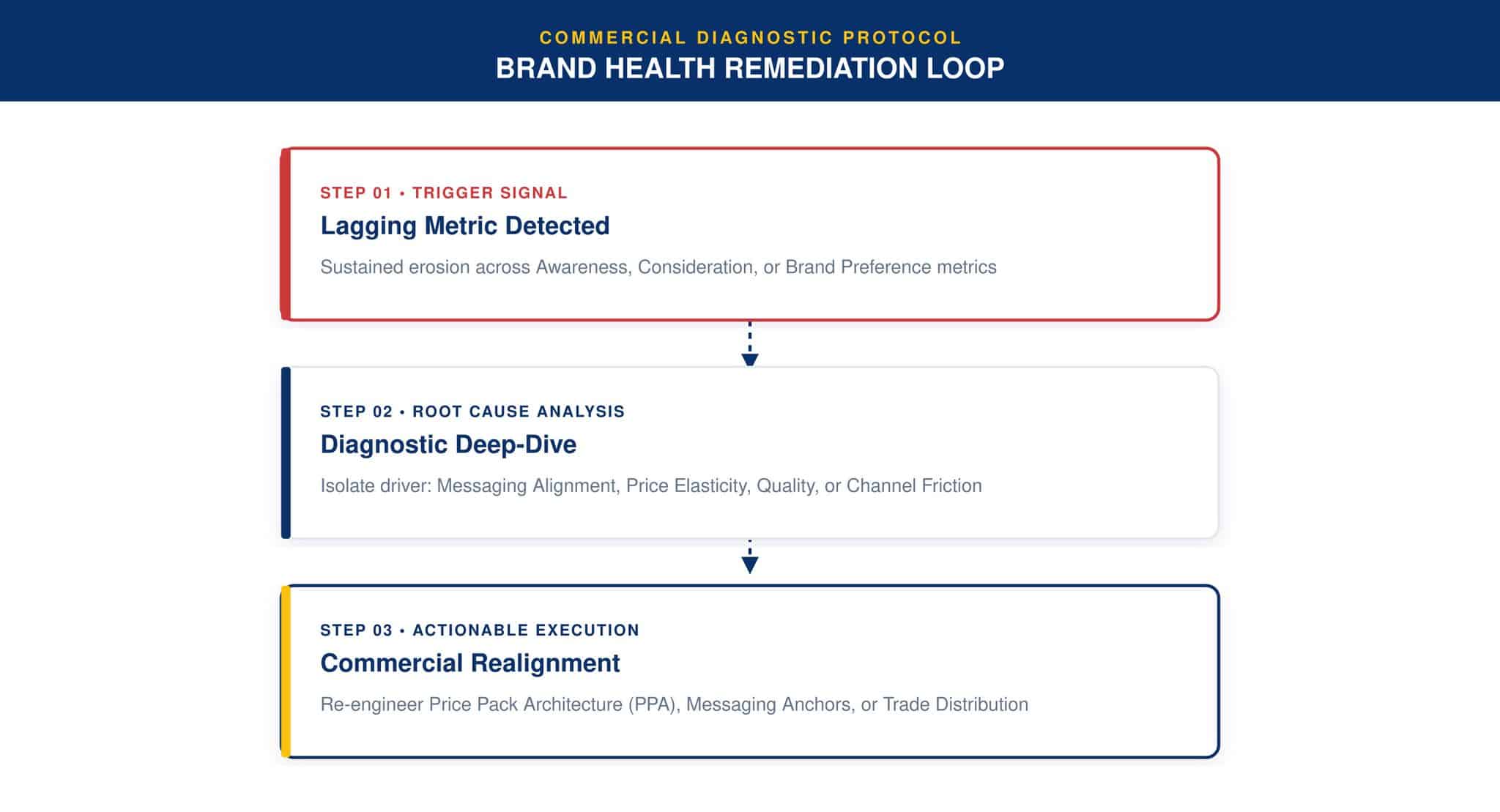
Rather than viewing poor scores as a failure, forward-thinking organizations treat them as an opportunity to understand why shoppers are migrating to competitors. Modern, tech-enabled brand tracking provides fast, continuous consumer insights that allow companies to pinpoint friction points without waiting for quarterly sales declines.
Acknowledging brand health signals allows commercial teams to:
- Uncover the Real “Why”: Move beyond surface-level sales metrics to discover the psychological and behavioral drivers causing consumers to choose alternative brands.
- Execute Precision Product and Portfolio Adjustments: Identify whether the fix requires altering product formulations, adjusting price-pack architecture (PPA), refreshing packaging, or refining brand positioning.
- Bridge the Value Gap: Understand what specific functional or emotional benefits are missing, ensuring your value proposition aligns with modern shopper expectations.
- Identify Competitor Strengths: Gain continuous clarity into competitor messaging tactics, promotional mechanics, and distribution strategies that are currently winning shelf space.
- Protect Profit Margins and Market Share: Make targeted, budget-conscious operational adjustments that boost sales velocity and drive sustainable revenue growth.
2. Deconstructing the Weakness: Where Is Your Brand Leaking Value?
A “weak brand” score is rarely a single, uniform problem. Brand tracking measures performance across a multi-stage consumer funnel. To fix a weak score, commercial leaders must isolate exactly where the breakdown is occurring along the purchase journey.
Gap A: The Awareness Deficit
If tracking shows low top-of-mind (TOM) or unaided awareness, your brand is simply invisible to a large portion of the category. This is often driven by fragmented media spend, ineffective creative framing, or poor digital shelf presence.
Gap B: The Consideration Bottleneck
If your brand enjoys high awareness but suffers from low consideration or intent-to-buy, shoppers know who you are but do not believe your product offers sufficient value relative to its shelf price.
To understand how price perception and psychological thresholds impact consideration, read our guide on How FMCGs Tap into Consumers’ Minds with Psychological Pricing.
Gap C: The Conversion Breakdown
When consideration is high but point-of-sale (POS) conversion lags, the problem usually sits in the trade environment. Out-of-stock SKUs, poor shelf placement in modern trade, or uncompetitive promotional bundles cause shoppers to default to adjacent options at the aisle.
Gap D: The Loyalty Leak
If trial rates are strong but repeat purchase metrics drop off, the issue resides in the product experience itself, ranging from packaging frustration to shifting consumer quality expectations.
To learn how primary behavioral research maps consumption rituals and product usage friction, explore What a Usage & Attitude Study Actually Tells You About Consumers.
3. Aligning Brand Health with Revenue Growth Management (RGM)
Fixing a weak brand tracking score requires connecting market research insights directly to commercial execution. Brand health does not exist in a vacuum; it directly impacts your brand’s pricing power, promotional efficiency, and retailer trade negotiations.
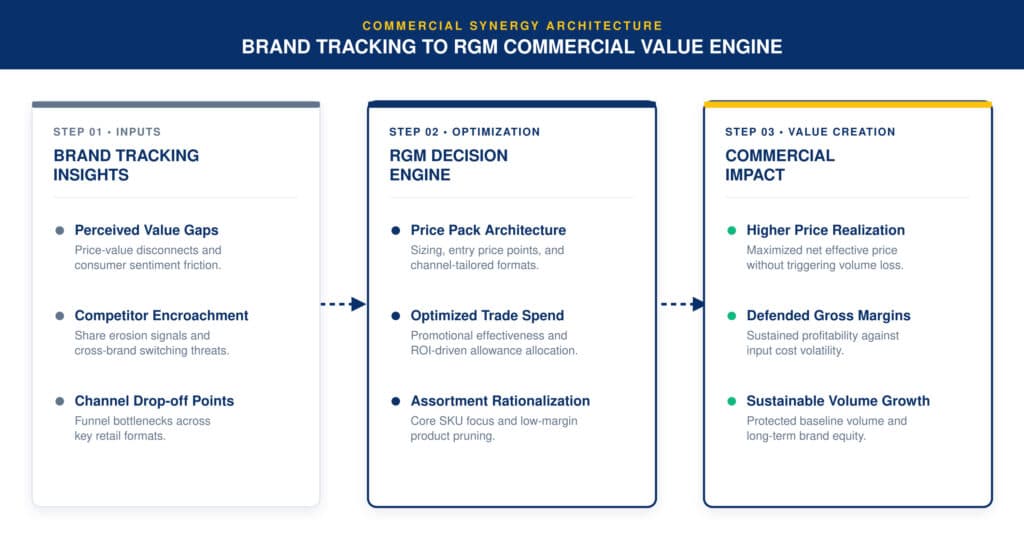
When brand tracking indicates weakening equity, commercial teams must deploy Revenue Growth Management (RGM) levers to stabilize market share:
- Re-Engineer Price-Pack Architecture (PPA): If inflation or currency devaluation has eroded brand affordability, introduce accessible package sizes or single-serve formats that protect core trial rates without resorting to margin-diluting discounts.
- Optimize Trade Spend ROI: Instead of running deep, unearned price cuts that weaken brand equity over time, realign promotional budgets behind high-ROI mechanics that incentivize multi-pack buys or trial across adjacent SKUs.
- Strengthen Retailer Joint Business Planning (JBP): Use tracking data to prove category value to retail buyers, showing how your brand drives basket size and shopper frequency across modern trade channels.
For a complete framework on balancing pricing, trade spend, and assortment mix, read RGM 360: Unlocking the Power of Pricing for CPG/FMCG.
4. How Modern Analytics and Testing De-Risk Brand Turnarounds
Once your tracking identifies the core weakness and your team formulates a recovery strategy, executing changes in the live market without prior testing introduces unnecessary commercial risk.
Leading global brands rely on structured testing protocols to validate strategic changes before rolling them out nationally:
Leveraging Advanced Data Architecture
By combining historical sales data with continuous behavioral streams and predictive analytics, brand leads can model “What-If” market scenarios. They can evaluate how a proposed packaging redesign, a new messaging angle, or a price adjustment will impact volume, revenue, and brand perception before committing capital.
Discover how modern analytics architectures accelerate enterprise decision-making in Unlocking Enterprise Value with Advanced Data Analytics.
Adhering to Global Methodological Standards
To ensure that brand tracking data and diagnostic studies reflect true consumer sentiment rather than statistical noise, enterprise research must follow rigorous international quality benchmarks, such as those established by ESOMAR World Research Standards.
Rebuild Your Brand Equity with Marketeers Research
Discovering a weak brand tracking score is the first step toward building a stronger, more resilient market presence. The Smart Value™ Platform and comprehensive tracking architectures from Marketeers Research provide brand leaders with the empirical clarity needed to diagnose performance gaps, model recovery scenarios, and drive sustainable growth.
By combining continuous consumer tracking, predictive analytics, and deep category expertise, our platforms empower your commercial team to:
- Isolate exact funnel friction points across awareness, consideration, conversion, and loyalty.
- Test proposed messaging, packaging, and pricing changes in simulated retail environments.
- Align marketing investments with proven Revenue Growth Management (RGM) levers.
- Turn brand health tracking from a static report card into a proactive commercial growth engine.
Turn Your Brand Tracking into Action Today
Don’t let declining brand tracking scores erode your market share or margin potential. Isolate consumer friction, validate strategic pivots, and rebuild your brand equity with confidence.
👉 Contact the team at Marketeers Research today to schedule a diagnostic brand tracking consultation.