

Entering a new geographic market, launching an adjacent category, or expanding into a fresh customer segment is one of the highest-stakes moves a business can make. The upside can transform a brand’s growth trajectory—but moving forward without rigorous data often results in misaligned pricing, missed demand, or sudden regulatory friction.
To turn market entry from a high-stakes gamble into a calculated expansion, strategic decision-makers rely on a comprehensive analytical blueprint: the 5 Cs of Market Assessment. By systematically evaluating Company, Customers, Consumers, Competition, and Context, business leaders gain a complete 360-degree view of market viability before committing capital.
At Marketeers Research, we combine deep local intelligence with structured research frameworks to de-risk market expansion. In this guide, we break down how evaluating each of the 5 Cs equips commercial teams with the clarity needed to enter new markets with confidence.
What Is the 5 Cs Framework in Market Assessment?
A market assessment isn’t just a collection of surface-level statistics; it is a structured evaluation designed to test the feasibility, demand, and risk profile of a new commercial move. While many strategic models focus purely on internal readiness or macro-environmental factors, the 5 Cs framework synthesizes internal capabilities with external market dynamics into a single diagnostic tool.
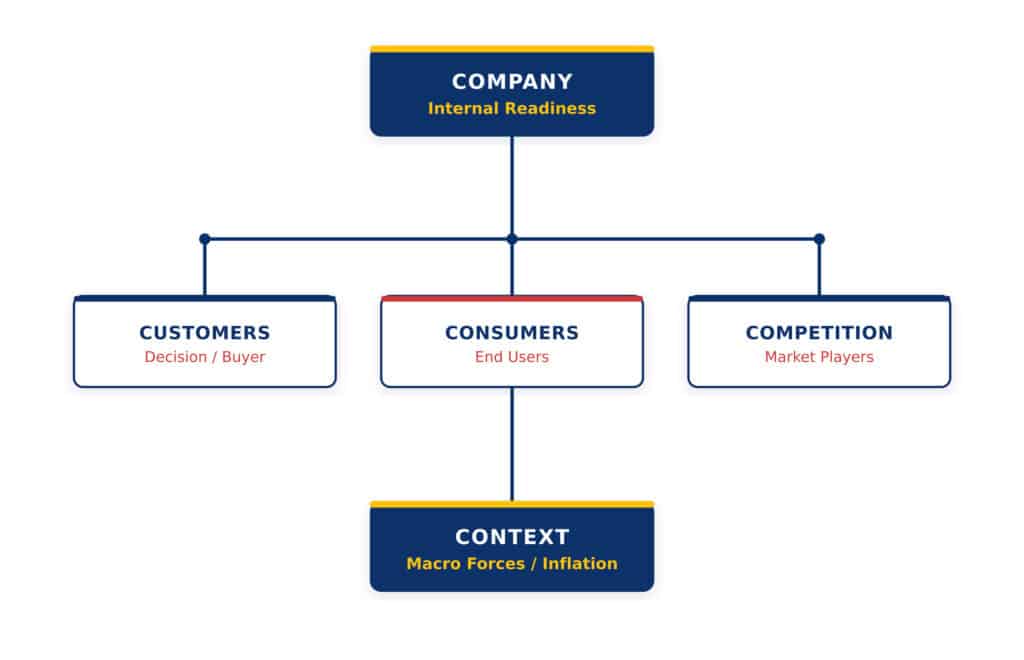
By examining how these five variables interact, organizations avoid common pitfalls—such as designing a product that users love (Consumers). Still, buyers refuse to fund (Customers), or building a strategy that looks compelling on paper but falls victim to macroeconomic headwinds (Context).
Combining qualitative exploration with quantitative validation turns these five theoretical pillars into an actionable decision engine. As detailed in our analysis on navigating product development and market entry challenges, grounding strategic roadmaps in real empirical research is what separates successful market entries from costly missteps.
Breaking Down the 5 Cs for Market Entry
Evaluating each of the 5 Cs individually reveals the granular insights needed to build a viable go-to-market strategy. Below, we break down each pillar and illustrate its application using real-world data points from an eight-week market assessment conducted for an investor evaluating entry into Egypt’s private school sector.
Company (Internal Readiness)
Before evaluating external opportunity, an organization must measure its own capabilities against the operational, financial, and cultural requirements of the target market.

Key Focus Areas: Capital requirements, brand equity adaptability, resource allocation, and core operational strengths.
Case Example: In evaluating entry into Egypt’s private education sector, the client’s core question was whether to deploy capital or walk away. Internal readiness analysis established the required operational runway needed to sustain construction, faculty hiring, and brand positioning across an 8-week decision cycle.
2. Competition (Market Landscape)
Mapping the competitive landscape reveals who dominates local market share, how incumbents set their pricing, and where underserved white spaces exist.
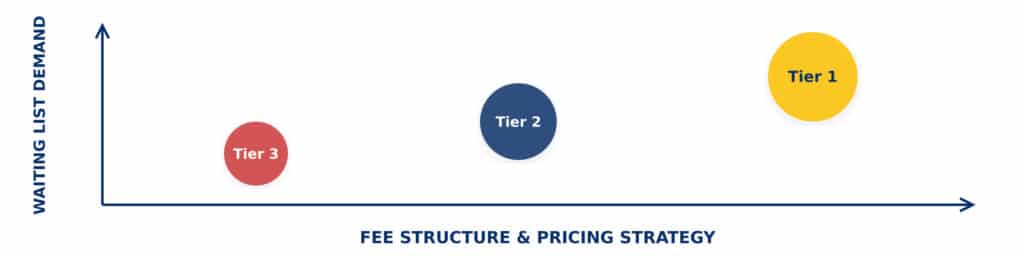
Key Focus Areas: Market concentration, incumbent fee structures, occupancy rates, and retention levels.
Case Example: Research mapped existing private schools to analyze how competitors structured tuition fees and maintained operating margins. By examining waiting lists, retention numbers, and capacity utilization across existing operators, the assessment provided real proof of underlying market demand.
3. Customers (The Buyers)
Understanding the customer—the economic decision-maker who evaluates options and pays for the service—is crucial for setting effective pricing and messaging.

Key Focus Areas: Purchasing power, decision drivers, perceived value, and adoption barriers.
Case Example: In the school expansion study, the parents were identified as the primary Customers—they hold the purchasing power and make the final financial decision. Research evaluated what drove their choice of school, what financial or cultural reservations held them back, and how they perceived different international and national curricula.
4. Consumers (The End Users)
Crucially, the person paying for a product or service is not always the one using it. Separating the consumer from the customer ensures product-market fit at the user level.

Key Focus Areas: End-user experience, feature preference, brand affinity, and age/demographic shifts in decision influence.
Case Example: In this sector, the students are the Consumers. Research revealed that a student’s say in school selection changes significantly with age. While parents make unilateral choices for primary education, older students exert substantial influence over high school selection, directly affecting school retention rates.
5. Context (Macro Environment)
Macroeconomic conditions, regulatory policies, and socio-cultural trends can dictate the success or failure of market entry regardless of internal readiness.

Key Focus Areas: Inflation, currency shifts, regulatory frameworks, socioeconomic trends, and policy changes.
Case Example: During the assessment period, macroeconomic inflation was the single largest contextual driver. The research evaluated how rising cost pressures were reshaping household budgets, determining the ceiling for tuition hikes parents could absorb before switching to lower-tier options.
How Marketeers Research Delivers Actionable Market Assessments
Evaluating the 5 Cs requires more than compiling publicly available statistics—it demands an integrated research approach that bridges qualitative context with quantitative scale. When organizations assess a new market, success hinges on moving from abstract market potential to definitive, risk-adjusted commercial recommendations.
At Marketeers Research, we operationalize the 5 Cs framework through bespoke primary field research, proprietary market modeling, and local industry expertise across regional markets. Rather than delivering passive market overviews, our assessments are designed to answer one fundamental question: Is this market worth entering, and if so, what is the exact playbook to succeed? As we explored in our strategic guide on why every growth strategy should start with a market assessment, grounding capital decisions in objective consumer and competitor intelligence is the single most reliable way to protect margin and accelerate time-to-market.
Real-World Case Study: Evaluating Egypt’s Private Education Sector
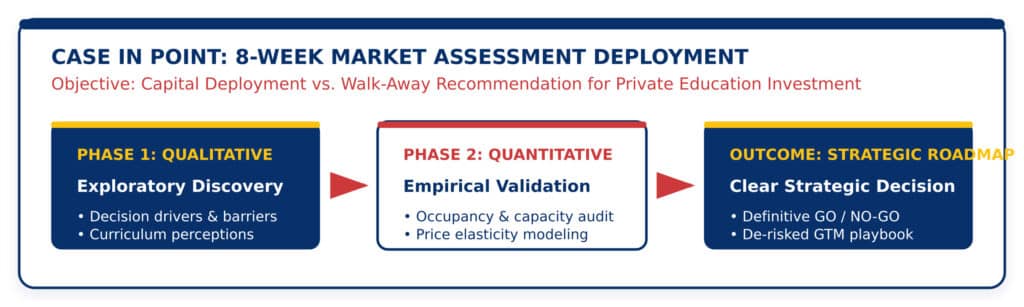
To demonstrate how this integrated methodology functions in practice, consider a investment decision evaluated by Marketeers Research. A high-net-worth institutional investor approached our team to evaluate a critical investment choice: should they deploy major capital into Egypt’s expanding private school sector, or walk away?
Over an eight-week working period, Marketeers Research designed and executed a multi-phased assessment that systematically tested all 5 Cs:
- Phase 1 (Qualitative Exploration): We conducted in-depth qualitative sessions with parents (Customers) and students (Consumers) to map emotional drivers, switching costs, and curriculum expectations. Simultaneously, expert interviews were conducted across the educational landscape to map structural inflation impact (Context).
- Phase 2 (Quantitative Validation): Armed with qualitative hypotheses, we rolled out quantitative field surveys and competitive benchmarking. This phase measured exact occupancy rates, waiting list volume, fee sensitivity thresholds, and retention rates across incumbent schools (Competitors).
By synthesizing internal investment readiness (Company) with external market realities across the other four Cs, Marketeers Research delivered a definitive, data-backed recommendation that transformed a complex market entry question into an actionable investment decision. To explore how our advisory team customizes this methodology for B2B and B2C enterprises, visit our Market Assessment Service Page.
Frequently Asked Questions (FAQ)
Q1: What is the main difference between general market research and a market assessment?
Answer: General market research often addresses localized tactical questions, such as testing a specific ad concept, evaluating package design, or tracking brand awareness. A market assessment is a holistic, strategic evaluation of market feasibility, financial viability, competitive dynamics, and growth runway. It is designed specifically to answer high-stakes commercial questions like market entry, portfolio expansion, or major capital allocation.
Q2: How long does a full 5 Cs market assessment take from brief to final presentation?
Answer: While timeline depends on geographic scope and target audience complexity (B2B vs. B2C), a comprehensive market assessment typically spans 4 to 12 weeks. As shown in our private education case study, an 8-week timeframe provides ample space to run a rigorous two-phase methodology—combining qualitative discovery with quantitative field validation—without delaying critical business timelines.
Q3: Why is it important to evaluate Customers and Consumers separately in a market assessment?
Answer: In many categories, the entity paying for the product or service (Customer) is not the entity using it (Consumer). For instance, in education, parents hold the budget while students experience the service; in B2B tech, IT directors purchase the software while line employees use it daily. Separating the two ensures that messaging addresses the buyer’s value requirements while product features satisfy the end-user’s operational needs, securing both initial adoption and long-term retention.
Q4: How does Marketeers Research account for macroeconomic volatility (like inflation) during an assessment?
Answer: Macroeconomic factors like currency devaluation and inflation directly impact both operating margins and consumer price elasticity. Marketeers Research incorporates dynamic economic modeling into the Context analysis, testing price sensitivity across socio-economic tiers. This allows brands to establish price floors and ceilings that protect margin while remaining accessible to target buyers.
Expanding into a new market is one of the most powerful levers for enterprise growth—but relying on internal assumptions or surface-level reports carries significant financial risk.
By structuring market entry around the 5 Cs of Market Assessment—Company, Customers, Consumers, Competition, and Context—business leaders replace guesswork with empirical clarity. Whether evaluating private education investments in Egypt, FMCG expansion across KSA, or new category launches in the GCC, an integrated assessment provides the visibility required to move forward with absolute confidence.