

For decades, commercial strategy across Egypt’s Fast-Moving Consumer Goods (FMCG) and retail sectors followed a standard playbook: define your target audience by age, gender, geographic location, and socioeconomic class (SEC), then deploy mass-market product variations and promotional campaigns aimed at those broad buckets.
In a stable economic environment, basic demographic profiling provided a functional approximation of market demand. But Egypt’s commercial reality has shifted dramatically.
Driven by persistent currency fluctuations, rapid inflation, the explosive growth of modern digital channels, and shifting household budgets, Egyptian consumer behavior has fragmented. Today, two 35-year-old middle-class mothers living in Cairo’s Nasr City—identical in demographic profile, household size, and income bracket—frequently demonstrate opposite purchasing behaviors:
- Shopper A: Trims her total basket size, abandons legacy multinational brands, buys unbranded bulk staples, and waits for temporary price reductions to preserve cash flow.
- Shopper B: Downsizes package volume rather than switching brands, prioritizing functional efficacy, sensory familiarity, and time-saving convenience for her family.
Relying solely on traditional demographic data creates an expensive operational blind spot. It explains who might walk into a store, but fails to reveal why they select a specific stock-keeping unit (SKU), how they integrate it into their daily routines, or what psychological triggers cause them to switch to a competitor.
To navigate this complexity, forward-thinking brands rely on a comprehensive usage and attitude study in Egypt. By shifting focus from basic consumer profiles to behavioral drivers, brand affinity, and usage occasions, a U&A study reveals the underlying mechanics of consumer decision-making.
The Collapse of Demographics as a Standalone Strategy in Egypt
Demographic metrics treat consumers as static categories. They assume that individuals who share physical or economic traits evaluate products using the same value criteria. However, Egypt’s unique market dynamics make demographic data alone insufficient for predicting commercial outcomes.
1. Macroeconomic Pressures & Dynamic Elasticity
Macroeconomic shifts over recent years have forced Egyptian households across all socioeconomic tiers to rethink their spending. According to financial analysis from the Central Bank of Egypt economic reports, persistent inflationary pressure has directly impacted consumer purchasing power.
When disposable income drops, consumers do not react uniformly within demographic bands. Instead, their choices are guided by deeply ingrained personal values, brand loyalty, and risk tolerance. A pure demographic model cannot predict which consumers will accept a price hike to maintain quality and which will instantly switch to a local alternative.
2. The Urban-Regional Behavioral Divide
Lumping “urban Egyptian consumers” into a single demographic group overlooks distinct regional habits:
- Greater Cairo: High digital channel adoption, rapid growth in quick-commerce apps, and acute time-poverty drive demand for convenient, pre-packaged solutions.
- Nile Delta Cities (e.g., Tanta, Mansoura): Strong brand awareness paired with high reliance on traditional retail networks and localized word-of-mouth validation.
- Upper Egypt (e.g., Asyut, Sohag): Multi-generational household dynamics where purchasing decisions prioritize total volume yield, durability, and bulk value over convenience messaging.
Demographic data lists these consumers under similar regional or income tags, missing the structural usage contexts that dictate how products are consumed in everyday life.
3. Cultural Micro-Cohorts
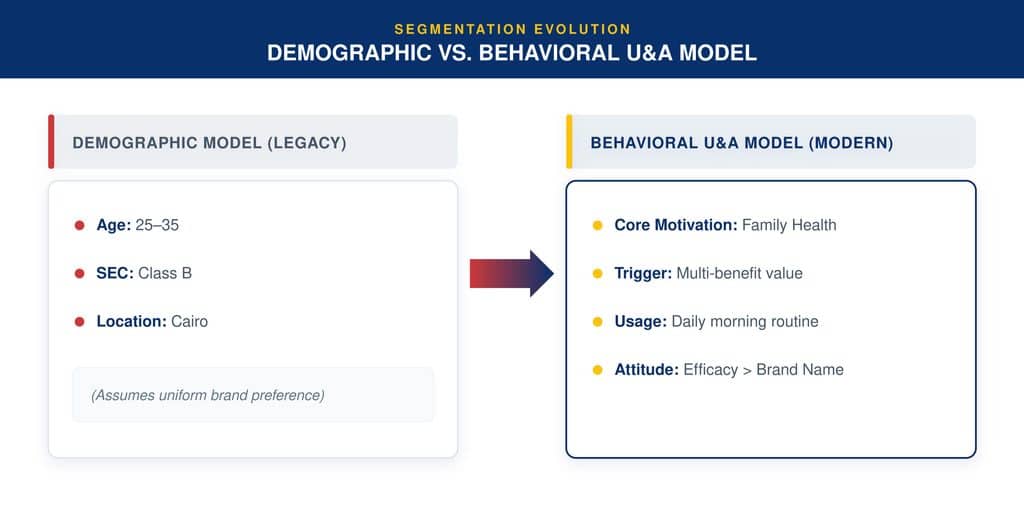
The rise of social commerce and digital connectivity across Egypt has fostered distinct micro-cohorts bound by shared lifestyle philosophies rather than age or income. From fitness-focused young professionals seeking functional, clean-label foods to budget-conscious parents organizing community buying circles, motivation now trumps demographics.
What a Usage & Attitude (U&A) Study Uncovers
A usage and attitude study in Egypt combines qualitative and quantitative methodologies to map out the complete consumer landscape within a given product category.
Where basic sales tracking reports what sold, a U&A study analyzes the behavioral mechanics behind every purchase:
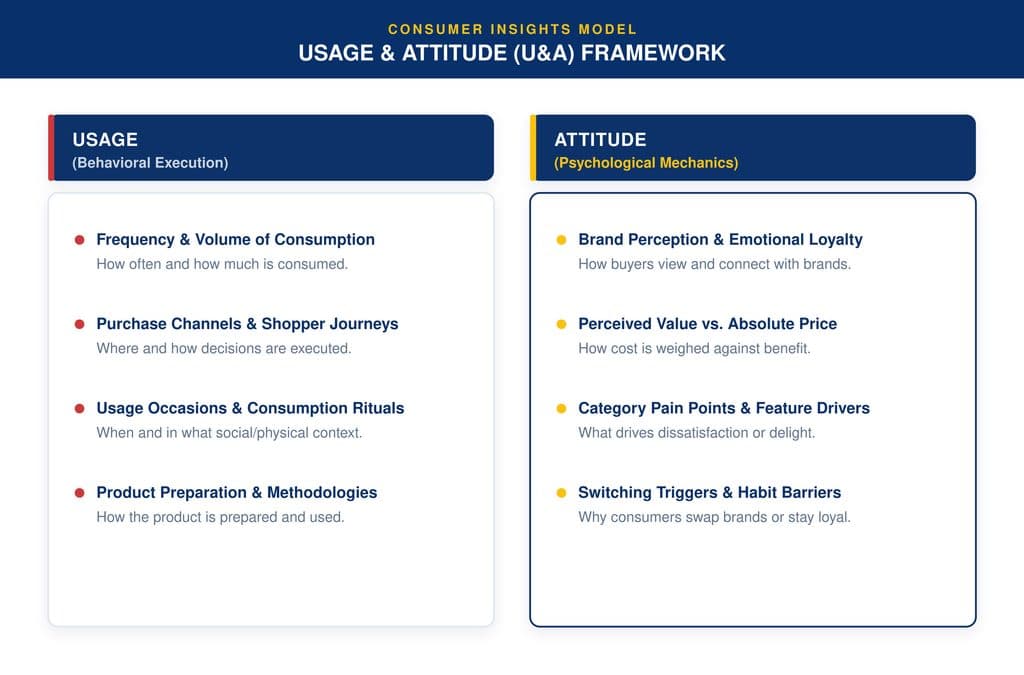
1. The Anatomy of Usage: Beyond “How Much” to “How and When”
The usage dimension of a U&A study tracks the real-world interaction between the consumer and the product:
- Frequency & Volume: Differentiating between heavy, medium, light, and lapsed users to understand where the core volume of category consumption resides.
- Occasion Mapping: Identifying the exact moments a product is used. For instance, is a beverage consumed as an energy pick-me-up during work hours, a social refreshment during family weekend gatherings, or a functional reward?
- The Consumption Ritual: Documenting how Egyptian consumers interact with a product in their homes. This includes secondary uses, custom mixing habits, or home-storage solutions that product developers rarely anticipate.
- Channel Navigation: Mapping where product categories are actually acquired—balancing modern hypermarkets, neighborhood corner grocers (kiosks and bakkals), and emerging e-commerce platforms.
2. The Mechanics of Attitude: Uncovering the “Why”
The attitude dimension evaluates the emotional, cognitive, and cultural beliefs that govern consumer choices:
- Brand Perception & Equity: Evaluating where your brand stands on top-of-mind awareness, perceived quality, trustworthiness, and innovation compared to category competitors.
- Price-Value Perceptions: Identifying what modern Egyptian consumers consider “worth paying for.” Is value defined by low shelf price, pack size, concentrated formulas that last longer, or multi-functional benefits?
- Unmet Needs & Friction Points: Pinpointing everyday frustrations with current products—ranging from hard-to-open packaging and short shelf life to artificial ingredients and unpleasant textures.
Unlocking Precision: Consumer Segmentation Research in Egypt
One of the most strategic outcomes of a comprehensive U&A study is robust consumer segmentation research in Egypt. Instead of dividing the population by superficial traits, advanced statistical techniques—such as cluster analysis and latent class modeling—group consumers by shared behaviors, attitudes, and functional needs.
In the Egyptian market, behavioral segmentation reveals distinct shopper archetypes that cut straight across traditional income and demographic boundaries.
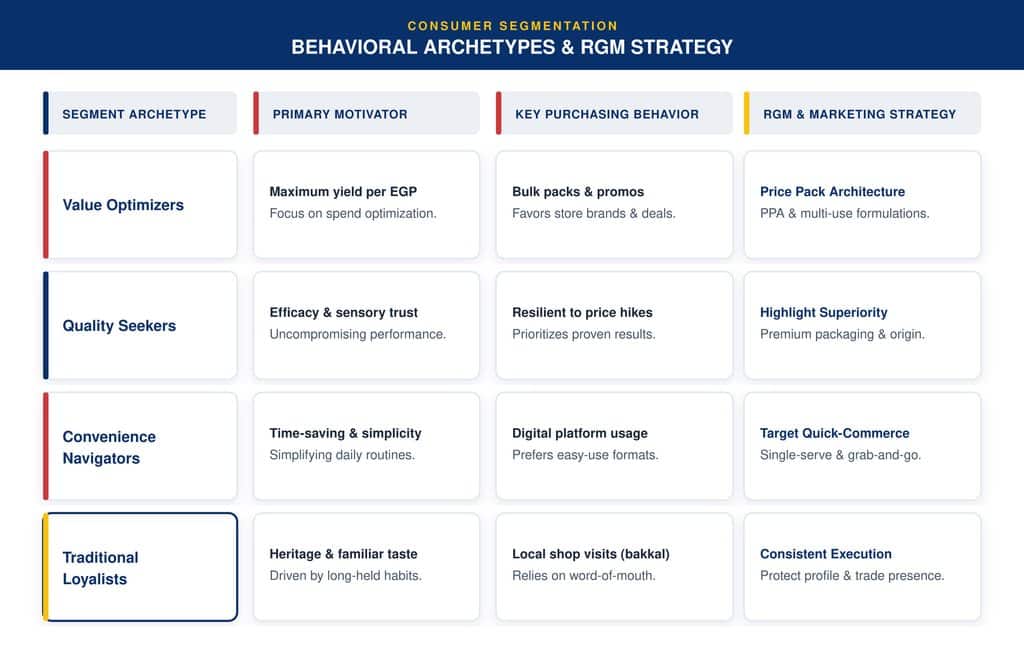
By understanding these segments, enterprise marketing and commercial teams can stop running fragmented, one-size-fits-all campaigns. Instead, they can tailor their product lines, messaging, and retail distribution to target the precise consumer groups driving profitable growth.
Strategic Applications for U&A Studies in Egypt’s FMCG Sector
Conducting a U&A study in the FMCG sector provides actionable data that powers every stage of commercial planning, from product development to trade terms negotiation.
1. Price Pack Architecture (PPA) & Revenue Growth Management (RGM)
Inflationary pressures mean setting the right price point is critical. A U&A study provides the underlying data required to optimize your portfolio’s Price Pack Architecture:
- Sizing Optimization: If research reveals that low-income households are running out of daily cash flow before month-end, launching smaller, single-serve “magic price point” packs allows brands to preserve trial rates without discounting core SKUs.
- Bulk & Family Formats: For households seeking long-term savings, a U&A study identifies the maximum acceptable pack size and price point that delivers high value while protecting manufacturer margins.
To learn more about optimizing your commercial structure, read our strategic breakdown on The Art of Revenue Growth Management (RGM) for Maximum Impact.
2. De-Risking New Product Development (NPD)
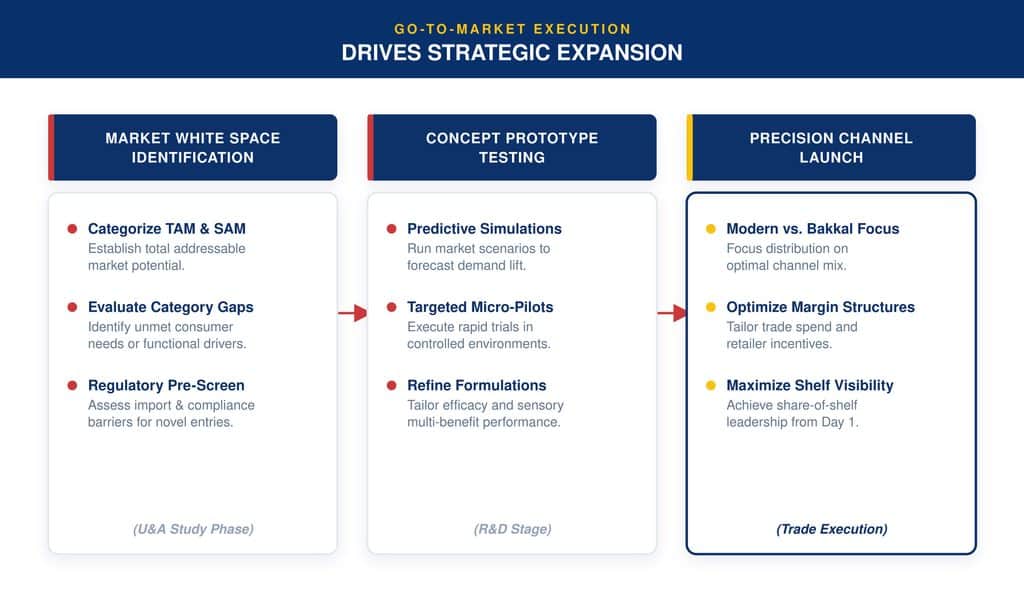
Launching new products in a crowded FMCG market involves significant capital investment. A U&A study acts as an early risk-reduction tool by mapping market “white spaces”—unmet needs that existing brands fail to serve.
For instance, if a U&A study in the Egyptian dairy category shows rising consumer demand for low-sugar products alongside frustration with the taste of existing artificial sweeteners, a brand can tailor its product development to focus specifically on natural, locally sourced sweetening alternatives.
3. Trade Marketing & Retail Channel Strategy
Egyptian retail is divided between modern trade (hypermarkets, supermarket chains) and traditional trade (hundreds of thousands of independent grocers across the country).
A U&A study fmcg maps where each behavioral segment prefers to buy specific product categories:
- If your target consumer relies heavily on neighborhood bakkals for immediate daily top-ups, concentrating your commercial budget entirely on hypermarket promotions will yield poor return on ad spend (ROAS).
- If research reveals that e-groceries are gaining traction for heavy, bulky household cleaning supplies, brands can reallocate trade marketing spend toward digital retail media platforms.
For an in-depth look at managing channel fragmentation, explore our guide on Brand Growth Strategies 2026: Navigating the New Market, Consumer, and Pricing Barriers.
Real-World Case Study: Transforming an Egyptian Dairy Brand
To see how behavioral insights drive commercial turnarounds, consider this real-world operational scenario from the Egyptian packaged food sector.
The Challenge
A leading domestic manufacturer of packaged cheese was losing market share across the Nile Delta region to both low-cost unbranded options and aggressive multinational competitors. Legacy sales reports showed falling reorder rates, but demographic data offered no clear explanation—the target demographic profile (women aged 25–50, SEC C1 & C2) remained unchanged.
The U&A Research Intervention
The brand commissioned a comprehensive usage and attitude study in Egypt, combining quantitative household surveys across six governorates with qualitative home-visit observations.
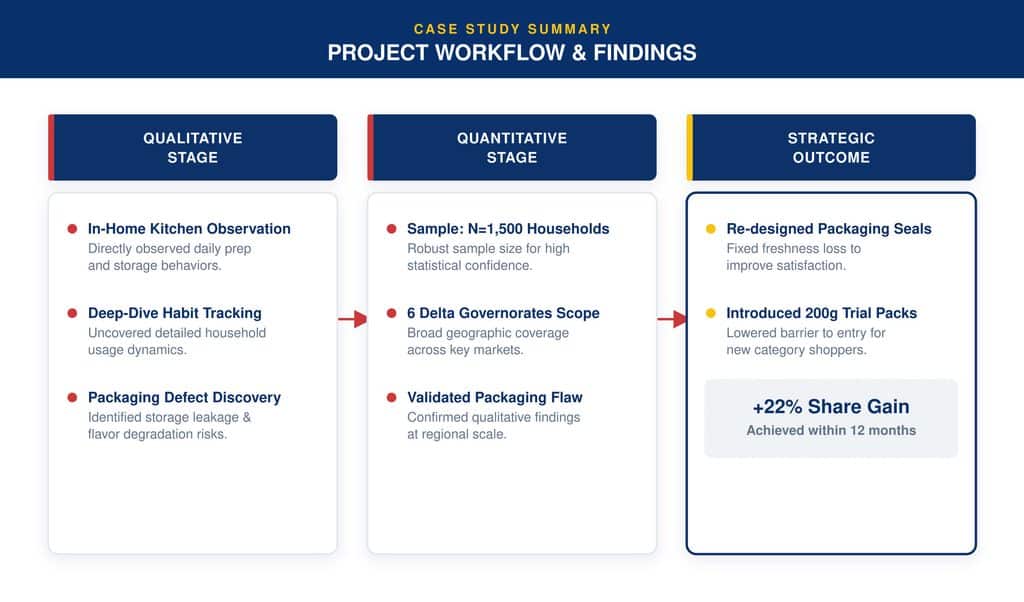
The study revealed three critical behavioral drivers that demographic profiles had completely missed:
- The Storage Friction: Over 65% of households stored packaged cheese in open refrigerators alongside traditional cooked meals. Standard packaging allowed ambient kitchen odors to alter the product’s taste within 48 hours, causing consumers to view the brand as lower quality.
- The Usage Occasion: Cheese was primarily used as a quick, mess-free ingredient for children’s school lunchbox sandwiches early in the morning, meaning easy-opening and clean dispensing were higher priorities than overall shelf-life extensions.
- Price Sensitivity vs. Cash Flow: While consumers recognized the brand’s quality, high inflation meant buying large 500g tubs created cash-flow friction during the final week of the month.
The Strategic Pivot & Results
Armed with these insights, the brand executed a three-part strategy:
- Packaging Redesign: Introduced a re-sealable container specifically engineered to block ambient refrigerator odors.
- Price Pack Architecture Adjustment: Introduced an affordable 200g “School-Week Pack” designed to hit an accessible price point for late-month shopping trips.
- Targeted Messaging: Shifted marketing creative from generic “Great Taste” claims to highlighting “Freshness That Lasts All Week for School Lunches.”
Within 12 months of implementation, the brand regained its lost Delta market share, achieved a 22% increase in regional sales volume, and successfully expanded its distribution footprint in traditional trade channels.
Methodological Blueprint: How to Execute a U&A Study in Egypt
Executing a successful usage and attitude study in Egypt requires localized field management, rigorous sample calibration, and qualitative and quantitative integration.
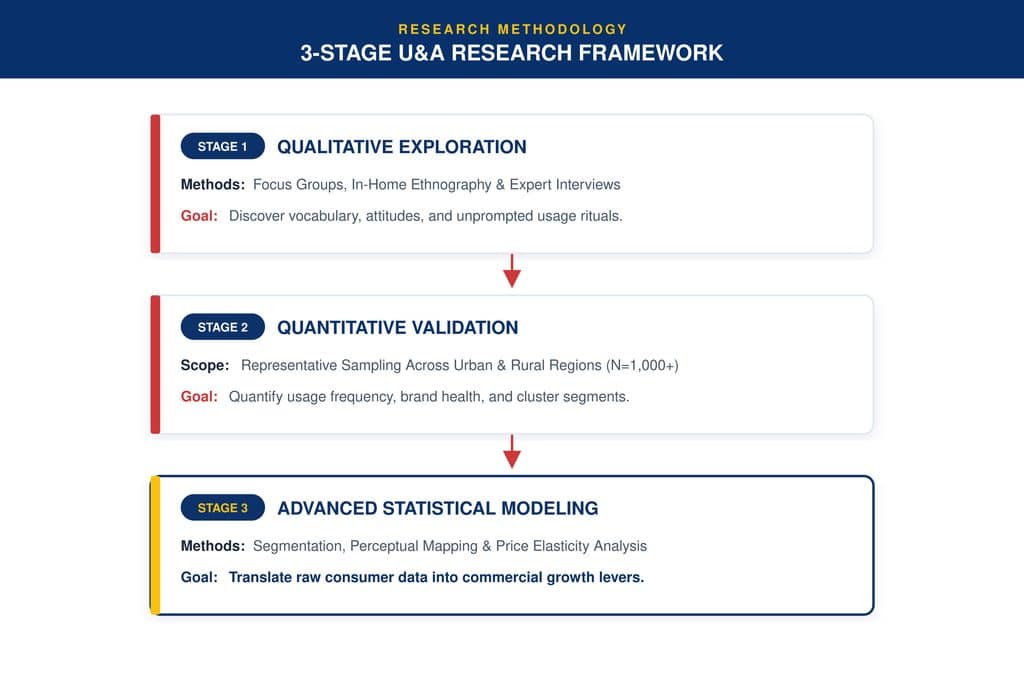
Step 1: Qualitative Exploration
Before launching large-scale quantitative surveys, qualitative research helps establish an accurate baseline:
- Focus Group Discussions (FGDs): Grouping consumers by behavioral traits to explore category attitudes, brand perceptions, and emotional associations.
- In-Home Ethnography: Observing how products are actually stored, prepared, and consumed within Egyptian households to capture habits that consumers forget to mention in written surveys.
Step 2: Quantitative Validation
To ensure data accuracy, quantitative survey sampling must account for Egypt’s demographic and regional diversity:
- Sample Calibration: Ensuring representative representation across Greater Cairo, Alexandria, Delta governorates, and Upper Egypt.
- Hybrid Data Collection: Combining Computer-Assisted Personal Interviewing (CAPI) for face-to-face household surveys with Mobile-Assisted Digital Surveys for high-density urban populations.
Step 3: Advanced Statistical Modeling
Raw survey data is converted into actionable strategy using analytical frameworks:
- Factor & Cluster Analysis: Grouping underlying attitudes to define clear consumer segmentation research archetypes.
- Perceptual Brand Mapping: Plotting your brand alongside competitors on key attribute axes (e.g., Price vs. Quality, Convenience vs. Heritage) to identify differentiation opportunities.
5 Common Pitfalls When Conducting U&A Research in Egypt
While U&A studies offer deep market clarity, improper execution can lead to misleading conclusions. Here are five common operational mistakes and how to avoid them:
1. Over-Indexing on Greater Cairo
Cairo represents a massive commercial hub, but relying exclusively on Cairene consumer data creates a distorted view of national demand. Spending habits, channel accessibility, and product preferences in Upper Egypt or the Delta differ significantly from those in affluent Cairo suburbs. A national U&A study must maintain balanced regional sampling.
2. Relying on Outdated Pre-Inflation Baselines
Comparing modern consumer attitude metrics to benchmark data collected prior to major economic adjustments can misrepresent brand health. Inflation has fundamentally altered consumer price anchors and baseline category expectations. Always evaluate current attitudes against contemporary economic realities.
3. Overloading the Survey Questionnaire
Attempting to measure every metric in a single questionnaire leads to respondent fatigue, reducing data reliability toward the end of the survey. Keep questionnaires focused on core usage habits, brand attitudes, and segmentation variables.
4. Treating Claimed Behavior as Actual Behavior
What consumers say they do in a survey does not always match their real-world actions. For instance, respondents may underreport how often they buy unbranded market goods due to social desirability bias. Validating survey responses against actual retail audit data or observational ethnography ensures higher data precision.
5. Failing to Connect Insights to Actionable RGM Levers
A U&A study should not sit on a shelf as an academic report. The insights must directly inform practical business decisions—such as refining your distribution mix, updating marketing messaging, or restructuring product package sizes.
For guidance on turning research insights into strategic business growth, read our guide on The Digital Maturity Framework: Where Does Your Enterprise Stand?.
The Future of Consumer Intelligence in Egypt
Driven by rapid technological adoption, the methodology behind usage and attitude research continues to evolve. Modern consumer research combines traditional survey models with real-time digital intelligence:
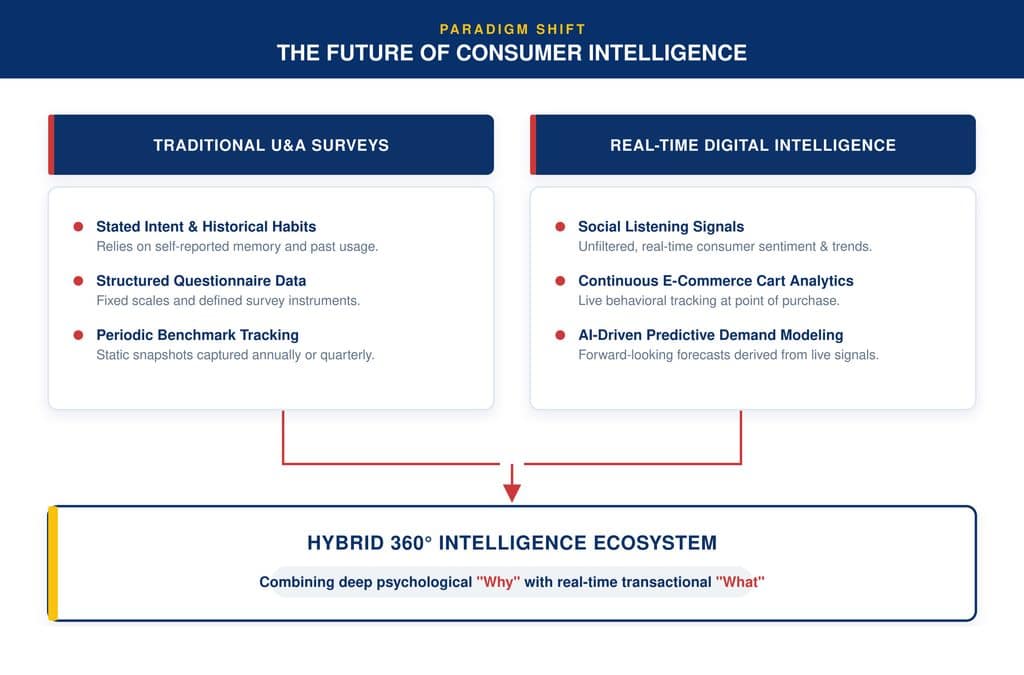
1. AI-Powered Trend Tracking & Social Listening
Integrating social media listening tools with traditional U&A research allows brands to track emerging consumer conversations in real time. Analyzing unstructured Arabic text data from digital platforms provides early warnings about shifting consumer sentiment, emerging recipe trends, or growing product dissatisfaction.
2. Predictive Behavioral Modeling
By combining historical U&A datasets with point-of-sale transactional data, advanced analytics engines can simulate how consumer segments will react to future market changes. Brands can test proposed price adjustments or product launches in simulated environments before executing them in the market.
To explore how advanced analytics can transform your decision-making, read our analysis on Data Analytics in FMCG: From Performance Measurement to Decision Engine.
Transitioning from Data Collection to Market Dominance
In Egypt’s dynamic commercial landscape, relying on outdated demographic assumptions is a high-risk strategy. Knowing the age, gender, and income bracket of your target audience is no longer enough to ensure market share.
A well-designed usage and attitude study in Egypt provides the deep behavioral, motivational, and attitudinal clarity needed to navigate market complexity. By revealing why consumers make choices, how they use products, and what values dictate their purchases, U&A studies give enterprise leaders the empirical baseline required to:
- Develop hyper-targeted consumer segmentation research strategies for Egypt.
- Optimize Price Pack Architecture and trade spend through precision Revenue Growth Management.
- De-risk new product launches by identifying genuine market white spaces.
- Strengthen trade negotiations with empirical proof of category demand.
Stop guessing who your consumers are based on superficial demographic traits. Partner with proven market research experts to map the true drivers of Egyptian consumer behavior, align your portfolio with real-world demand, and secure a lasting competitive advantage.
👉 Ready to uncover what is truly driving your category in Egypt? Connect with the team at Marketeers Research today to design a tailored Usage & Attitude Study that transforms your commercial execution.