

How CPG and FMCG Enterprises Can Navigate Inflation, Currency Devaluations, and Shifting Shopper Behaviors Through Data-Driven Agility and Precision RGM.
The modern global economy operates in a state of continuous disruption. For commercial directors, brand managers, and executive leadership within the Fast-Moving Consumer Goods (FMCG) and Consumer Packaged Goods (CPG) sectors, managing a business today means navigating compounding macroeconomic pressures: persistent currency devaluations, volatile raw material import costs, supply chain bottlenecks, and shifting household budgets.
In volatile markets, traditional growth playbooks fall short. Blanket list price increases risk pushing consumers over critical psychological affordability thresholds, driving them toward unbranded goods or retailer private labels. Conversely, aggressive cost-cutting without data-driven precision can strip a brand of its core equity and compromise product quality.
Achieving sustainable growth in a volatile market requires transitioning from defensive survival tactics to an offensive, data-backed commercial strategy. Enterprises must align their pricing architecture, operational efficiency, and marketing spend around empirical shopper behaviors. By focusing on five core operational pillars, forward-thinking brands can protect gross margins, defend distribution footprints, and capture market share while weaker competitors retreat.
The Core Challenge: Navigating Inflationary Pressures and Demand Volatility
When operating costs rise, businesses face a fundamental dilemma: absorb margin compression or pass price hikes onto cash-strapped consumers.
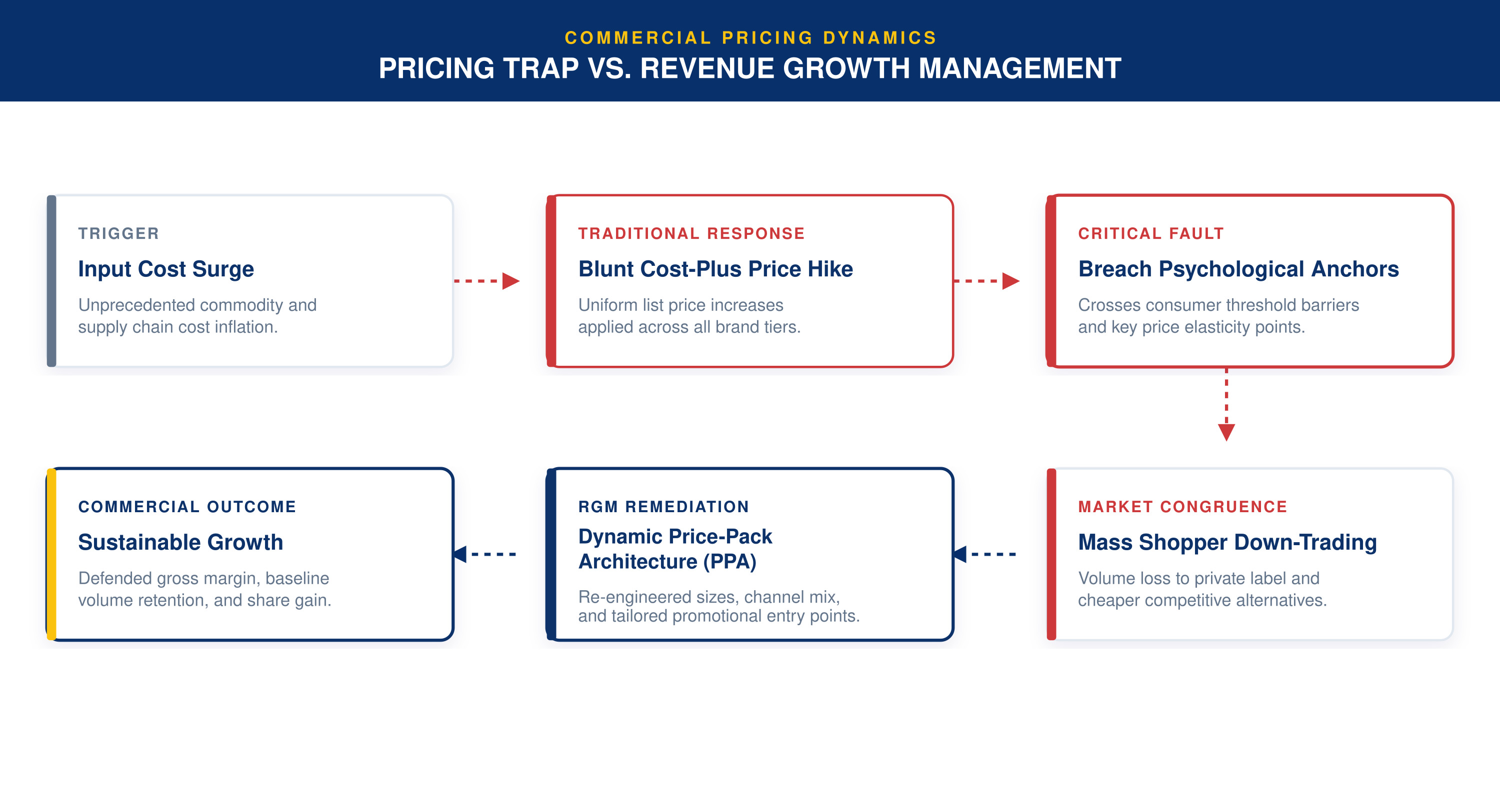
Executing uniform, portfolio-wide price hikes without measuring price elasticity creates severe market friction:
- Shopper Down-Trading: Highly price-sensitive consumer segments migrate to budget alternatives, smaller package sizes, or local unbranded options.
- Margin Dilution: Leaving premium, inelastic SKUs underpriced while over-pricing high-volume staple items forfeits significant net revenue.
- Retailer Friction: Major hypermarket and supermarket buyers resist frequent list-price adjustments, demanding higher trade spend allowances or threatening product delisting.
To resolve these tensions and build long-term commercial resilience, organizations must deploy five interconnected strategic pillars.
Pillar 1: Adjusting Marketing Strategy via Precision Value Framing
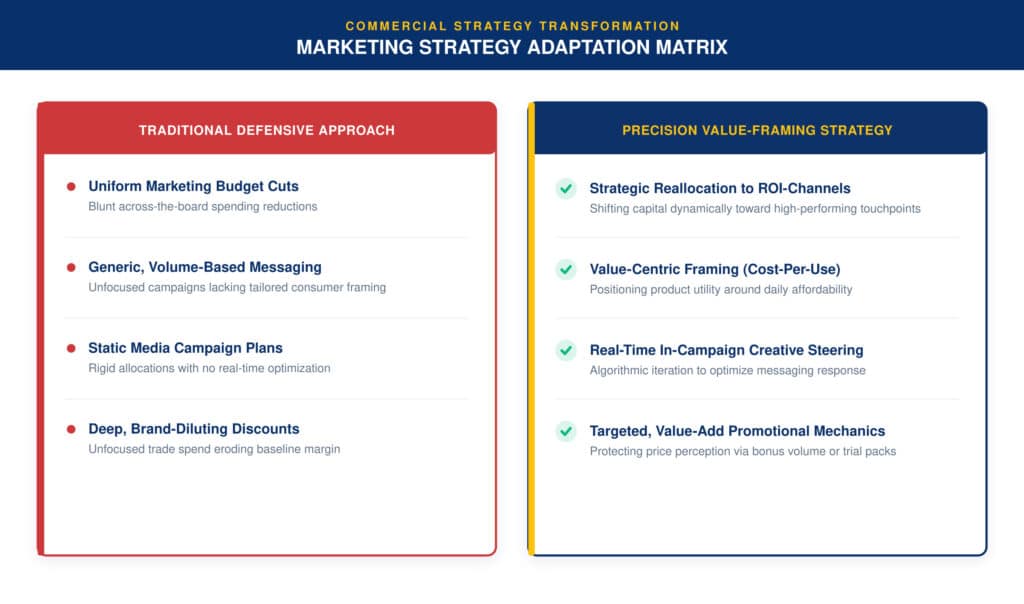
During economic downturns, many organizations make the strategic mistake of slashing marketing budgets uniformly across the board. However, global commercial benchmarks from McKinsey & Company demonstrate that brands maintaining or strategically reallocating brand equity investments during economic contractions recover market share significantly faster during subsequent recovery cycles.
Adjusting your marketing strategy during volatile periods is not simply about reducing ad spend—it is about optimizing Return on Ad Spend (ROAS) through precise value framing and channel efficiency:
Highlighting Perceived Utility
Rather than competing purely on price, reframe your brand messaging around product efficacy, zero wastage, and cost-per-use value. For example, positioning a concentrated laundry detergent around “cost per wash load” rather than total shelf package price helps consumers recognize the underlying utility, bridging the perceived value gap.
To learn how consumer cognitive framing and left-digit bias influence purchasing decisions, read our guide on How FMCGs Tap into Consumers’ Minds with Psychological Pricing.
Reallocating to Performance Channels
Shift marketing spend away from unmeasurable broad-reach campaigns toward trackable digital channels, performance marketing networks, and retail media networks (RMNs) where real-time conversion rates can be measured and optimized continuously.
Pillar 2: Real-Time Tracking of Shifting Shopper Behaviors
Macroeconomic shocks alter consumer habits overnight. As household budgets contract, shopping frequency, basket size composition, and channel selection change rapidly. Relying on annual market research reports or retrospective quarterly analysis means acting on outdated consumer assumptions.
To maintain a competitive edge, brands must embed continuous consumer insights into their decision-making frameworks.
Identifying Category Leakage
When prices shift across a category, where does your lost volume go? Are shoppers switching to private labels, down-sizing their purchase volume, or exiting the category entirely? Tracking real-time cross-price elasticity allows brand managers to identify exact tipping points before customer drop-off occurs.
To understand how primary research tracks consumption rituals and brand usage friction, explore What a Usage & Attitude Study Actually Tells You About Consumers.
Measuring Brand Equity Signals
Monitoring top-of-mind (TOM) awareness, consideration scores, and purchase intent in real time ensures that pricing or promotional changes do not silently erode brand equity.
Discover how to turn negative tracking signals into growth opportunities in What if Your Brand Tracking Reveals a Weak Brand?.
Pillar 3: Focusing on Customer Retention and Value Architecture
Acquiring new customers in a volatile market is significantly more expensive than retaining existing brand advocates. According to business research published by the Harvard Business Review, increasing customer retention rates by just 5% can increase overall profitability by 25% to 95%.
Retaining loyal shoppers during high-inflation cycles requires aligning your Price-Pack Architecture (PPA) with consumer affordability limits.
Price-Pack Architecture (PPA)
Rather than executing list-price increases on standard packages, re-engineer packaging formats to protect core consumer cash-out points:
- Entry-Level SKUs: Single-serve or smaller weight variants designed for cash-constrained households nearing the end of their monthly pay cycle.
- Bulk Family Formats: Multi-pack bundles aimed at higher-income shoppers seeking bulk savings, locking in pantry share and blocking competitor trial.
For a complete framework on implementing pack size adjustments and value tiering, read Supercharging FMCGs with Tailored Pricing Strategies.
Pillar 4: Increasing Operational Efficiency Across the Value Chain
Operational efficiency during economic instability goes beyond cost reduction; it centers on eliminating structural friction across the supply chain, sales distribution, and trade marketing networks.
In volatile markets—such as agricultural or livestock sectors heavily dependent on imported raw materials—supply-side shocks propagate quickly down the value chain.
When input costs surge, brands that lack visibility into their broader value chain misdiagnose early supply signals as routine cost problems. They react with delayed price increases rather than proactively restructuring their commercial operations.
Eliminating Trade Spend Waste
Up to 50% of traditional trade promotion expenditure fails to generate incremental profit lift. By eliminating margin-diluting promotional discounts and reallocating funds toward proven, high-performing retail channels, brands boost operational margins without raising consumer shelf prices.
Learn how structural shifts move through complex supply ecosystems in What the Poultry Value Chain Shift Means for the Brands Inside It.
Pillar 5: Investing in Advanced Technologies, AI, and Predictive Analytics
Navigating market volatility requires replacing slow, manual reporting routines with agile, tech-enabled decision engines. Organizations relying on static spreadsheets or retrospective post-campaign reporting operate with inherent delay, reacting to market shifts weeks after competitors have adjusted.
According to global research guidelines established by ESOMAR World Research Standards, modern commercial decisions must be backed by empirical data validation and compliant research architectures.
Predictive Scenario Simulation
Artificial Intelligence (AI) and Machine Learning (ML) enable Revenue Growth Management (RGM) teams to model complex market scenarios before committing capital to production or retail execution. Executives can run predictive simulations to answer critical strategic questions:
- “What is the exact volume and margin impact if we reduce package weight by 10% while maintaining the current shelf price?”
- “How will competitor volume react if we adjust trade spend terms in modern hypermarkets?”
Discover how AI and predictive modeling accelerate corporate decision velocity in The Deepening Effect of Generative AI in the Workplace.
Building a Unified Commercial Architecture with Revenue Growth Management (RGM)
Achieving sustainable growth in a volatile market requires unifying marketing strategy, consumer insights, retention tactics, operational efficiency, and advanced analytics into a single end-to-end commercial framework: Revenue Growth Management (RGM).
By connecting these levers through an empirical, data-driven approach, enterprise leaders can build a resilient commercial engine capable of thriving across economic cycles.
For a complete deep-dive into mastering end-to-end revenue management, read RGM 360: Unlocking the Power of Pricing for CPG/FMCG.
Achieve Sustainable Growth with Marketeers Research
Navigating volatile markets with confidence requires real-time consumer clarity and predictive analytics tools. Marketeers’ Smart Value™ Platform provides commercial leaders, brand directors, and RGM teams with an end-to-end intelligence ecosystem designed to protect margins, optimize pricing, and secure market share.
By integrating continuous consumer tracking, AI-powered price elasticity modeling, and virtual shelf scenario simulations, our platforms empower your organization to:
- Identify real-time consumer price sensitivity thresholds and value perception gaps.
- Model the net profitability impact of proposed Price-Pack Architecture (PPA) adjustments.
- Eliminate wasted trade spend by optimizing promotional mechanics before campaign execution.
- Build an agile, data-driven commercial engine designed for sustainable long-term growth.
Future-Proof Your Business Strategy Today
Don’t let market volatility or economic uncertainty compromise your profitability and market share. Validate consumer elasticity, simulate strategic choices, and build a resilient commercial framework with confidence.